• HOME
  • NEWS
  • EXPLORE
    • CAREER
      • Companies
      • Jobs
    • EVENTS
    • iGEM
      • News
      • Team
    • PHOTOS
    • VIDEO
    • WIKI
  • BLOG
  • COMMUNITY
    • FACEBOOK
    • INSTAGRAM
    • TWITTER
Monday, June 22, 2026
BIOENGINEER.ORG
No Result
View All Result
  • Login
  • HOME
  • NEWS
  • EXPLORE
    • CAREER
      • Companies
      • Jobs
        • Lecturer
        • PhD Studentship
        • Postdoc
        • Research Assistant
    • EVENTS
    • iGEM
      • News
      • Team
    • PHOTOS
    • VIDEO
    • WIKI
  • BLOG
  • COMMUNITY
    • FACEBOOK
    • INSTAGRAM
    • TWITTER
  • HOME
  • NEWS
  • EXPLORE
    • CAREER
      • Companies
      • Jobs
        • Lecturer
        • PhD Studentship
        • Postdoc
        • Research Assistant
    • EVENTS
    • iGEM
      • News
      • Team
    • PHOTOS
    • VIDEO
    • WIKI
  • BLOG
  • COMMUNITY
    • FACEBOOK
    • INSTAGRAM
    • TWITTER
No Result
View All Result
Bioengineer.org
No Result
View All Result
Home NEWS Science News

NASA sees Tropical Cyclone Debbie form and strengthen

Bioengineer by Bioengineer
March 27, 2017
in Science News
Reading Time: 2 mins read
0
Share on FacebookShare on TwitterShare on LinkedinShare on RedditShare on Telegram
IMAGE

Credit: Credits: NRL/NASA

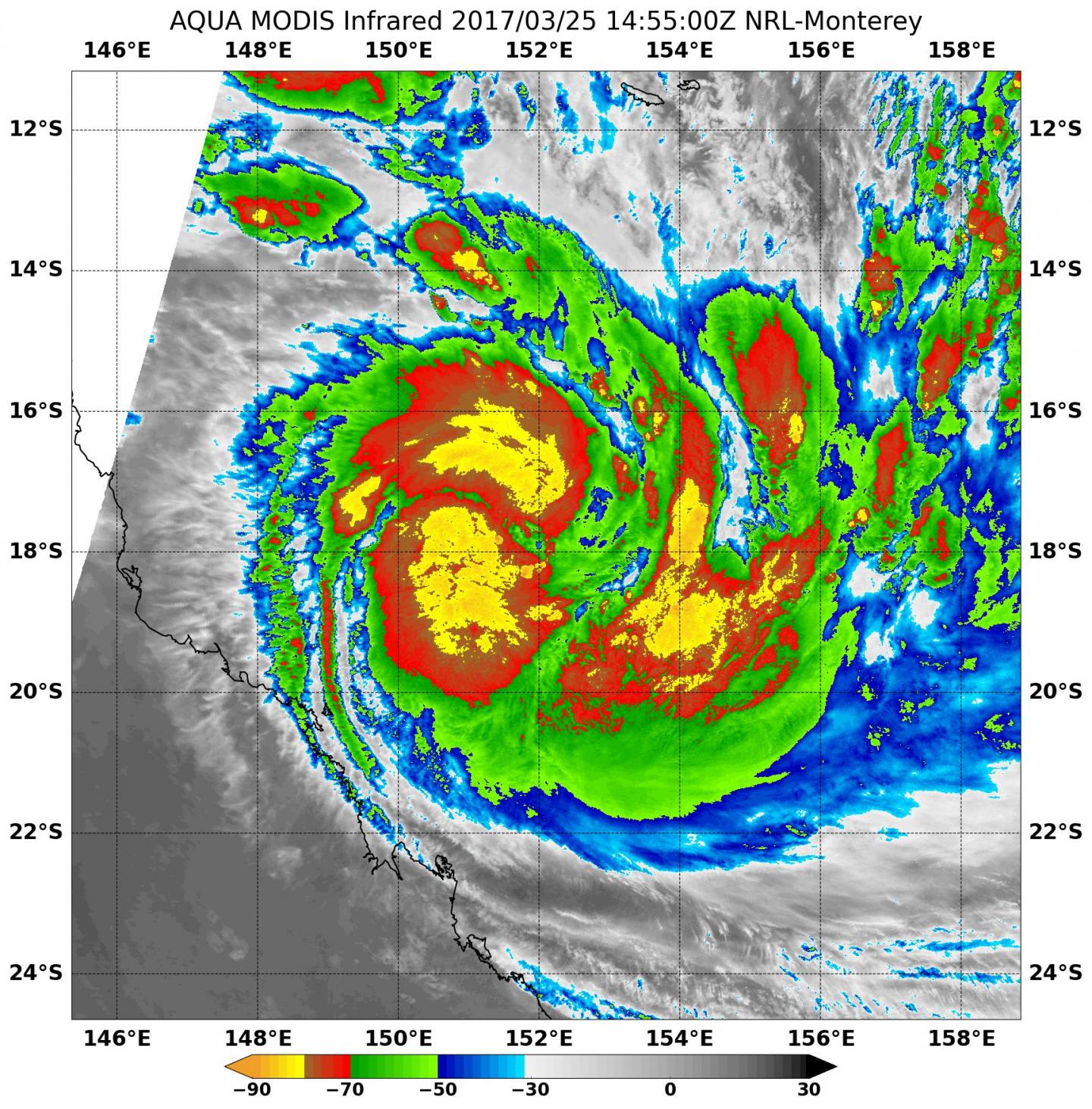
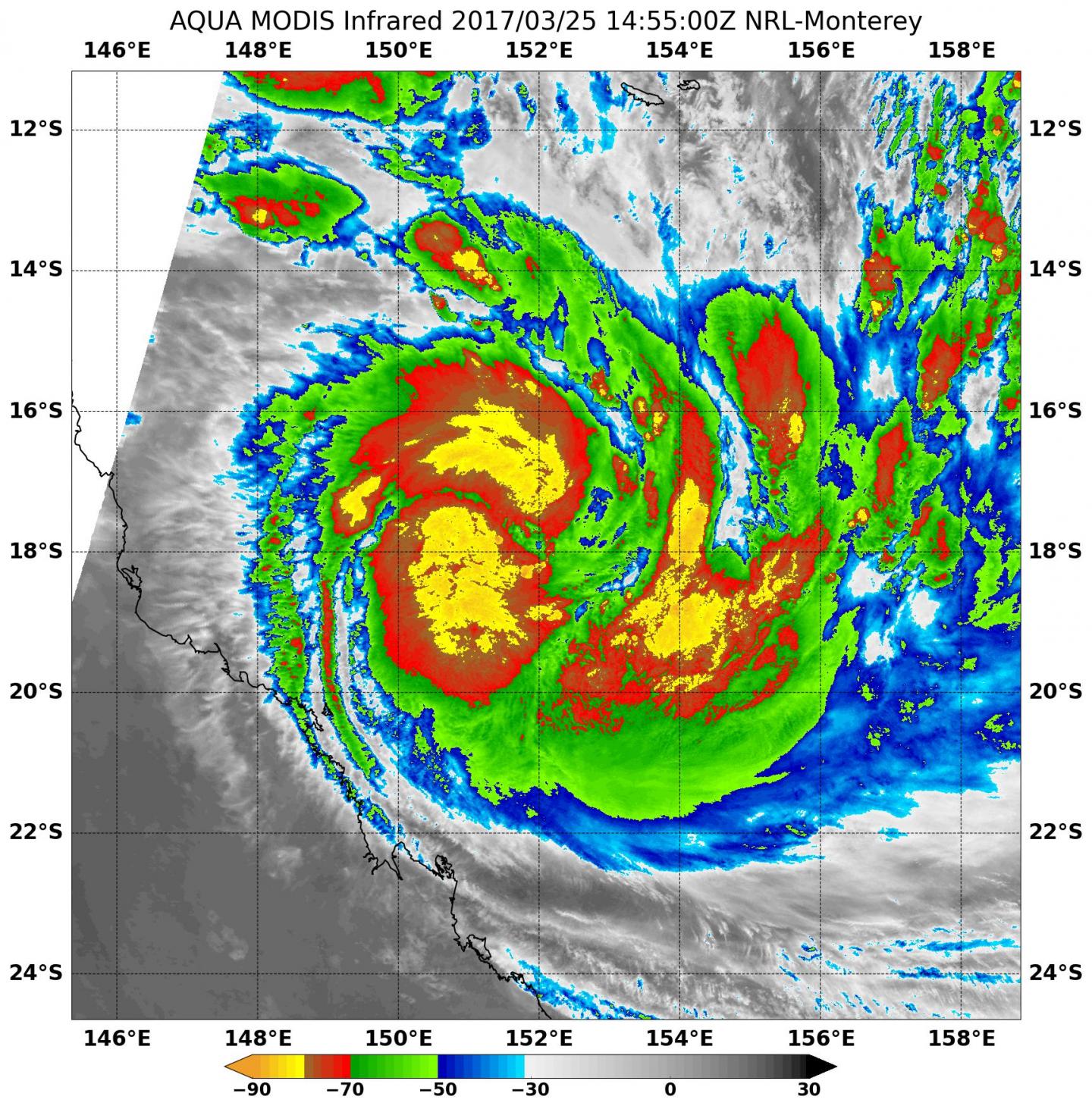
The tropical low pressure area previously known as System 91P has developed into a tropical cyclone named Debbie in the Southern Pacific Ocean and threatens eastern Queensland, Australia. NASA's Aqua satellite provided an infrared look at the storm that revealed powerful thunderstorms quickly developed around the center. Debbie has already triggered warnings in Queensland.

The Moderate Resolution Imaging Spectroradiometer or MODIS instrument that flies aboard NASA's Aqua satellite captured infrared temperature data of the newly developed tropical storm on March 25 at 10:55 a.m. EDT (14:55 UTC). The MODIS data showed cloud top temperatures of strong thunderstorms around the center of circulation as cold as minus 80 degrees Fahrenheit (minus 62.2 Celsius). Temperatures that cold indicate strong uplift in the storm and cloud tops high into the troposphere. NASA research has shown that storms with cloud tops that cold have the ability to generate heavy rain.

The Australian Bureau of Meteorology or ABM has issued warnings and watches for eastern Queensland. The Warning zone includes: Ayr to St Lawrence including Bowen, Mackay, and the Whitsunday Islands. The Watch zone includes: remaining coastal areas from Cairns to Ayr including Innisfail and Townsville, extending inland to Charters Towers and Mount Coolon.

Details of Tropical Cyclone Debbie at 2 p.m. EST on March 25 (4:00 am AEST: on Sunday, March 26 local time). Debbie had sustained winds near 100 kph (62.4 mph/54 knots). It was located near 17.9 degrees south latitude and 151.7 degrees east longitude, about 535 km (332 miles) east-northeast of Townesville, Queensland, Australia. Debbie was moving to the west-southwest at 2 knots (2.3 mph/3.7 kph)

Tropical cyclone Debbie is expected to adopt a steady west-southwest track later Sunday morning AEST and intensify into a category 3 system by Sunday afternoon AEST. Tropical cyclone Debbie is likely to intensify further prior to making landfall between Townsville and Proserpine on Tuesday morning.

ABM said "The very destructive core of Tropical Cyclone Debbie is currently expected to cross the coast between Townsville and Proserpine on Tuesday morning, most likely as a Category 4 (Category 5 on the Saffir-Simpson Hurricane Wind Scale) tropical cyclone, with wind gusts up to 260 kph (161.6 mph) near the center,"

###

For updated forecasts, visit: http://www.bom.gov.au/cyclone/index.shtml.

Media Contact

Rob Gutro
[email protected]
@NASAGoddard

http://www.nasa.gov/goddard

############

Story Source: Materials provided by Scienmag

Share12Tweet8Share2ShareShareShare2

Related Posts

Microalgae-Powered Microbots Target Bladder Cancer

June 22, 2026

AOC1 Controls Labor via Spermidine-Driven Autophagy

June 22, 2026

Microbial Inoculants: Boosting Sustainable Agroecosystem Health

June 22, 2026

Do Demographic, Birth, and Parental Factors Influence the Risk of Early-Onset Colorectal Cancer?

June 22, 2026
Please login to join discussion

POPULAR NEWS

  • Saying Goodbye to PGY-6: Pediatric Fellowship Realities

    103 shares
    Share 41 Tweet 26
  • Multi-Hospital Study Reveals Long Covid Burden Is Twice as High as Current Estimates

    92 shares
    Share 36 Tweet 23
  • Detection of EDCs in Breast Milk and Infant Urine Up to Six Months Highlights Early Exposure Risks

    77 shares
    Share 31 Tweet 19
  • New Drug Candidate Developed at McMaster Shows Potential for Treating Brain Cancer

    58 shares
    Share 23 Tweet 15

About

We bring you the latest biotechnology news from best research centers and universities around the world. Check our website.

Follow us

Recent News

Microalgae-Powered Microbots Target Bladder Cancer

AOC1 Controls Labor via Spermidine-Driven Autophagy

Microbial Inoculants: Boosting Sustainable Agroecosystem Health

Subscribe to Blog via Email

Enter your email address to subscribe to this blog and receive notifications of new posts by email.

Join 82 other subscribers
  • Contact Us

Bioengineer.org © Copyright 2023 All Rights Reserved.

Welcome Back!

Login to your account below

Forgotten Password?

Retrieve your password

Please enter your username or email address to reset your password.

Log In
No Result
View All Result
  • Homepages
    • Home Page 1
    • Home Page 2
  • News
  • National
  • Business
  • Health
  • Lifestyle
  • Science

Bioengineer.org © Copyright 2023 All Rights Reserved.