• HOME
  • NEWS
  • EXPLORE
    • CAREER
      • Companies
      • Jobs
    • EVENTS
    • iGEM
      • News
      • Team
    • PHOTOS
    • VIDEO
    • WIKI
  • BLOG
  • COMMUNITY
    • FACEBOOK
    • INSTAGRAM
    • TWITTER
Sunday, February 8, 2026
BIOENGINEER.ORG
No Result
View All Result
  • Login
  • HOME
  • NEWS
  • EXPLORE
    • CAREER
      • Companies
      • Jobs
        • Lecturer
        • PhD Studentship
        • Postdoc
        • Research Assistant
    • EVENTS
    • iGEM
      • News
      • Team
    • PHOTOS
    • VIDEO
    • WIKI
  • BLOG
  • COMMUNITY
    • FACEBOOK
    • INSTAGRAM
    • TWITTER
  • HOME
  • NEWS
  • EXPLORE
    • CAREER
      • Companies
      • Jobs
        • Lecturer
        • PhD Studentship
        • Postdoc
        • Research Assistant
    • EVENTS
    • iGEM
      • News
      • Team
    • PHOTOS
    • VIDEO
    • WIKI
  • BLOG
  • COMMUNITY
    • FACEBOOK
    • INSTAGRAM
    • TWITTER
No Result
View All Result
Bioengineer.org
No Result
View All Result
Home NEWS Science News

NASA sees ‘nada’ strength left in Tropical Cyclone Nada

Bioengineer by Bioengineer
December 1, 2016
in Science News
Reading Time: 2 mins read
0
Share on FacebookShare on TwitterShare on LinkedinShare on RedditShare on Telegram
IMAGE

Credit: Credits: NASA JPL/Ed Olsen

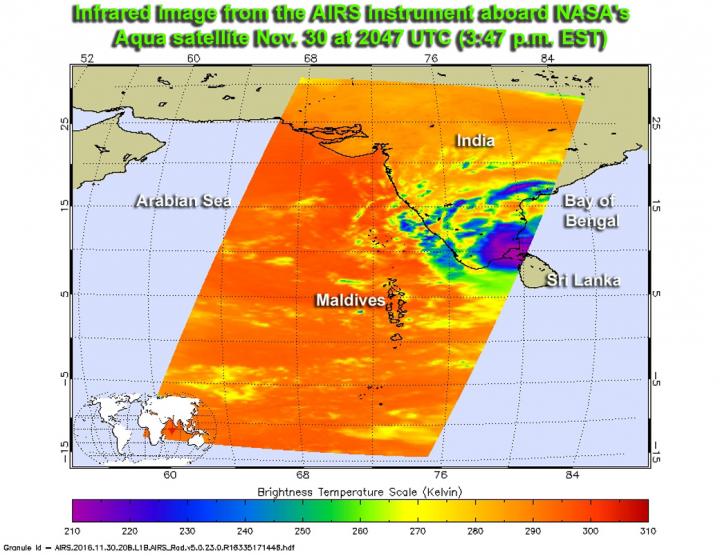
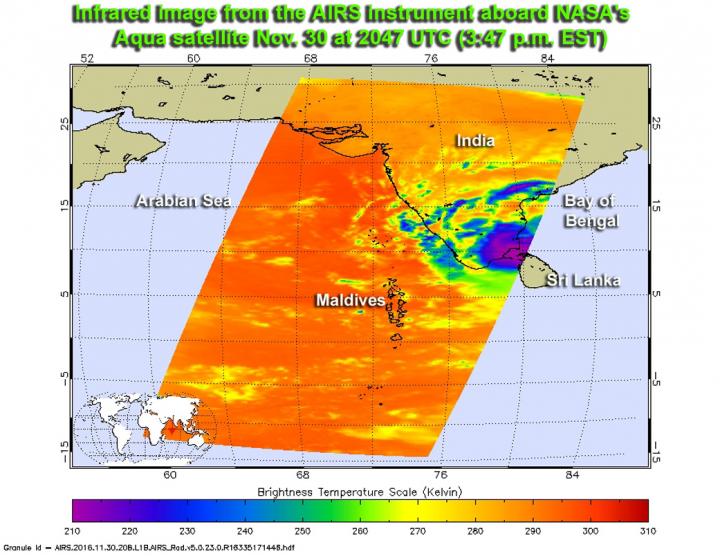
NASA's Aqua satellite flew over Tropical Cyclone Nada in the Northern Indian Ocean and infrared imagery showed that Nada had "nada" in terms of strong thunderstorms.

The Atmospheric Infrared Sounder or AIRS instrument aboard Aqua provided temperature data on Nada on Nov. 30 at 3:47 p.m. EST (2047 UTC). At the time of the overpass, the northwestern quadrant of the storm had already spread over southeastern India and the center was approaching landfall. There was a small area of cold cloud top temperatures (indicating strong thunderstorms) near minus 63 Fahrenheit (minus 53 degrees Celsius) over the Palk Strait. The Palk Strait lies between the Tamil Nadu state of India and the northern province of the island nation of Sri Lanka.

By early Dec. 1, infrared data showed and virtually no associated deep convection (rapidly rising air that creates the thunderstorms that make up a tropical cyclone) or strong thunderstorms.

Animated multispectral satellite on Dec. 1 at 5:49 a.m. EST (1049 UTC) showed that the low-level center of circulation was still symmetric, so the interaction with land had not yet elongated the storm.

The Joint Typhoon Warning Center (JTWC) issued their final warning on Nada on Dec. 1 at 10 a.m. EST (1500 UTC). At that time, Nada's maximum sustained winds were near 35 knots (40 mph/62 kph) and weakening. The storm was centered near 10.5 degrees north latitude and 80.7 degrees east longitude.

Nada is forecast to move west-northwest over southern India. Its remnants are expected to dissipate over land in the next day.

###

Media Contact

Rob Gutro
[email protected]
@NASAGoddard

http://www.nasa.gov/goddard

############

Story Source: Materials provided by Scienmag

Share12Tweet8Share2ShareShareShare2

Related Posts

Community Involvement Eases Depression in China’s Empty Nesters

February 8, 2026

Group Therapy Boosts Recovery in Elderly Depression

February 8, 2026

Evaluating Biosimilar Trastuzumab for Breast Cancer in Thailand

February 8, 2026

Decoding Phantom Limb Movements via Intraneural Signals

February 8, 2026
Please login to join discussion

POPULAR NEWS

  • Robotic Ureteral Reconstruction: A Novel Approach

    Robotic Ureteral Reconstruction: A Novel Approach

    82 shares
    Share 33 Tweet 21
  • Digital Privacy: Health Data Control in Incarceration

    63 shares
    Share 25 Tweet 16
  • Breakthrough in RNA Research Accelerates Medical Innovations Timeline

    53 shares
    Share 21 Tweet 13
  • Mapping Tertiary Lymphoid Structures for Kidney Cancer Biomarkers

    50 shares
    Share 20 Tweet 13

About

We bring you the latest biotechnology news from best research centers and universities around the world. Check our website.

Follow us

Recent News

Community Involvement Eases Depression in China’s Empty Nesters

Group Therapy Boosts Recovery in Elderly Depression

Evaluating Biosimilar Trastuzumab for Breast Cancer in Thailand

Subscribe to Blog via Email

Enter your email address to subscribe to this blog and receive notifications of new posts by email.

Join 74 other subscribers
  • Contact Us

Bioengineer.org © Copyright 2023 All Rights Reserved.

Welcome Back!

Login to your account below

Forgotten Password?

Retrieve your password

Please enter your username or email address to reset your password.

Log In
No Result
View All Result
  • Homepages
    • Home Page 1
    • Home Page 2
  • News
  • National
  • Business
  • Health
  • Lifestyle
  • Science

Bioengineer.org © Copyright 2023 All Rights Reserved.