• HOME
  • NEWS
  • EXPLORE
    • CAREER
      • Companies
      • Jobs
    • EVENTS
    • iGEM
      • News
      • Team
    • PHOTOS
    • VIDEO
    • WIKI
  • BLOG
  • COMMUNITY
    • FACEBOOK
    • INSTAGRAM
    • TWITTER
Sunday, April 19, 2026
BIOENGINEER.ORG
No Result
View All Result
  • Login
  • HOME
  • NEWS
  • EXPLORE
    • CAREER
      • Companies
      • Jobs
        • Lecturer
        • PhD Studentship
        • Postdoc
        • Research Assistant
    • EVENTS
    • iGEM
      • News
      • Team
    • PHOTOS
    • VIDEO
    • WIKI
  • BLOG
  • COMMUNITY
    • FACEBOOK
    • INSTAGRAM
    • TWITTER
  • HOME
  • NEWS
  • EXPLORE
    • CAREER
      • Companies
      • Jobs
        • Lecturer
        • PhD Studentship
        • Postdoc
        • Research Assistant
    • EVENTS
    • iGEM
      • News
      • Team
    • PHOTOS
    • VIDEO
    • WIKI
  • BLOG
  • COMMUNITY
    • FACEBOOK
    • INSTAGRAM
    • TWITTER
No Result
View All Result
Bioengineer.org
No Result
View All Result
Home NEWS Science News

NASA sees Hurricane Oscar transitioning to extratropical low

Bioengineer by Bioengineer
November 1, 2018
in Science News
Reading Time: 2 mins read
0
Share on FacebookShare on TwitterShare on LinkedinShare on RedditShare on Telegram
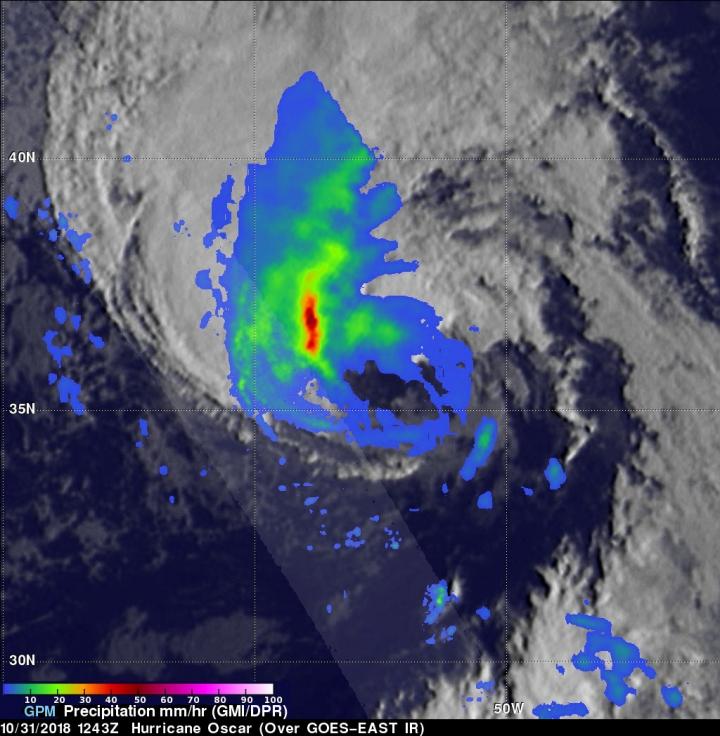
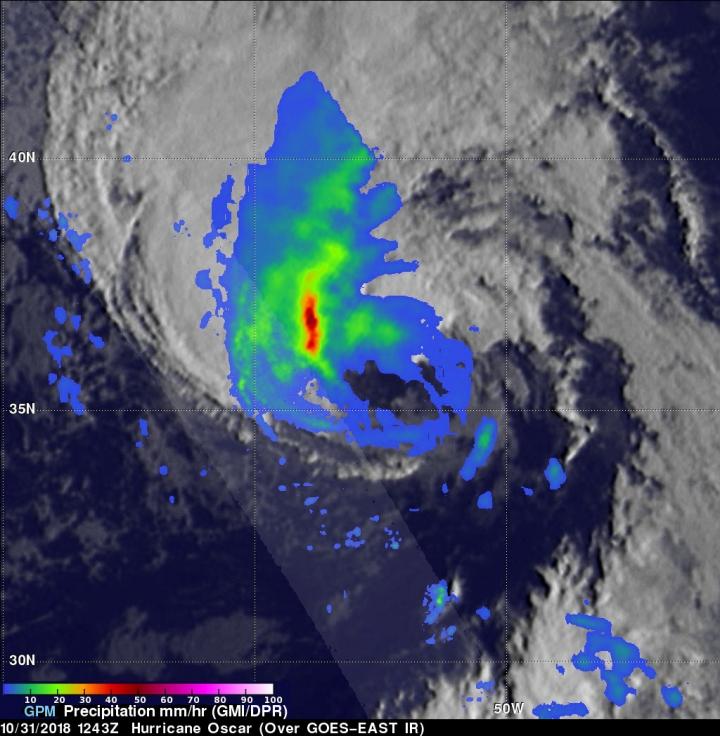
IMAGE

Credit: NASA/JAXA, Hal Pierce

Hurricane Oscar has transitioned into an extra-tropical low pressure area in the northeastern Atlantic Ocean. The Global Precipitation Measurement mission or GPM core satellite provided a look at rainfall occurring within the storm.

When a storm becomes extra-tropical, it means that a tropical cyclone has lost its "tropical" characteristics. The National Hurricane Center defines "extra-tropical" as a transition that implies both poleward displacement (meaning it moves toward the north or south pole) of the cyclone and the conversion of the cyclone's primary energy source from the release of latent heat of condensation to baroclinic (the temperature contrast between warm and cold air masses) processes. It is important to note that cyclones can become extratropical and still retain winds of hurricane or tropical storm force.

On October 31, 2018 at 8:43 a.m. EDT (1243 UTC) the GPM core observatory satellite had a pass over hurricane Oscar. The hurricane had maximum sustained winds of about 74.8 mph (65 knots) and was moving toward the northeast while becoming more extratropical in appearance. GPM's Microwave Imager (GMI) showed that the heaviest convective rainfall was located well northwest of the low level center of circulation. Rain was falling at a rate of about 2 inches (50.8 mm) per hour in that area.

At NASA's Goddard Space Flight Center in Greenbelt, Md. a simulated 3-D view was created from GPM data looking from the east toward the storm. The image was derived from GPM's radar (DPR Ku Band) data. GPM's radar swath (DPR Ku Band) passed through storms on Oscar's western side. GPM's DPR found that very few storm tops were reaching heights above 5.6 miles (9.0 km) but heavy downpours were returning strong radar reflectivity values to the GPM satellite. Radar reflectivity values were frequently observed in the 3D cross-section through heavy rainfall in the northwestern side of the hurricane. GPM is a joint mission between NASA and the Japan Aerospace Exploration Agency, JAXA.

Oscar is now an extra-tropical low pressure area and is expected to pass northwest of Ireland over the weekend of Nov. 3 and 4 and will bring winds and rain to the country.

###

Media Contact

Rob Gutro
[email protected]
@NASAGoddard

http://www.nasa.gov/goddard

Original Source

https://blogs.nasa.gov/hurricanes/tag/oscar-2018/

Share12Tweet8Share2ShareShareShare2

Related Posts

Elevated Fetal Catecholamine Metabolites Signal Growth Restriction

Elevated Fetal Catecholamine Metabolites Signal Growth Restriction

April 19, 2026

Comorbidities Shape Hip Fracture Surgery Outcomes

April 19, 2026

Wastewater Detects Drug-Resistant Candidozyma auris Emergence

April 18, 2026

Metabolically Healthy Obesity Linked to 20-Year Heart Risk

April 18, 2026
Please login to join discussion

POPULAR NEWS

  • Scientists Investigate Possible Connection Between COVID-19 and Increased Lung Cancer Risk

    62 shares
    Share 25 Tweet 16
  • NSF funds machine-learning research at UNO and UNL to study energy requirements of walking in older adults

    101 shares
    Share 40 Tweet 25
  • Boosting Breast Cancer Risk Prediction with Genetics

    47 shares
    Share 19 Tweet 12
  • Self-Oscillating Electroactive Nanocomposites Boost Heat Pumps

    41 shares
    Share 16 Tweet 10

About

We bring you the latest biotechnology news from best research centers and universities around the world. Check our website.

Follow us

Recent News

Elevated Fetal Catecholamine Metabolites Signal Growth Restriction

Comorbidities Shape Hip Fracture Surgery Outcomes

Wastewater Detects Drug-Resistant Candidozyma auris Emergence

Subscribe to Blog via Email

Success! An email was just sent to confirm your subscription. Please find the email now and click 'Confirm' to start subscribing.

Join 79 other subscribers
  • Contact Us

Bioengineer.org © Copyright 2023 All Rights Reserved.

Welcome Back!

Login to your account below

Forgotten Password?

Retrieve your password

Please enter your username or email address to reset your password.

Log In
No Result
View All Result
  • Homepages
    • Home Page 1
    • Home Page 2
  • News
  • National
  • Business
  • Health
  • Lifestyle
  • Science

Bioengineer.org © Copyright 2023 All Rights Reserved.