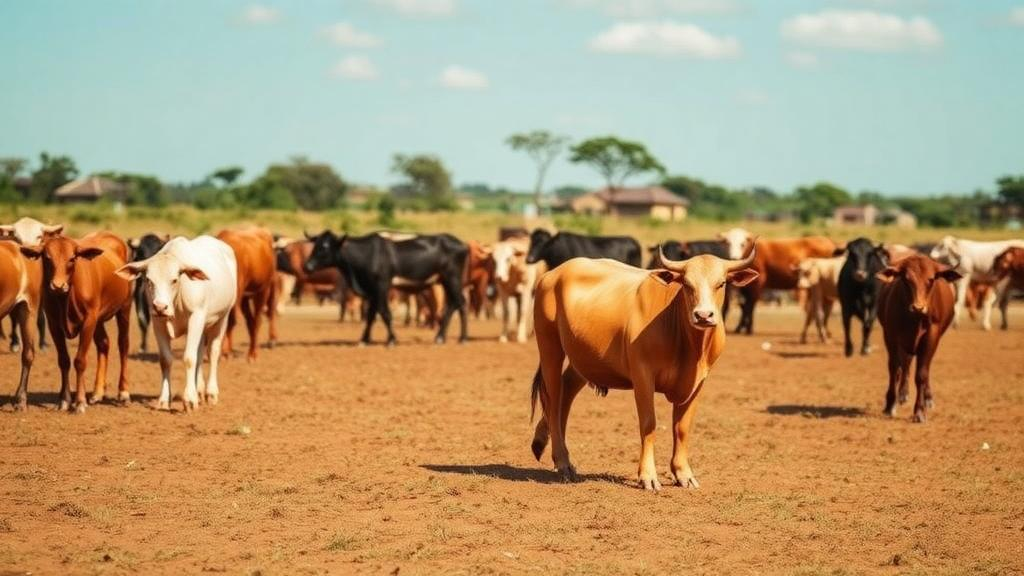
In the semi-arid expanses of Lupane District in western Zimbabwe, cattle are far more than livestock. They serve as living banks, sources of draft power, milk, manure, and cultural identity, anchoring the livelihoods of nearly 50,000 communal farming households. Yet when drought strikes or tick-borne Theileriosis—known locally as January Disease—sweeps through herds, these families face devastating losses with almost no financial safety net. Insurance uptake in the district stands at a staggering 0.01 percent, despite recurrent droughts and a January 2026 outbreak that claimed roughly 1,600 of the 550,000 cattle in Matabeleland North in a single month. A new study published in Discover Agriculture argues that artificial intelligence could finally bridge this gap, and it proposes a conceptual framework designed around the specific barriers that have kept communal farmers uninsured for decades.
The research, led by Nyasha Nyakuchena of the Women’s University in Africa together with Joseph P. Musara and Emmanuel Zivenge, began with a rigorous quantitative survey rather than a technology-first mindset. Guided by a positivist philosophy, the team applied the Kothari sample size formula to a population of 49,841 communal cattle farmers spread across 23 wards, deriving a statistically representative sample of 219 households from four purposively selected villages: Daluka, Sibangane, Mthupane, and Shabula. Data were collected between May and June 2026 using structured questionnaires administered through KoboCollect, with responses stored offline during network outages and synchronized later. Four trained enumerators, all university graduates fluent in IsiNdebele and versed in local customs, conducted the interviews, a detail that proved essential in a region where skepticism toward formal institutions runs deep.
The demographic portrait that emerged underscores the vulnerability of these households. Most respondents were male, at 62 percent, with an average age of 47 years, and herd sizes ranging from 3 to 25 cattle. Educational attainment was low: 54 percent had completed only primary schooling, and just 12 percent held secondary or higher qualifications. Income sources were largely subsistence-based, and 71 percent of respondents relied on cattle as their primary asset. In other words, the very people with the most to lose from climate shocks are those least equipped, economically and informationally, to access conventional insurance products designed for capital-intensive commercial ranching.
Binary logistic regression, run in JAMOVI version 2.6.44, identified the determinants that actually drive adoption willingness. The model showed moderate explanatory power with McFadden’s Pseudo R-squared of 0.28, a significant likelihood ratio test, and an area under the ROC curve of 0.81, indicating strong discrimination between adopters and non-adopters. Affordability emerged as the single strongest predictor, with a coefficient of 1.25 and an odds ratio of 3.50, meaning farmers who perceived premiums as affordable were three and a half times more likely to adopt insurance. Awareness followed closely at a coefficient of 0.99 and an odds ratio of 2.70, while education reached a coefficient of 0.83 and herd size 0.64. Institutional trust, with a coefficient of 0.74, was a significant direct predictor of adoption willingness. Notably, age, gender, and income diversification showed no statistically significant effects, suggesting that adoption decisions hinge on economic, informational, and institutional factors rather than demographics alone.
These findings matter because they reframe the insurance problem. Adoption, the authors argue, is not a linear cost-benefit calculation but an adaptive evolution shaped by historical mistrust, literacy barriers, and communication gaps. Zimbabwe’s financial institutions have long struggled with credibility, particularly after the hyperinflation crisis of the 2000s destroyed savings and confidence in formal systems. Cultural practices such as ukufuyisela, the loaning of cattle to relatives, provide informal resilience that conventional insurance models fail to recognize, making formal products feel alien and urban-centric. Meanwhile, transaction costs compound the problem: sending a human adjuster to verify cattle deaths in remote districts can cost more than the premiums collected, discouraging insurers from serving communal areas at all.
In response, the study proposes the Tri-Modular AI Resilience Engine, or TMAIE, a conceptual architecture that maps each technological component directly onto an empirically identified adoption barrier. The first pillar employs Convolutional Neural Networks for biometric cattle identification, creating tamper-proof digital records of ownership that reduce fraud, ownership disputes, and claim rejections, thereby strengthening institutional trust. The second pillar uses Recurrent Neural Networks to process satellite-derived NDVI vegetation indices, enabling index-based drought triggers that automate payouts and slash verification costs, directly improving affordability. The third pillar deploys Transformer-based natural language processing localized to IsiNdebele, ChiShona, and Zimbabwe’s other officially recognized languages, offering voice-first interfaces that eliminate literacy barriers and expand awareness among farmers who cannot read contracts or navigate smartphone apps.
The framework’s designers are careful to situate it within global developments while emphasizing its departures. Kenya and Ethiopia’s Index-Based Livestock Insurance pioneered satellite-triggered payouts, but critics note that trust deficits remained unresolved. Southern African indemnity-based products from commercial insurers serve ranchers with capital but exclude communal farmers through high premiums and verification costs. TMAIE’s distinctive contribution is the explicit pairing of technological precision with social legitimacy: trusted village agents would mediate biometric scanning, explain NDVI triggers, and bridge generational and digital divides, transforming insurance uptake from an isolated transaction into a community-embedded resilience process. The authors also anchor the framework theoretically in the Technology Acceptance Model, which explains how perceived usefulness and ease of use shape uptake of new technologies.
Crucially, the researchers are candid about limitations. TMAIE was not implemented, trained, pilot-tested, or validated within the scope of the study; it remains a conceptual framework requiring stakeholder workshops, model development, and field trials before any practical deployment. The NDVI-based monitoring pillar carries a significant basis-risk limitation: vegetation indices can detect drought and forage decline but cannot identify or predict disease outbreaks such as Theileriosis, meaning cattle could die from tick-borne infection even when forage conditions appear favorable. Future iterations would need integration with veterinary surveillance systems, livestock health records, and disease reporting platforms. The study’s cross-sectional design also captures associations rather than causal relationships, and self-reported data may carry recall or social desirability bias.
The strategic recommendations extend beyond technology. At the national policy level, the authors urge Zimbabwe’s government to subsidize mobile data costs for agricultural AI platforms, lowering entry barriers for farmers for whom data bundles are prohibitively expensive. Insurers are called to adopt blockchain-based claim tracking, providing immutable records that farmers can independently verify, a radical transparency measure aimed at rebuilding trust rooted in memories of failed schemes and unfulfilled promises. Future research, the authors suggest, should examine village agents as digital intermediaries for elderly farmers, who expressed particular discomfort with digital platforms and risk being excluded from resilience innovations.
Zimbabwe’s National Development Strategy 2 aims to rebuild the national herd to six million cattle by 2030, positioning livestock as a pillar of rural industrialization. But without financial protection tools that safeguard communal farmers against climate shocks, that target risks remaining aspirational. Rainfall variability in Natural Region IV, where Lupane sits, exceeds 40 percent, forcing uninsured farmers into cycles of distress-selling during droughts and slow recovery afterward. What this study offers is not a finished product but an evidence-based blueprint: proof that affordability, awareness, and trust—not demographics—are the levers that matter, and a tri-modular AI architecture engineered to pull each of those levers. Whether TMAIE can move adoption from 0.01 percent toward meaningful coverage will depend on the pilot studies, stakeholder validation, and institutional reforms that must now follow.
Subject of Research: AI-driven frameworks for communal cattle insurance adoption and climate resilience in Zimbabwe
Article Title: Artificial intelligence driven framework for enhancing sustainability and resilience in communal cattle insurance in Lupane District Zimbabwe
Article References: Nyakuchena, N., Musara, J. P., & Zivenge, E. (2026). Artificial intelligence driven framework for enhancing sustainability and resilience in communal cattle insurance in Lupane District Zimbabwe. Discover Agriculture, 4(1), Article 315. https://doi.org/10.1007/s44279-026-00786-y
Image Credits: AI Generated
DOI: 10.1007/s44279-026-00786-y
Keywords: artificial intelligence, cattle insurance, Zimbabwe, communal farming, climate resilience, logistic regression, biometric identification, NDVI, natural language processing, index-based insurance, smallholder farmers, Theileriosis
News Source: William Thompson. (October 6, 2026). AI Framework Aims to Rescue Zimbabwe’s Cattle Farmers From Climate Ruin. Scienmag.