• HOME
  • NEWS
  • EXPLORE
    • CAREER
      • Companies
      • Jobs
    • EVENTS
    • iGEM
      • News
      • Team
    • PHOTOS
    • VIDEO
    • WIKI
  • BLOG
  • COMMUNITY
    • FACEBOOK
    • INSTAGRAM
    • TWITTER
Sunday, January 11, 2026
BIOENGINEER.ORG
No Result
View All Result
  • Login
  • HOME
  • NEWS
  • EXPLORE
    • CAREER
      • Companies
      • Jobs
        • Lecturer
        • PhD Studentship
        • Postdoc
        • Research Assistant
    • EVENTS
    • iGEM
      • News
      • Team
    • PHOTOS
    • VIDEO
    • WIKI
  • BLOG
  • COMMUNITY
    • FACEBOOK
    • INSTAGRAM
    • TWITTER
  • HOME
  • NEWS
  • EXPLORE
    • CAREER
      • Companies
      • Jobs
        • Lecturer
        • PhD Studentship
        • Postdoc
        • Research Assistant
    • EVENTS
    • iGEM
      • News
      • Team
    • PHOTOS
    • VIDEO
    • WIKI
  • BLOG
  • COMMUNITY
    • FACEBOOK
    • INSTAGRAM
    • TWITTER
No Result
View All Result
Bioengineer.org
No Result
View All Result
Home NEWS Science News Chemistry

NASA launches two rockets studying auroras

Bioengineer by Bioengineer
April 9, 2019
in Chemistry
Reading Time: 2 mins read
0
IMAGE
Share on FacebookShare on TwitterShare on LinkedinShare on RedditShare on Telegram

IMAGE

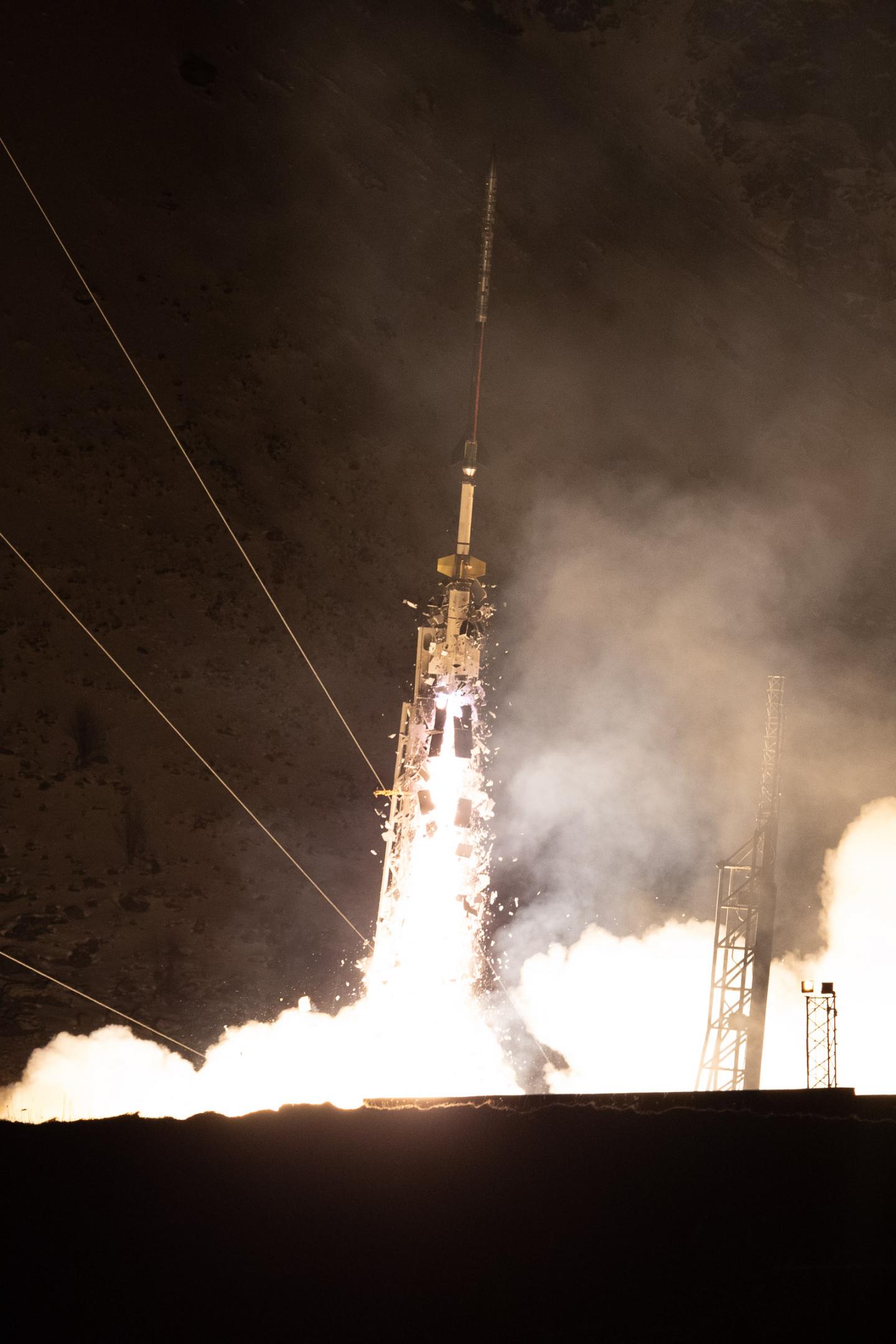
Credit: NASA/Lee Wingfield

NASA successfully launched the Auroral Zone Upwelling Rocket Experiment or AZURE mission on April 5 from the Andøya Space Center in Norway.

Two Black Brant XI-A sounding rockets were launched at 6:14 and 6:16 p.m. EDT on April 5 carrying scientific instruments for studying the energy exchange within an aurora.

The AZURE mission is designed to make measurements of the atmospheric density and temperature with instruments on the rockets and deploying visible gas tracers, trimethyl aluminum (TMA) and a barium/strontium mixture, which ionizes when exposed to sunlight. The vapors were released over the Norwegian Sea at 71 through 150 miles altitude.

These mixtures, using substances similar to those found in fireworks, created colorful clouds that allow researchers to track the flow of neutral and charged particles with the auroral wind. By tracking the movement of these colorful clouds via ground-based photography and triangulating their moment-by-moment position in three dimensions, AZURE will provide valuable data on the vertical and horizontal flow of particles in two key regions of the ionosphere over a range of different altitudes.

Many people believe the Earth’s atmosphere “ends” some 20-30 miles above the ground. However, the air we breathe does not abruptly end at some predefined point — instead, it gradually thins. At 150 to 200 miles above Earth, the “air” is extremely thin and these vapor clouds disperse rapidly and follow the winds which can be moving at a few hundred miles per hour.

AZURE is one of nine missions being conducted as part of the Grand Challenge Initiative (GCI) – Cusp, a series of international sounding rocket missions planned for launch in 2018 – 2020.

NASA and U.S. scientists are joining those from Norway, Japan, Canada and other countries to investigate the physics of heating and charged particle precipitation in this region called the geomagnetic cusp — one of the few places on Earth with easy access to the electrically charged solar wind that pervades the solar system.

NASA previously conducted two missions in December 2018 and two in January 2019 as part of the Initiative. The final two NASA missions — the Cusp Heating Investigation and the Cusp Region Experiment — are scheduled for November 2019.

###

More information on NASA’s use of vapor tracers in scientific studies is available at:

https://www.nasa.gov/mission_pages/sounding-rockets/index.html

AZURE is supported through NASA’s Sounding Rocket Program at the agency’s Wallops Flight Facility in Virginia. NASA’s Heliophysics Division manages the sounding rocket program.

Media Contact
Karen C. Fox
[email protected]

Original Source

https://www.nasa.gov/feature/goddard/2019/nasa-launches-two-rockets-studying-auroras

Tags: AstronomyAstrophysicsExperiments in SpaceSpace/Planetary ScienceStars/The Sun
Share12Tweet8Share2ShareShareShare2

Related Posts

blank

Advancing Alkene Chemistry: Homologative Difunctionalization Breakthrough

January 8, 2026
Biocompatible Ligand Enables Safe In-Cell Protein Arylation

Biocompatible Ligand Enables Safe In-Cell Protein Arylation

January 8, 2026

Monovalent Pseudo-Natural Products Boost IDO1 Degradation

January 7, 2026

Catalytic Enantioselective [1,2]-Wittig Rearrangement Breakthrough

January 7, 2026
Please login to join discussion

POPULAR NEWS

  • Enhancing Spiritual Care Education in Nursing Programs

    154 shares
    Share 62 Tweet 39
  • PTSD, Depression, Anxiety in Childhood Cancer Survivors, Parents

    146 shares
    Share 58 Tweet 37
  • Robotic Ureteral Reconstruction: A Novel Approach

    50 shares
    Share 20 Tweet 13
  • Impact of Vegan Diet and Resistance Exercise on Muscle Volume

    47 shares
    Share 19 Tweet 12
v>

About

We bring you the latest biotechnology news from best research centers and universities around the world. Check our website.

Follow us

Recent News

Developing Eye Care Guidelines for Prone Ventilation

Guillain-Barré Syndrome Linked to TNF Inhibitor in Blau

Dual Nanocarriers Target Smad3 and Runx2 in Aortic Valve Disease

Subscribe to Blog via Email

Enter your email address to subscribe to this blog and receive notifications of new posts by email.

Join 71 other subscribers
  • Contact Us

Bioengineer.org © Copyright 2023 All Rights Reserved.

Welcome Back!

Login to your account below

Forgotten Password?

Retrieve your password

Please enter your username or email address to reset your password.

Log In
No Result
View All Result
  • Homepages
    • Home Page 1
    • Home Page 2
  • News
  • National
  • Business
  • Health
  • Lifestyle
  • Science

Bioengineer.org © Copyright 2023 All Rights Reserved.