• HOME
  • NEWS
  • EXPLORE
    • CAREER
      • Companies
      • Jobs
    • EVENTS
    • iGEM
      • News
      • Team
    • PHOTOS
    • VIDEO
    • WIKI
  • BLOG
  • COMMUNITY
    • FACEBOOK
    • INSTAGRAM
    • TWITTER
Thursday, May 14, 2026
BIOENGINEER.ORG
No Result
View All Result
  • Login
  • HOME
  • NEWS
  • EXPLORE
    • CAREER
      • Companies
      • Jobs
        • Lecturer
        • PhD Studentship
        • Postdoc
        • Research Assistant
    • EVENTS
    • iGEM
      • News
      • Team
    • PHOTOS
    • VIDEO
    • WIKI
  • BLOG
  • COMMUNITY
    • FACEBOOK
    • INSTAGRAM
    • TWITTER
  • HOME
  • NEWS
  • EXPLORE
    • CAREER
      • Companies
      • Jobs
        • Lecturer
        • PhD Studentship
        • Postdoc
        • Research Assistant
    • EVENTS
    • iGEM
      • News
      • Team
    • PHOTOS
    • VIDEO
    • WIKI
  • BLOG
  • COMMUNITY
    • FACEBOOK
    • INSTAGRAM
    • TWITTER
No Result
View All Result
Bioengineer.org
No Result
View All Result
Home NEWS Science News

NASA finds strong storms in developing Tropical Storm Mekkhala

Bioengineer by Bioengineer
August 10, 2020
in Science News
Reading Time: 2 mins read
0
IMAGE
Share on FacebookShare on TwitterShare on LinkedinShare on RedditShare on Telegram

IMAGE

Credit: Credit: NASA/NRL

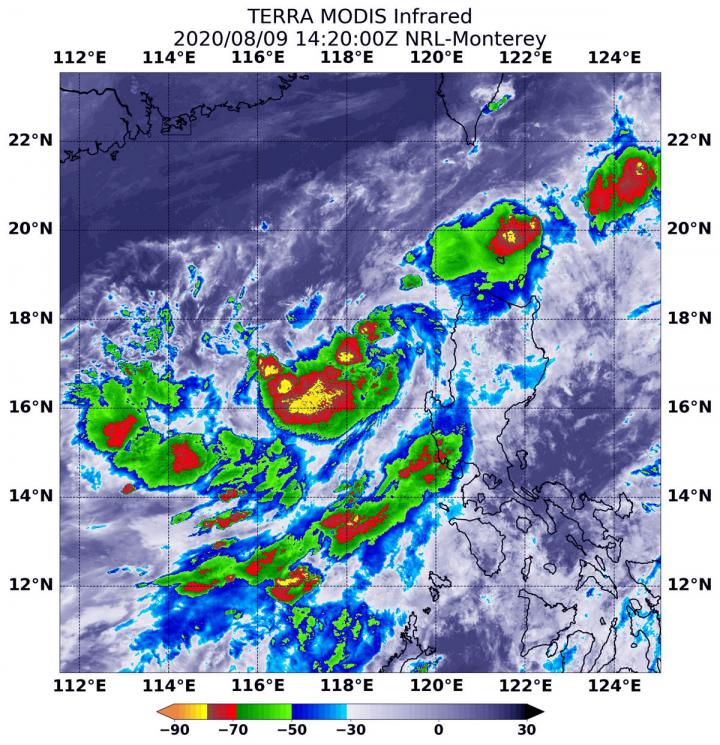
After Tropical Depression 07W formed close to the western Philippines, it moved away and strengthened into a tropical storm in the South China Sea. NASA’s Terra satellite provided a look at the strength of the storms that make up the tropical cyclone.

On Aug. 9 at 11 p.m. EDT (Aug. 10 at 0300 UTC), Tropical Depression 07W formed near latitude 16.8 degrees north and longitude 118.3 degrees east, about 204 nautical miles northwest of Manila, Philippines.

When it formed it was close enough to the Philippines to generate warnings. Tropical cyclone wind signal #1 was posted for western portions of Ilocos Norte and Sur, La Union, western parts of Pangasinan, and northern part of Zambales. Those warnings were dropped by Aug. 10 as the system moved west and away from the Philippines.

Infrared imagery gathered on Aug. 9 at 10:20 a.m. EDT (1420 UTC) was from the Moderate Resolution Imaging Spectroradiometer or MODIS instrument. MODIS flies aboard NASA’s Terra satellite. MODIS gathered temperature information about 07W’s cloud tops. Infrared data provides temperature information, and the strongest thunderstorms that reach high into the atmosphere have the coldest cloud top temperatures.

MODIS found the most powerful thunderstorms were around the center of circulation, and several other areas around the center where temperatures were as cold as or colder than minus 80 degrees Fahrenheit (minus 62.2 Celsius). Those areas were surrounded by thunderstorms slightly less high in the atmosphere, but still powerful rainmakers with cloud top temperatures as cold as or colder than minus 70 degrees Fahrenheit (minus 56.6 Celsius). Cloud top temperatures that cold indicate strong storms with the potential to generate heavy rainfall.

Tropical Depression 07W became a tropical storm at 5 a.m. EDT (0900 UTC) on Aug, 10 and was renamed Tropical Storm Mekkhala. Mekkhala is known locally in the Philippines as Ferdie. The storm’s maximum sustained winds had increased to 35 knots (40 mph). It was centered near latitude 20.2 degrees north and longitude 118.7 degrees east, about 332 nautical miles south-southwest of Taipei, Taiwan. Mekkhala was moving to the north.

The Joint Typhoon Warning Center expects that Mekkhala will continue to move north before moving ashore in southern China.

Tropical cyclones/hurricanes are the most powerful weather events on Earth. NASA’s expertise in space and scientific exploration contributes to essential services provided to the American people by other federal agencies, such as hurricane weather forecasting.

By Rob Gutro
NASA’s Goddard Space Flight Center

###

Media Contact
Rob Gutro
[email protected]

Original Source

https://blogs.nasa.gov/hurricanes/2020/08/10/mekkhala-northwestern-pacific-ocean/

Tags: Atmospheric ChemistryAtmospheric ScienceClimate ChangeClimate ScienceEarth ScienceMeteorologyTechnology/Engineering/Computer ScienceTemperature-Dependent PhenomenaWeather/Storms
Share12Tweet8Share2ShareShareShare2

Related Posts

UVR8 Variations Influence Plant Heat Tolerance and Yield

May 14, 2026
Lineage and Organ Signals Forge Intrinsic Nerves — Medicine

Lineage and Organ Signals Forge Intrinsic Nerves

May 14, 2026

Functional Ability and Heat Vulnerability in Older Adults

May 14, 2026

Impact of Invitation Types on Breast Screening Attendance

May 14, 2026
Please login to join discussion

POPULAR NEWS

  • Research Indicates Potential Connection Between Prenatal Medication Exposure and Elevated Autism Risk

    842 shares
    Share 337 Tweet 211
  • New Study Reveals Plants Can Detect the Sound of Rain

    729 shares
    Share 291 Tweet 182
  • Salmonella Haem Blocks Macrophages, Boosts Infection

    62 shares
    Share 25 Tweet 16
  • Breastmilk Balances E. coli and Beneficial Bacteria in Infant Gut Microbiomes

    57 shares
    Share 23 Tweet 14

About

We bring you the latest biotechnology news from best research centers and universities around the world. Check our website.

Follow us

Recent News

UVR8 Variations Influence Plant Heat Tolerance and Yield

Lineage and Organ Signals Forge Intrinsic Nerves

Functional Ability and Heat Vulnerability in Older Adults

Subscribe to Blog via Email

Enter your email address to subscribe to this blog and receive notifications of new posts by email.

Join 82 other subscribers
  • Contact Us

Bioengineer.org © Copyright 2023 All Rights Reserved.

Welcome Back!

Login to your account below

Forgotten Password?

Retrieve your password

Please enter your username or email address to reset your password.

Log In
No Result
View All Result
  • Homepages
    • Home Page 1
    • Home Page 2
  • News
  • National
  • Business
  • Health
  • Lifestyle
  • Science

Bioengineer.org © Copyright 2023 All Rights Reserved.