Credit: Credit: NASA/NRL
The third tropical cyclone of the Atlantic Ocean basin has been generating large amounts of rainfall over Mexico’s Yucatan and parts of Central America. Using satellite data, NASA analyzed that heavy rainfall and provided forecasters with valuable cloud top temperature data to help assess the strength of the storm.
On June 2, 2020, by 2 p.m. EDT, Tropical Depression 03L strengthened into Tropical Storm Cristobal over Mexico’s Gulf of Campeche. The Gulf of Campeche is surrounded by Mexico’s Yucatan Peninsula, and the gulf is part of the southwestern Gulf of Mexico.
Cristobal remained in the Bay of Campeche on June 3, and a Tropical Storm Warning remained in effect from Campeche to Puerto de Veracruz.
Analyzing Rainfall
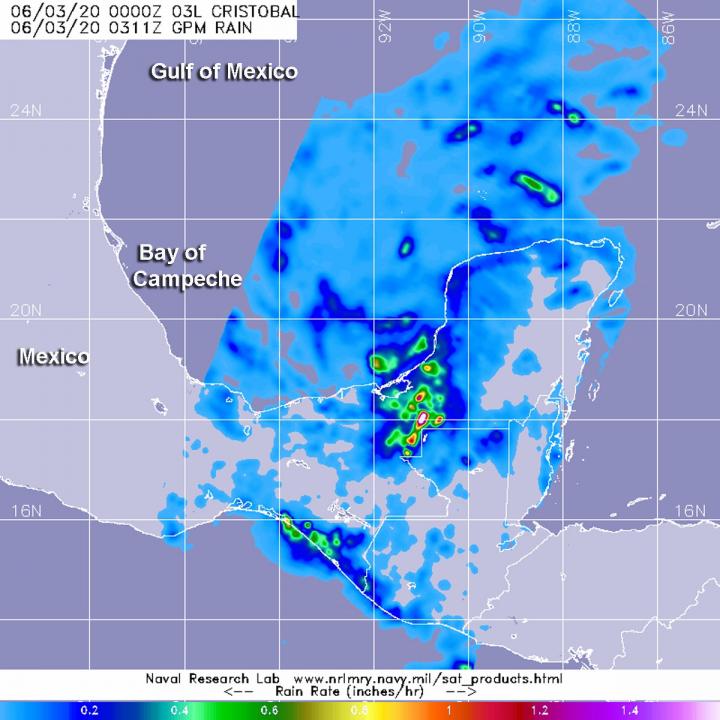
The Global Precipitation Measurement mission or GPM satellite provided a look at Cristobal’s rainfall rates on June 3 at 0311 UTC (June 2 at 11:11 p.m. EDT). GPM found heaviest rainfall south of center over Mexico’s Yucatan Peninsula, falling at rates of more than 1 inch (25 mm) per hour. Lighter rain rates appear around the entire system.
Analyzing Cloud Top Temperatures
Another way NASA analyzes tropical cyclones is by using infrared data that provides temperature information. The Moderate Resolution Imaging Spectroradiometer or MODIS instrument aboard NASA’s Aqua satellite provided data on cloud top temperatures of Cristobal.
Cloud top temperatures provide information to forecasters about where the strongest storms are located within a tropical cyclone. Tropical cyclones do not always have uniform strength, and some sides are stronger than others. The stronger the storms, the higher they extend into the troposphere, and the colder their cloud top temperatures.
On June 3 at 4:20 a.m. EDT (0820 UTC) NASA’s Aqua satellite analyzed Tropical Storm Cristobal using the MODIS instrument and found coldest cloud top temperatures as cold as or colder minus 80 degrees Fahrenheit (minus 62.2 Celsius). A large area of the strongest storms were located over the Yucatan Peninsula and along the coastline of the Bay of Campeche. NASA research has shown that cloud top temperatures that cold indicate strong storms that have the capability to create heavy rain.
NASA provides data to forecasters at NOAA’s National Hurricane Center or NHC so they can incorporate it in their forecasting.
Cristobal’s Status on June 3, 2020
The National Hurricane Center noted on June 3 at 8 a.m. EDT (1200 UTC), the center of Tropical Storm Cristobal was located by an Air Force Hurricane Hunter aircraft near latitude 18.8 degrees north and longitude 92.1 degrees west. The center was about 25 miles (40 km) northwest of Ciudad Del Carmen, Mexico.
Cristobal was moving toward the southeast near 3 mph (6 kph), and is expected to turn toward the east later in the day. Maximum sustained winds were near 60 mph (95 kph) with higher gusts. Tropical-storm-force winds extended outward up to 60 miles (95 km) from the center. Gradual weakening is forecast while the center remains inland, but re-strengthening is expected after Cristobal moves back over water Thursday night and Friday [June 5]. The minimum central pressure reported by an Air Force Hurricane Hunter aircraft is 994 millibars.
NHC Forecast for Cristobal
A motion toward the north-northeast and north is expected on Thursday and Friday. On the forecast track, the center will cross the southern Bay of Campeche coast later today and move inland over eastern Mexico tonight and Thursday. The center is forecast to move back over the Bay of Campeche Thursday night and Friday.
Tropical cyclones/hurricanes are the most powerful weather events on Earth. NASA’s expertise in space and scientific exploration contributes to essential services provided to the American people by other federal agencies, such as hurricane weather forecasting.
GPM is a joint mission between NASA and the Japan Aerospace Exploration Agency, JAXA. The GPM and Aqua satellites are part of a fleet of NASA Earth observing satellites.
For updated forecasts, visit: http://www.
###
Media Contact
Rob Garner
[email protected]
Original Source
https:/