• HOME
  • NEWS
  • EXPLORE
    • CAREER
      • Companies
      • Jobs
    • EVENTS
    • iGEM
      • News
      • Team
    • PHOTOS
    • VIDEO
    • WIKI
  • BLOG
  • COMMUNITY
    • FACEBOOK
    • INSTAGRAM
    • TWITTER
Monday, July 13, 2026
BIOENGINEER.ORG
No Result
View All Result
  • Login
  • HOME
  • NEWS
  • EXPLORE
    • CAREER
      • Companies
      • Jobs
        • Lecturer
        • PhD Studentship
        • Postdoc
        • Research Assistant
    • EVENTS
    • iGEM
      • News
      • Team
    • PHOTOS
    • VIDEO
    • WIKI
  • BLOG
  • COMMUNITY
    • FACEBOOK
    • INSTAGRAM
    • TWITTER
  • HOME
  • NEWS
  • EXPLORE
    • CAREER
      • Companies
      • Jobs
        • Lecturer
        • PhD Studentship
        • Postdoc
        • Research Assistant
    • EVENTS
    • iGEM
      • News
      • Team
    • PHOTOS
    • VIDEO
    • WIKI
  • BLOG
  • COMMUNITY
    • FACEBOOK
    • INSTAGRAM
    • TWITTER
No Result
View All Result
Bioengineer.org
No Result
View All Result
Home NEWS Science News Health

Narrative risk messaging and vaccine hesitancy

Bioengineer by Bioengineer
April 18, 2023
in Health
Reading Time: 2 mins read
0
Three treatment messages and one control message
Share on FacebookShare on TwitterShare on LinkedinShare on RedditShare on Telegram

Public health messages that focus on protecting others are more effective at increasing vaccination rates than messages focused on protecting oneself, according to a study. Vaccine hesitancy is a challenge for public health workers and others concerned with reducing the deleterious effects of infectious diseases. Elizabeth Shanahan and colleagues tested three visual policy narrative messages promoting COVID-19 vaccination that emphasized protecting oneself, one’s circle of friends and family, or one’s community. A non-narrative control message simply urged participants to “get the vaccine” with an accompanying image of a syringe. The authors surveyed 3,900 people in early 2021, randomly assigning one of the messages to each survey respondent. The authors were able to resurvey 2,268 of the participants eight weeks later, and collected information about whether the participants had chosen to get the vaccine in the interim. Message conditions focusing on protecting others (the mean of “protect your circle” and “protect your community”) lead to higher odds of COVID-19 vaccination than messages that urged viewers to “protect yourself.” While there were no direct effects of narrative conditions on vaccination behavior, each narrative message that activated a positive response and motivation to get the vaccine resulted in higher vaccination rates eight weeks later than the control message. The results reveal the power of using narrative construction in public health messaging, according to the authors.
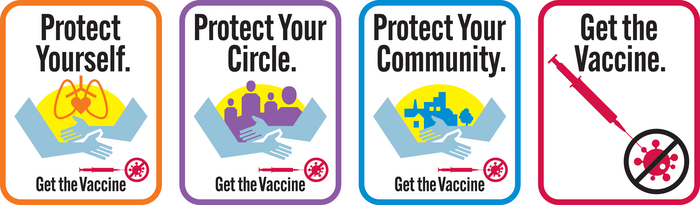
 

Three treatment messages and one control message

Credit: Shanahan et al.

Public health messages that focus on protecting others are more effective at increasing vaccination rates than messages focused on protecting oneself, according to a study. Vaccine hesitancy is a challenge for public health workers and others concerned with reducing the deleterious effects of infectious diseases. Elizabeth Shanahan and colleagues tested three visual policy narrative messages promoting COVID-19 vaccination that emphasized protecting oneself, one’s circle of friends and family, or one’s community. A non-narrative control message simply urged participants to “get the vaccine” with an accompanying image of a syringe. The authors surveyed 3,900 people in early 2021, randomly assigning one of the messages to each survey respondent. The authors were able to resurvey 2,268 of the participants eight weeks later, and collected information about whether the participants had chosen to get the vaccine in the interim. Message conditions focusing on protecting others (the mean of “protect your circle” and “protect your community”) lead to higher odds of COVID-19 vaccination than messages that urged viewers to “protect yourself.” While there were no direct effects of narrative conditions on vaccination behavior, each narrative message that activated a positive response and motivation to get the vaccine resulted in higher vaccination rates eight weeks later than the control message. The results reveal the power of using narrative construction in public health messaging, according to the authors.


Journal

PNAS Nexus

DOI

10.1093/pnasnexus/pgad080

Article Title

Visual policy narrative messaging improves COVID-19 vaccine uptake

Article Publication Date

18-Apr-2023
Share12Tweet8Share2ShareShareShare2

Related Posts

New Tick-Borne Threat: Anaplasmosis Spreads in Canada

July 13, 2026

Paid Work Linked to Cognitive Benefits in Older Chinese Adults

July 13, 2026

Bioinspired Microcapsule Reactor Using Engineered Probiotics for IBD Treatment

July 13, 2026

Nationwide Study Reveals Multimorbidity Factors in Older Chinese Adults

July 12, 2026

POPULAR NEWS

  • Detection of EDCs in Breast Milk and Infant Urine Up to Six Months Highlights Early Exposure Risks

    77 shares
    Share 31 Tweet 19
  • New Drug Candidate Developed at McMaster Shows Potential for Treating Brain Cancer

    58 shares
    Share 23 Tweet 15
  • KTU Researchers Explore Ultrasound’s Role in Enhancing Blood Flow Beyond Diagnostics

    53 shares
    Share 21 Tweet 13
  • Experimental Therapy Simultaneously Destroys Prostate Tumor Cells and Reactivates Antitumor Immunity

    46 shares
    Share 18 Tweet 12

About

We bring you the latest biotechnology news from best research centers and universities around the world. Check our website.

Follow us

Recent News

Computer-Controlled Electricity Quickly Shapes Flat Nanofilms into 3D Structures

How Particle Shape and Spin Affect Optical Manipulation Efficiency

New Tick-Borne Threat: Anaplasmosis Spreads in Canada

Subscribe to Blog via Email

Enter your email address to subscribe to this blog and receive notifications of new posts by email.

Join 85 other subscribers
  • Contact Us

Bioengineer.org © Copyright 2023 All Rights Reserved.

Welcome Back!

Login to your account below

Forgotten Password?

Retrieve your password

Please enter your username or email address to reset your password.

Log In
No Result
View All Result
  • Homepages
    • Home Page 1
    • Home Page 2
  • News
  • National
  • Business
  • Health
  • Lifestyle
  • Science

Bioengineer.org © Copyright 2023 All Rights Reserved.