• HOME
  • NEWS
  • EXPLORE
    • CAREER
      • Companies
      • Jobs
    • EVENTS
    • iGEM
      • News
      • Team
    • PHOTOS
    • VIDEO
    • WIKI
  • BLOG
  • COMMUNITY
    • FACEBOOK
    • INSTAGRAM
    • TWITTER
Monday, January 19, 2026
BIOENGINEER.ORG
No Result
View All Result
  • Login
  • HOME
  • NEWS
  • EXPLORE
    • CAREER
      • Companies
      • Jobs
        • Lecturer
        • PhD Studentship
        • Postdoc
        • Research Assistant
    • EVENTS
    • iGEM
      • News
      • Team
    • PHOTOS
    • VIDEO
    • WIKI
  • BLOG
  • COMMUNITY
    • FACEBOOK
    • INSTAGRAM
    • TWITTER
  • HOME
  • NEWS
  • EXPLORE
    • CAREER
      • Companies
      • Jobs
        • Lecturer
        • PhD Studentship
        • Postdoc
        • Research Assistant
    • EVENTS
    • iGEM
      • News
      • Team
    • PHOTOS
    • VIDEO
    • WIKI
  • BLOG
  • COMMUNITY
    • FACEBOOK
    • INSTAGRAM
    • TWITTER
No Result
View All Result
Bioengineer.org
No Result
View All Result
Home NEWS Science News Chemistry

Nanostructures modeled on moth eyes effective for anti-icing

Bioengineer by Bioengineer
August 4, 2020
in Chemistry
Reading Time: 2 mins read
0
IMAGE
Share on FacebookShare on TwitterShare on LinkedinShare on RedditShare on Telegram

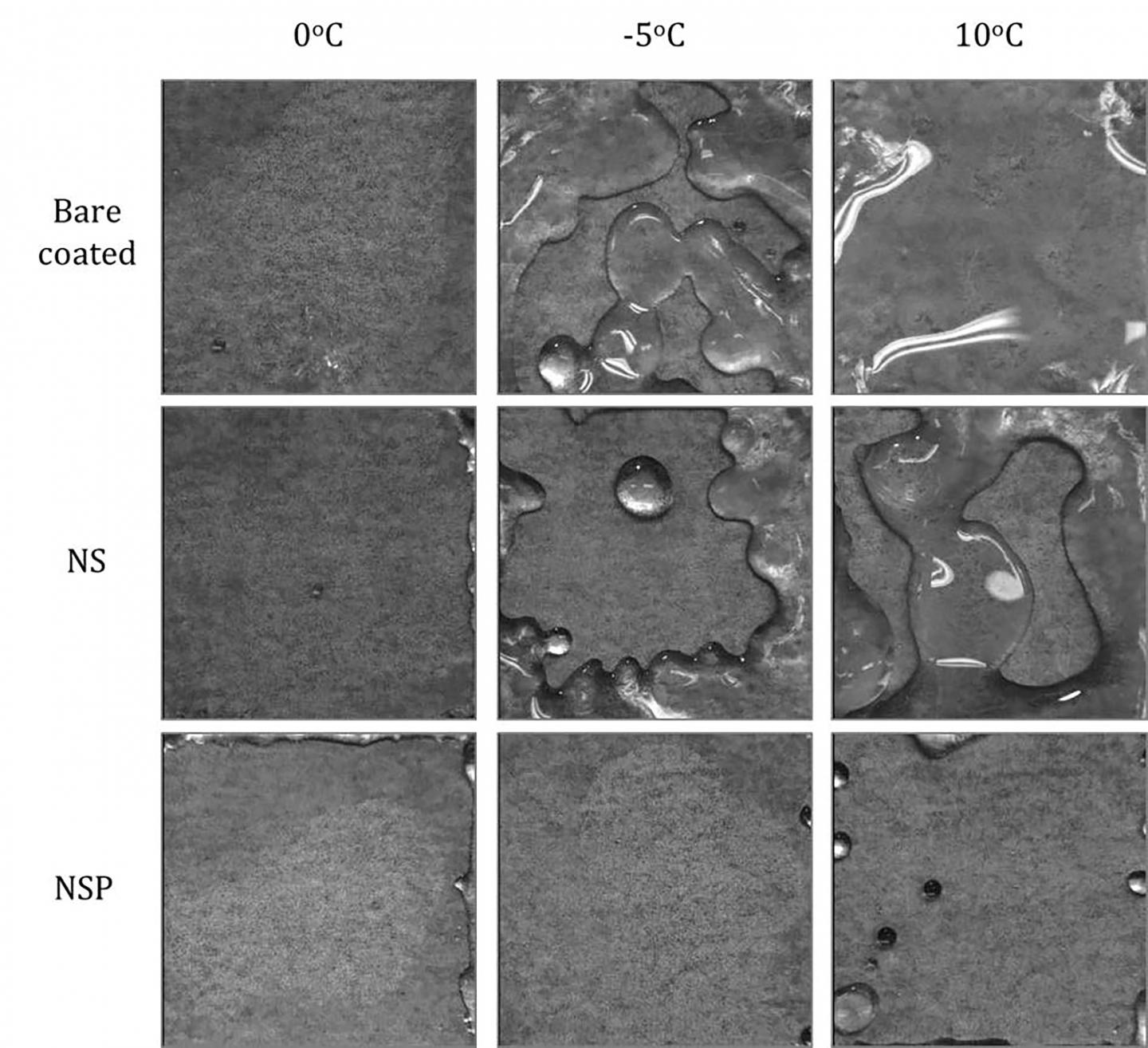
Nanostructures covered with a paraffin layer modeled on moth eyes exhibit anti-icing, anti-reflective properties
IMAGE

Credit: Nguyen Ba Duc

WASHINGTON, August 4, 2020 — Researchers have been working for decades on improving the anti-icing performance of functional surfaces. Ice accumulation on aircraft wings, for instance, can reduce lifting force, block moving parts and cause disastrous problems.

Research in the journal AIP Advances, from AIP Publishing, investigates a unique nanostructure, modeled on moth eyes, that has anti-icing properties. Moth eyes are of interest because they have a distinct ice-phobic and transparent surface.

The researchers fabricated the moth eye nanostructure on a quartz substrate that was covered with a paraffin layer to isolate it from a cold and humid environment. Paraffin wax was chosen as a coating material due to its low thermal conductivity, easy coating and original water repellency.

“We evaluated the anti-icing properties of this unique nanostructure covered with paraffin in terms of adhesion strength, freezing time and mimicking rain sustainability,” said Nguyen Ba Duc, one of the authors.

Ice accumulation on energy transmission systems, vehicles and ships in a harsh environment often leads to massive destruction and contributes to serious accidents.

The researchers found the moth eyes nanostructure surface coated in paraffin exhibited greatly improved anti-icing performance, indicating the advantage of combining original water repellency and a unique heat-delaying structure. The paraffin interfered in the icing process in both water droplet and freezing rain experiments.

The number of air blocks trapped inside the nanostructure also contributed to delaying heat transfer, leading to an increase in freezing time of the attached water droplets.

“We also determined this unique nanostructure sample is suitable for optical applications, such as eyeglasses, as it has high transparency and anti-reflective properties,” said Ba Duc.

The high transparency and anti-reflective effects were due to the nanostructure being modeled on moth eyes, which have these transparent and anti-reflective properties.

###

The article, “Investigate structure for transparent anti-icing surfaces,” is authored by Nguyen Ba Duc and Nguyen Thanh Binh. The article will appear in AIP Advances on Aug. 4, 2020 (DOI: 10.1063/5.0019119). After that date, it can be accessed at https://aip.scitation.org/doi/10.1063/5.0019119.

ABOUT THE JOURNAL

AIP Advances is an open access journal publishing in all areas of physical sciences–applied, theoretical, and experimental. The inclusive scope of AIP Advances makes it an essential outlet for scientists across the physical sciences. See https://aip.scitation.org/journal/adv.

Media Contact
Larry Frum
[email protected]

Related Journal Article

http://dx.doi.org/10.1063/5.0019119

Tags: Atomic/Molecular/Particle PhysicsChemistry/Physics/Materials SciencesIndustrial Engineering/ChemistryMaterialsMechanical EngineeringTechnology/Engineering/Computer Science
Share12Tweet8Share2ShareShareShare2

Related Posts

Creating Synthetic Protein-Binding DNA Systems in Cells

January 17, 2026
blank

Chiral Catalysis Powers Rotary Molecular Motors

January 16, 2026

Selective GlcNAc to GalNAc Epimerization via Kinetic Control

January 15, 2026

Thermal [2+2] Cycloaddition Builds Gem-Difluoro Bicycloalkanes

January 13, 2026
Please login to join discussion

POPULAR NEWS

  • Enhancing Spiritual Care Education in Nursing Programs

    155 shares
    Share 62 Tweet 39
  • PTSD, Depression, Anxiety in Childhood Cancer Survivors, Parents

    148 shares
    Share 59 Tweet 37
  • Robotic Ureteral Reconstruction: A Novel Approach

    78 shares
    Share 31 Tweet 20
  • Study Reveals Lipid Accumulation in ME/CFS Cells

    54 shares
    Share 22 Tweet 14

About

We bring you the latest biotechnology news from best research centers and universities around the world. Check our website.

Follow us

Recent News

Improving Patient Satisfaction in Eastern Nepal’s Healthcare

Impact of Lane Change Trajectories on Passenger Comfort

Advancements in Isolated Kalman Filtering Techniques

Subscribe to Blog via Email

Enter your email address to subscribe to this blog and receive notifications of new posts by email.

Join 71 other subscribers
  • Contact Us

Bioengineer.org © Copyright 2023 All Rights Reserved.

Welcome Back!

Login to your account below

Forgotten Password?

Retrieve your password

Please enter your username or email address to reset your password.

Log In
No Result
View All Result
  • Homepages
    • Home Page 1
    • Home Page 2
  • News
  • National
  • Business
  • Health
  • Lifestyle
  • Science

Bioengineer.org © Copyright 2023 All Rights Reserved.