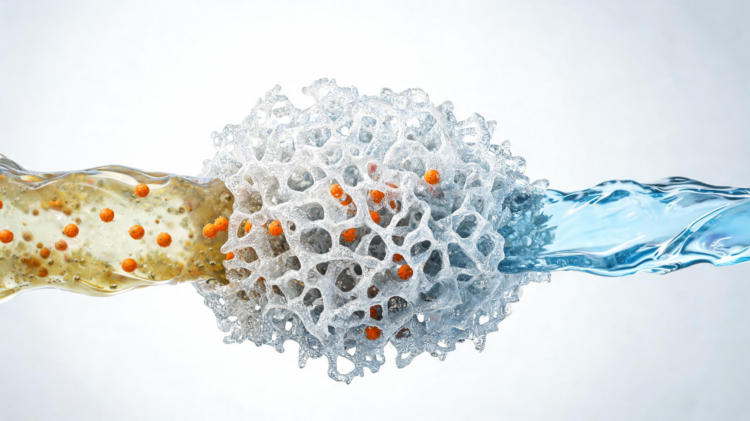
A tailored nanoporous material could make it easier for laboratories to find minute quantities of cadmium in wastewater and natural water, according to research published in the Journal of Saudi Chemical Society. The material combines SBA-15, a mesoporous form of silica, with a chemical ligand called 4-(4-chlorobenzylideneimino)-3-methyl-5-mercapto-1,2,4-triazole, abbreviated CBIMMT. The resulting nano-sorbent is designed to capture cadmium(II) ions from large water samples, concentrate them into a much smaller volume, and enable measurement with flame atomic absorption spectrometry, or FAAS. In tests reported by Fatemeh Kazemi, Anahita Khodabakhshi-Omran, and Ali Mirabi, the approach detected cadmium at concentrations as low as 3.7 nanograms per milliliter. It also produced a calibration range from 15 to 600 nanograms per milliliter and a relative standard deviation of 1.6 percent. Those figures matter because cadmium can be difficult to measure when it is present at very low levels or mixed with the complex chemical background of environmental samples. Rather than replacing established instruments, the material works as a sample-preparation step intended to make those instruments more sensitive and selective.
Cadmium is a toxic heavy metal released through activities including metal processing, electroplating, battery production, paint manufacturing, ceramics, printing, tanning, and textile and paper production. Once it enters waterways, it can persist and move through aquatic systems. Human exposure is particularly concerning because the kidneys are a major target of cadmium toxicity, and long-term exposure can impair renal function. The source study notes drinking-water limits of 5 micrograms per liter from the U.S. Environmental Protection Agency and 3 micrograms per liter from the World Health Organization, while the EPA limit for dissolved cadmium in freshwater is 1.8 micrograms per liter. Measuring concentrations near such thresholds requires more than simply placing a water sample into an instrument. Natural waters and industrial effluents contain dissolved salts, organic compounds, suspended matter, and other metals that can interfere with analysis. At the same time, the target ions may be below the direct detection capability of relatively accessible instruments such as FAAS. Separating and concentrating cadmium before measurement can address both problems by removing much of the sample matrix and increasing the analyte concentration.
The researchers chose SBA-15 as the foundation because its structure consists of an ordered network of mesopores and a large internal surface area. The silica surface is rich in silanol groups, written chemically as –OH, which can be used as attachment points for functional molecules. Unmodified SBA-15 provides space for adsorption, but its interactions with cadmium are not sufficiently selective or efficient for the intended application. CBIMMT adds nitrogen- and sulfur-containing sites capable of interacting with cadmium ions through coordination. In this design, the silica acts as a high-area scaffold while the ligand supplies much of the chemical recognition. The team synthesized SBA-15 using a block-copolymer template, tetraethyl orthosilicate as the silica source, hydrochloric acid, potassium chloride, and water. After formation, the template was removed with ethanol. The researchers then refluxed 2 grams of SBA-15 with 1 gram of CBIMMT in ethanol at 80 degrees Celsius for 24 hours. The modified solid was filtered and dried, producing the SBA-15/CBIMMT nano-sorbent examined in the study.
A suite of material-characterization techniques was used to determine whether the modification changed the structure and to verify that the ligand was present. Transmission electron microscopy showed that the synthesized SBA-15 had a consistent hexagonal mesoporous arrangement, with pore sizes below approximately 20 nanometers. Brunauer–Emmett–Teller, or BET, analysis measured a specific surface area of 397.4 square meters per gram for the original silica. After CBIMMT was added, the surface area fell to 351.6 square meters per gram, a change the researchers attributed to ligand coverage of the pore surfaces. The reduction is consistent with molecules occupying some of the available surface while leaving a substantial porous framework intact. Field-emission scanning electron microscopy indicated that CBIMMT covered the SBA-15 surface, while carbon, nitrogen, and sulfur detected by CHNS elemental analysis further supported the presence of the organic ligand. Energy-dispersive X-ray spectroscopy also identified the ligand-associated elements and, after adsorption, showed cadmium on the material. Thermogravimetric analysis revealed a 27.4 percent mass loss between about 272 and 394 degrees Celsius, attributed principally to removal of CBIMMT, with smaller losses associated with water and remaining organic components.
The analytical procedure was based on solid-phase extraction. In the optimized protocol, 100 milliliters of water containing cadmium was adjusted to pH 5 with an acetate buffer and mixed with 60 milligrams of the nano-sorbent. Shaking at room temperature for 20 minutes allowed cadmium ions to contact and bind to the ligand-functionalized surface. The solid was then separated by centrifugation at 8,000 revolutions per minute for five minutes. The captured ions were released with just 1 milliliter of 0.3-molar nitric acid, which disrupts the cadmium–ligand interactions and transfers the metal into a concentrated solution for FAAS measurement. The ratio between the original 100-milliliter sample and the final 1-milliliter eluent gives a preconcentration factor of 100. That concentration step is central to the method: a dilute signal distributed through a relatively large sample becomes a stronger signal in a small volume, while the extraction stage helps reduce matrix effects. The researchers investigated pH, sorbent quantity, contact time, eluent composition and concentration, sample volume, and salinity to establish these operating conditions.
pH controlled how effectively the material captured cadmium. Extraction increased as pH rose from 2 to approximately 5. Under strongly acidic conditions, the amine and sulfide groups of CBIMMT become protonated, making them less available to bind positively charged cadmium ions. Protons also compete with cadmium for the ligand’s active sites. At higher pH values, however, cadmium can begin forming hydroxide species or precipitates, making it harder to distinguish adsorption from other removal processes. The researchers therefore selected pH 5 as the practical optimum. Testing different sorbent masses showed that 60 milligrams captured the cadmium under the study conditions; adding more produced little additional improvement. The modified material’s extraction efficiency was more than twice that of unmodified SBA-15, highlighting the contribution of CBIMMT rather than surface area alone. Cadmium uptake changed little after 20 minutes of contact, so longer extraction was unnecessary. Among the acids tested for release, 0.3-molar nitric acid in a 1-milliliter volume provided quantitative elution. Extraction remained stable when sodium nitrate concentrations reached 0.5 molar, suggesting that the method can tolerate highly saline samples.
The material’s reported maximum adsorption capacity was 411 milligrams of cadmium per gram of nano-sorbent, calculated from equilibrium experiments using different initial cadmium concentrations. The researchers also assessed selectivity by adding potentially interfering ions to cadmium solutions. Most tested cations and anions caused no significant effect even when present at concentrations ten times higher than cadmium, with tolerance defined as a relative error within plus or minus 5 percent. In repeat measurements of a 100-nanogram-per-milliliter standard, the relative standard deviation was 1.6 percent. The reported limit of quantification was 12.3 nanograms per milliliter, calculated using the standard relationship between blank variability and calibration-curve slope. The sorbent could be reused three times after washing with the recovery solution, although adsorption declined from 98.6 percent initially to 95.1 percent after the third cycle. Possible reasons include particle loss during elution, leaching of attached ligand, or formation of strong complexes that are not completely reversed. These results indicate promising repeat use, while also identifying durability as an issue for future optimization.
To test performance beyond prepared solutions, the researchers applied the procedure to well water, seawater, tap water, river water, hospital wastewater, wastewater from an electrical power plant, and wastewater from an MDF factory. Samples were passed through 0.45-micrometer membrane filters to remove suspended particles before extraction. Cadmium in the examined well-water and tap-water samples was below the method’s detection limit. Because a certified reference material was unavailable, the team evaluated accuracy by adding known cadmium concentrations to the different sample types. Relative recoveries ranged from 95.2 to 97.9 percent, indicating that the varied chemical matrices had limited influence under the tested conditions. The findings do not establish that the material removes cadmium from contaminated water at treatment scale, nor do they demonstrate long-term performance in continuous systems. Instead, they show that a relatively simple nano-sorbent can prepare environmental samples for trace analysis using widely available FAAS equipment. The study reports the first experimental investigation of SBA-15 modified with CBIMMT for cadmium extraction and preconcentration, positioning the material as a candidate for routine monitoring where expensive plasma-based instruments may not be accessible.
The reported adsorption capacity should be interpreted as a laboratory equilibrium value rather than a direct prediction of how much cadmium the sorbent would remove from an untreated water stream. In an analytical extraction, the practical objective is quantitative and reproducible transfer of cadmium into the eluent. That makes selectivity, recovery, and consistency across different matrices as important as the capacity measurement itself. The study’s recovery tests, conducted by spiking several environmental and industrial water types, address this analytical requirement, although they do not substitute for testing against certified reference materials.
The material characterization also illustrates why several independent measurements are useful for a functionalized porous sorbent. Electron microscopy provides information about morphology and pore organization, surface-area analysis tracks changes in accessible porosity, elemental measurements indicate incorporation of the carbon-, nitrogen-, and sulfur-containing ligand, and thermogravimetry estimates the organic fraction and its thermal behavior. Together, these observations support the interpretation that CBIMMT was attached to, or associated with, the silica framework rather than the observed cadmium response arising solely from unmodified SBA-15. Further work could clarify attachment stability, regeneration over more cycles, and performance with more complex or continuously flowing samples.
Subject of Research: CBIMMT-functionalized SBA-15 for cadmium preconcentration and detection in water
Article Title: Synthesis of CBIMMT-modified SBA-15 as a novel nano-sorbent to preconcentrate, extraction and determination of trace amounts of Cd (II) ions in wastewater and natural water samples
Article References: Kazemi, F., Khodabakhshi-Omran, A., & Mirabi, A. (2026). Synthesis of CBIMMT-modified SBA-15 as a novel nano-sorbent to preconcentrate, extraction and determination of trace amounts of Cd (II) ions in wastewater and natural water samples. Journal of Saudi Chemical Society, 30(5), Article 64. https://doi.org/10.1007/s44442-026-00117-2
Image Credits: AI Generated
DOI: 10.1007/s44442-026-00117-2
Keywords: cadmium detection, SBA-15, nanochemistry, solid-phase extraction, water pollution, wastewater analysis, mesoporous silica, flame atomic absorption, Synthesis, CBIMMT-modified, novel, nano-sorbent
Cite Scienmag News
APA MLA Chicago
Scienmag. (August 28, 2026). Nanoporous Silica Trap Detects Trace Cadmium in Contaminated Water. https://scienmag.com/nanoporous-silica-trap-detects-trace-cadmium-in-contaminated-water/
Scienmag. “Nanoporous Silica Trap Detects Trace Cadmium in Contaminated Water.” Scienmag, 28 August 2026, https://scienmag.com/nanoporous-silica-trap-detects-trace-cadmium-in-contaminated-water/. Accessed 28 August 2026.
Scienmag. “Nanoporous Silica Trap Detects Trace Cadmium in Contaminated Water.” Scienmag. August 28, 2026. https://scienmag.com/nanoporous-silica-trap-detects-trace-cadmium-in-contaminated-water/
Copy citation Download RIS
Tags: cadmium detectionCBIMMT-modifiedChemical ligand CBIMMT for heavy metal captureEnvironmental water sample analysis for heavy metalsflame atomic absorptionFlame atomic absorption spectrometry (FAAS) in water testingImproving sensitivity and selectivity in trace metal detectionMesoporous SBA-15 silica in environmental analysismesoporous silicanano-sorbentNano-sorbent for cadmium ion concentrationnanochemistryNanomaterial-based methods for toxic metal analysisNanoporous silica for trace cadmium detectionnovelSample preparation techniques for environmental pollutantsSBA-15Sensitive detection of low-level cadmium contaminationsolid-phase extractionSynthesisToxicitywastewater analysisWater pollution