• HOME
  • NEWS
  • EXPLORE
    • CAREER
      • Companies
      • Jobs
    • EVENTS
    • iGEM
      • News
      • Team
    • PHOTOS
    • VIDEO
    • WIKI
  • BLOG
  • COMMUNITY
    • FACEBOOK
    • INSTAGRAM
    • TWITTER
Friday, June 26, 2026
BIOENGINEER.ORG
No Result
View All Result
  • Login
  • HOME
  • NEWS
  • EXPLORE
    • CAREER
      • Companies
      • Jobs
        • Lecturer
        • PhD Studentship
        • Postdoc
        • Research Assistant
    • EVENTS
    • iGEM
      • News
      • Team
    • PHOTOS
    • VIDEO
    • WIKI
  • BLOG
  • COMMUNITY
    • FACEBOOK
    • INSTAGRAM
    • TWITTER
  • HOME
  • NEWS
  • EXPLORE
    • CAREER
      • Companies
      • Jobs
        • Lecturer
        • PhD Studentship
        • Postdoc
        • Research Assistant
    • EVENTS
    • iGEM
      • News
      • Team
    • PHOTOS
    • VIDEO
    • WIKI
  • BLOG
  • COMMUNITY
    • FACEBOOK
    • INSTAGRAM
    • TWITTER
No Result
View All Result
Bioengineer.org
No Result
View All Result
Home NEWS Science News Chemistry

Nanoparticles reveal their location via mirror SELFI

Bioengineer by Bioengineer
April 7, 2021
in Chemistry
Reading Time: 2 mins read
0
IMAGE
Share on FacebookShare on TwitterShare on LinkedinShare on RedditShare on Telegram

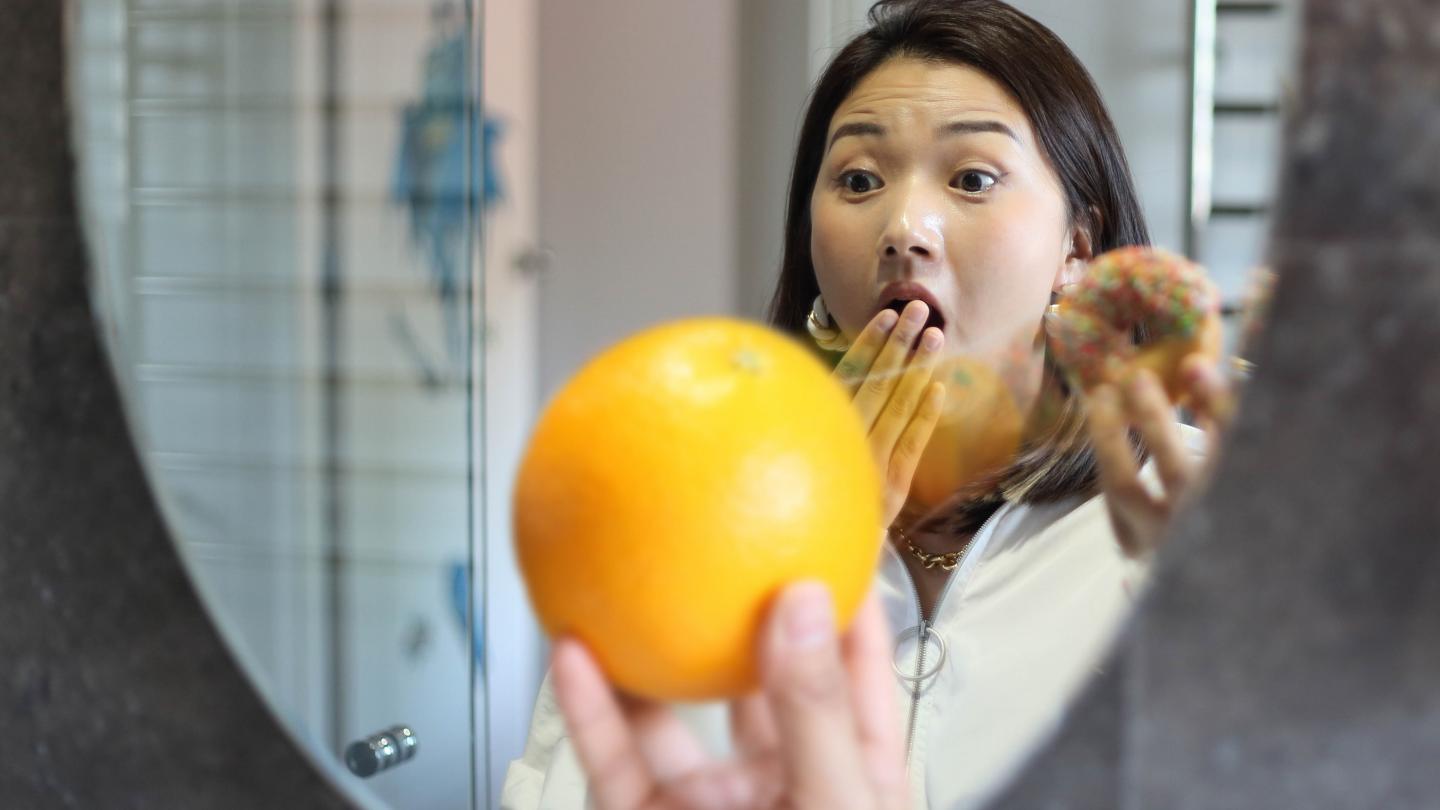
Can a mirror turn an orange into a doughnut?
IMAGE

Credit: Dr Fan Wang

Can a mirror turn an orange into a doughnut? The answer is definitely no in the real (macro) world. But at the nanoscale, a mirror can turn an “orange” shaped pattern into a “doughnut” shaped pattern by overlapping the “orange” with its reflected mirror image.

A team of researchers from the University of Technology Sydney (UTS) has shown for the first time that fluorescent nanoparticles placed near a mirror generate unique patterns that can be used to pinpoint their location.

The researchers attribute this effect to the light emitting nanoparticle’s interference with its own mirror image. Using this method they can also detect the size of particles to a resolution of one nanometre – or around 1/80,000th of the diameter of a human hair.

This breakthrough in ultra-sensitive measuring technology, published in Nature Communications, could have many applications including tracking and analysing disease causing viruses and other pathogens.

“When we look in a mirror it doesn’t change our physical shape, but that’s not the case with emission patterns of nanoparticles,” says leading co-author Dr Fan Wang from the UTS Institute for Biomedical Materials and Devices.

“If you put a nanoparticle in front of a mirror, it will change its image by itself, and the image shape reflects the spacing between the particle and the mirror. This is due to the phase difference between the emitter and its image,” he says.

The researchers describe this encoding of position information from a particle emission’s self-interference as the “SELFI effect”. The resulting patterns include Gaussian, doughnut and archery target shapes.

“To the best of our knowledge, the spatial distribution of the spontaneous emission’s SELFI from multiple emitters at the nanoscale has not been reported,” says leading co-author Professor Dayong Jin.

“This SELFI leads to a fast, high-resolution and anti-drift sensing method to accurately resolve the position of a single nanoparticles.”

The nanoparticles are doped with many rare-earth element ions to achieve the necessary luminescence to create an effective SELFI.

The authors note this new method is suitable for conventional widefield fluorescence microscopy setups without requiring system modification.

###

The open access article ‘Axial localization and tracking of self-interference nanoparticles by lateral point spread functions’ is published in Nature Communications.

Media Contact
Leilah Schubert
[email protected]

Original Source

https://www.uts.edu.au/news/tech-design/nanoparticles-reveal-their-location-mirror-selfi

Related Journal Article

http://dx.doi.org/10.1038/s41467-021-22283-0

Tags: Atomic/Molecular/Particle PhysicsBiomedical/Environmental/Chemical EngineeringChemistry/Physics/Materials SciencesMaterialsNanotechnology/Micromachines
Share12Tweet8Share2ShareShareShare2

Related Posts

AI and Physics Collaborate to Design Advanced Hydrogen Storage Materials

June 25, 2026

International Team Including Dresden Scientists Develops Novel Designer Proteins for Advanced Study of Living Tissue

June 25, 2026

New Study Uncovers Key Factors Driving Water Chemistry in Nanoscale Environments

June 25, 2026

Plasma Technology Extends Catalyst Lifespan in Hydrogen Production

June 24, 2026
Please login to join discussion

POPULAR NEWS

  • Saying Goodbye to PGY-6: Pediatric Fellowship Realities

    103 shares
    Share 41 Tweet 26
  • Multi-Hospital Study Reveals Long Covid Burden Is Twice as High as Current Estimates

    92 shares
    Share 36 Tweet 23
  • Detection of EDCs in Breast Milk and Infant Urine Up to Six Months Highlights Early Exposure Risks

    77 shares
    Share 31 Tweet 19
  • New Drug Candidate Developed at McMaster Shows Potential for Treating Brain Cancer

    58 shares
    Share 23 Tweet 15

About

We bring you the latest biotechnology news from best research centers and universities around the world. Check our website.

Follow us

Recent News

Tracking Lanthanide-Labeled Microplastics in Plants

POSTECH Researchers Slash Cost of Reconstituted Cell-Free Systems by 95%

AI and Physics Collaborate to Design Advanced Hydrogen Storage Materials

Subscribe to Blog via Email

Success! An email was just sent to confirm your subscription. Please find the email now and click 'Confirm' to start subscribing.

Join 82 other subscribers
  • Contact Us

Bioengineer.org © Copyright 2023 All Rights Reserved.

Welcome Back!

Login to your account below

Forgotten Password?

Retrieve your password

Please enter your username or email address to reset your password.

Log In
No Result
View All Result
  • Homepages
    • Home Page 1
    • Home Page 2
  • News
  • National
  • Business
  • Health
  • Lifestyle
  • Science

Bioengineer.org © Copyright 2023 All Rights Reserved.