


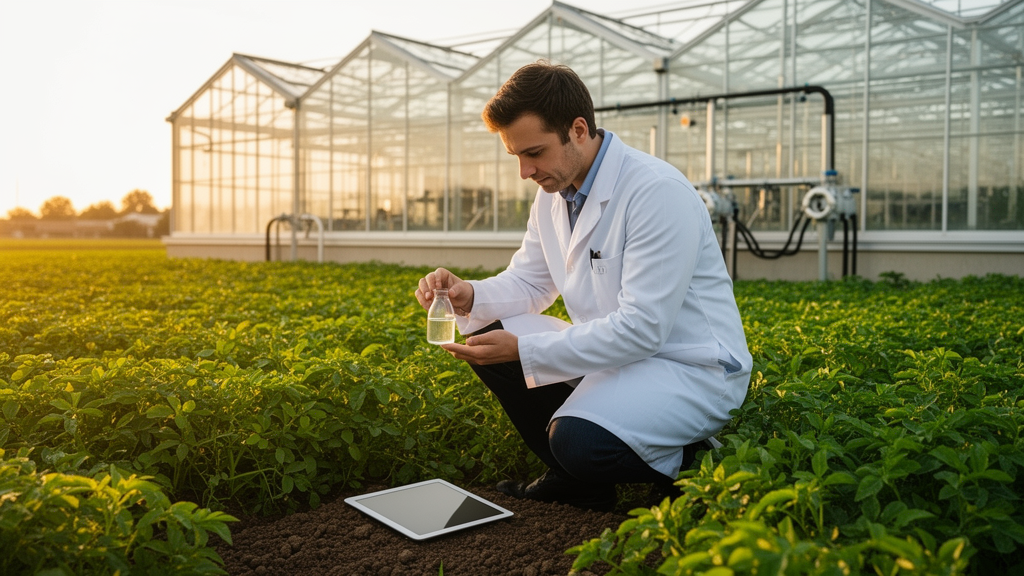
Nanoparticles measuring between 1 and 100 nanometers are being recruited to tackle some of agriculture’s hardest problems: shrinking arable land, degraded soil fertility and stubbornly plateauing crop yields. A concise review published in the journal Bioscience Nanotechnology on 5 August 2026 synthesizes the agronomic functions and underlying molecular mechanisms of typical engineered nanomaterials, drawing on peer-reviewed literature from Web of Science and Scopus published between 2015 and 2026. Its central message is double-edged: nanomaterials can regulate crop nutrition, stimulate growth, bolster stress tolerance, suppress disease and deliver bioactive compounds with unprecedented precision, yet the same properties that make them powerful can damage soil ecosystems, poison plants and travel up the food chain.
The review, authored by Wenjun Wu, Yuangang Jiang, Jingyao Deng, Houjin Huang and Xiang Liu, organizes agriculturally relevant nanomaterials into four categories: metal and metal oxide nanoparticles such as zinc oxide, titanium dioxide, silver and copper oxide; carbon-based nanomaterials including fullerenes, carbon nanotubes and graphene derivatives; silica nanoparticles; and elemental nanoparticles such as selenium and copper. What unites them are the so-called nano-effects—surface effects, small-size effects, quantum size effects and macroscopic quantum tunneling—that give matter at this scale ultra-high chemical reactivity, tunable optical and magnetic behavior, and easily functionalized surfaces. Nano-fertilizers and nano-pesticides are the most widely adopted products, designed to raise the utilization efficiency of nutrients and active agrochemical ingredients while cutting waste.
Zinc oxide nanoparticles emerge as dual-purpose workhorses. As nanoscale zinc donors, their accelerated dissolution, improved rhizosphere penetration and sustained nutrient supply elevate zinc bioavailability in soil–plant systems, supporting vegetative growth and yield accumulation. Against phytopathogens they work through two routes: released zinc ions penetrate pathogenic cells and disrupt enzyme activities and core metabolic cascades, while the particles themselves trigger excessive reactive oxygen species accumulation that destroys microbial membrane integrity. Under ultraviolet irradiation, ZnO nanoparticles can also photocatalytically degrade organic pollutants, pointing to a role in environmental remediation. Studies compiled in the review indicate that rational doses strengthen crop resistance to salinity, chilling, drought and heavy metal toxicity—for example, seed pre-treatment mitigated salt-stress suppression of germination in maize by maintaining sodium–potassium ion balance and optimizing alpha-amylase activity—although effects depend heavily on plant genotype and experimental conditions.
Dosage, however, is everything. The review reports that optimal growth-promoting concentrations of ZnO nanoparticles fall between 50 and 200 milligrams per liter for wheat, rapeseed, maize and other staple crops, while levels above 500 milligrams per liter tend to restrain root development and provoke intracellular oxidative stress. The authors caution that these thresholds vary markedly between species, resisting any simple low-dose-stimulates, high-dose-inhibits rule. Titanium dioxide nanoparticles tell a complementary story: anatase-phase TiO2 generates highly oxidizing reactive oxygen species under ultraviolet excitation, making it a candidate for decomposing organophosphorus and pyrethroid pesticide residues and inactivating pathogens in water. In crops, appropriate concentrations raised leaf chlorophyll content and boosted photosynthetic electron transport, promoting biomass accumulation through reactive oxygen signaling that primes the plant’s antioxidant defenses. But in tomato, 0.5 grams per liter promoted photosynthetic parameters while 2 grams per liter inhibited them, and in coriander 50 milligrams per liter increased fresh weight while 400 milligrams per liter damaged root tip cells.
Carbon-based nanomaterials excel as carriers and sensors. Graphene oxide acted as a water transport carrier, promoting directional migration of soil moisture and significantly increasing germination rates and seedling biomass in chives and spinach, while carbon nanotubes and graphene quantum dots can penetrate seed coats and cell walls, potentially forming channels that facilitate water and nutrient uptake. Their high surface area and abundant hydroxyl and carboxyl groups let them load pesticides, nucleic acids and plant hormones via pi–pi stacking, hydrogen bonding or covalent conjugation for sustained or targeted delivery. Yet concentration dependence persists: low concentrations of graphene had no significant effect or slightly promoted rice seedling growth, whereas high concentrations triggered root oxidative injury, with inhibition severity rising with dose. Silica nanoparticles, meanwhile, silicify epidermal cell walls into physical barriers that curb transpiration for drought resilience and block invading fungal hyphae, and also upregulate salicylic acid- and jasmonic acid-dependent defense genes. Pre-soaking with 100 to 800 milligrams per liter relieved copper-oxide-induced root growth suppression in sorghum, wheat and rye—though the protection vanished in triticale.
Among elemental nanoparticles, silver stands out for broad-spectrum antimicrobial action, releasing silver ions that bind sulfhydryl groups in microbial membrane proteins and metabolic enzymes, disrupting respiration, while also physically damaging cell membranes and elevating intracellular reactive oxygen species. Low concentrations deliver efficient antimicrobial effects without significant crop toxicity; high concentrations inhibit root development and induce oxidative damage, with tolerance thresholds differing sharply between crops. Selenium nanoparticles serve as low-toxicity fortifiers: under salt stress, combined treatment of rapeseed seeds with selenium and zinc oxide nanoparticles improved germination rate, antioxidant enzyme activities and hormonal balance, and absorbed selenium is converted into organic forms supporting glutathione peroxidase. Copper nanoparticles supply copper ions as cofactors for oxidoreductases involved in photosynthetic electron transport, respiration and cell wall metabolism, while inhibiting pathogens. In a field investigation of drought-stressed soybean, foliar application of 50 milligrams per liter copper oxide nanoparticles markedly improved biomass of leaves, stems, pods and seeds, whereas 200 milligrams per liter caused obvious phytotoxicity and impaired chloroplast ultrastructure. Smaller particles amplified both benefit and harm: 25-nanometer copper oxide particles produced higher copper bioaccumulation and aggravated oxidative stress in soybean tissues relative to 50- and 250-nanometer counterparts.
The hazard side of the ledger is substantial. Once in soil, nanoparticles suppress core nitrogen cycling pathways such as nitrification and denitrification, alter soil enzyme activity profiles and reduce microbial biodiversity, ultimately eroding fertility and the self-restoration capacity of soil ecosystems. Carbon-based nanomaterials have been documented to disrupt soil carbon cycling and non-selectively inhibit beneficial nitrogen-fixing and phosphate-solubilizing bacteria. Soil fauna including earthworms and nematodes suffer acute and chronic toxicity affecting growth, reproduction and ecological function, and nanoparticles absorbed by plant roots can bioaccumulate and magnify along trophic levels. In plants, phytotoxicity is driven chiefly by excessive reactive oxygen species that trigger lipid peroxidation, membrane damage and DNA fragmentation; physical deposition can also block stomata and vascular bundles, impeding water and nutrient transport. Some materials, notably titanium dioxide nanoparticles, have been reported to downregulate genes tied to plant innate immunity, potentially increasing susceptibility to disease.
Food safety questions remain open. Residual levels and chemical speciation of nanoparticles in edible tissues are core indicators for hazard identification, and post-harvest washing, boiling and frying can modify particle size distribution, surface properties and dissolution profiles, altering bioavailability in the human gut. Orally consumed nanoparticles can partially cross the intestinal barrier into systemic circulation and accumulate in the liver and spleen, and chronic low-dose exposure has been linked in the literature to persistent inflammation and metabolic dysfunction—though the review stresses that dose–response relationships in humans remain inadequately characterized and chronic low-dose toxicological data are scarce. Under standardized laboratory conditions, the authors summarize an acute phytotoxicity gradient: silver nanoparticles are most toxic, followed by copper, then moderately toxic zinc oxide and selenium, with silica and carbon-based materials least toxic—but they warn these hierarchies depend on plant species and soil parameters and have limited predictive accuracy for real fields.
Looking forward, the review outlines three priorities: stimuli-responsive nanocarriers that release agrochemicals on demand in response to pH, temperature or pathogen invasion; coupling nanobiosensing with artificial intelligence for real-time crop monitoring; and eco-friendly green synthesis using plant extracts and microbes. Each faces hard constraints. Most smart delivery studies remain confined to greenhouses and hydroponics; nanosensors achieving parts-per-billion sensitivity often depend on bulky benchtop equipment; and biogenically synthesized nanoparticles suffer batch-to-batch fluctuations in size and surface chemistry, with regulatory frameworks written only for chemically synthesized materials. The authors conclude that nano-agriculture must evolve from discrete single-purpose nanoparticle use toward integrated, precise, intelligent and environmentally sustainable agro-nanosystems—with systematic safety evaluation before market deployment as the non-negotiable condition.
Subject of Research: Applications and molecular mechanisms of nanoparticles in agriculture
Article Title: Nanoparticles in agriculture: a concise review of applications and molecular mechanisms
Article References: Wu, W., Jiang, Y., Deng, J., Huang, H., & Liu, X. (2026). Nanoparticles in agriculture: a concise review of applications and molecular mechanisms. Bioscience Nanotechnology, 2(1), Article 20. https://doi.org/10.1186/s44331-026-00030-w
Image Credits: AI Generated
DOI: 10.1186/s44331-026-00030-w
Keywords: nanoparticles, nano-agriculture, ZnO nanoparticles, TiO2 nanoparticles, nanofertilizers, nanopesticides, phytotoxicity, soil microbiome, food safety, green synthesis, nanobiosensing, stress tolerance
News Source: Alan Morgan. (October 29, 2026). Nanoparticles Move From Lab to Field as Agriculture Seeks Precision Tools. Scienmag.



