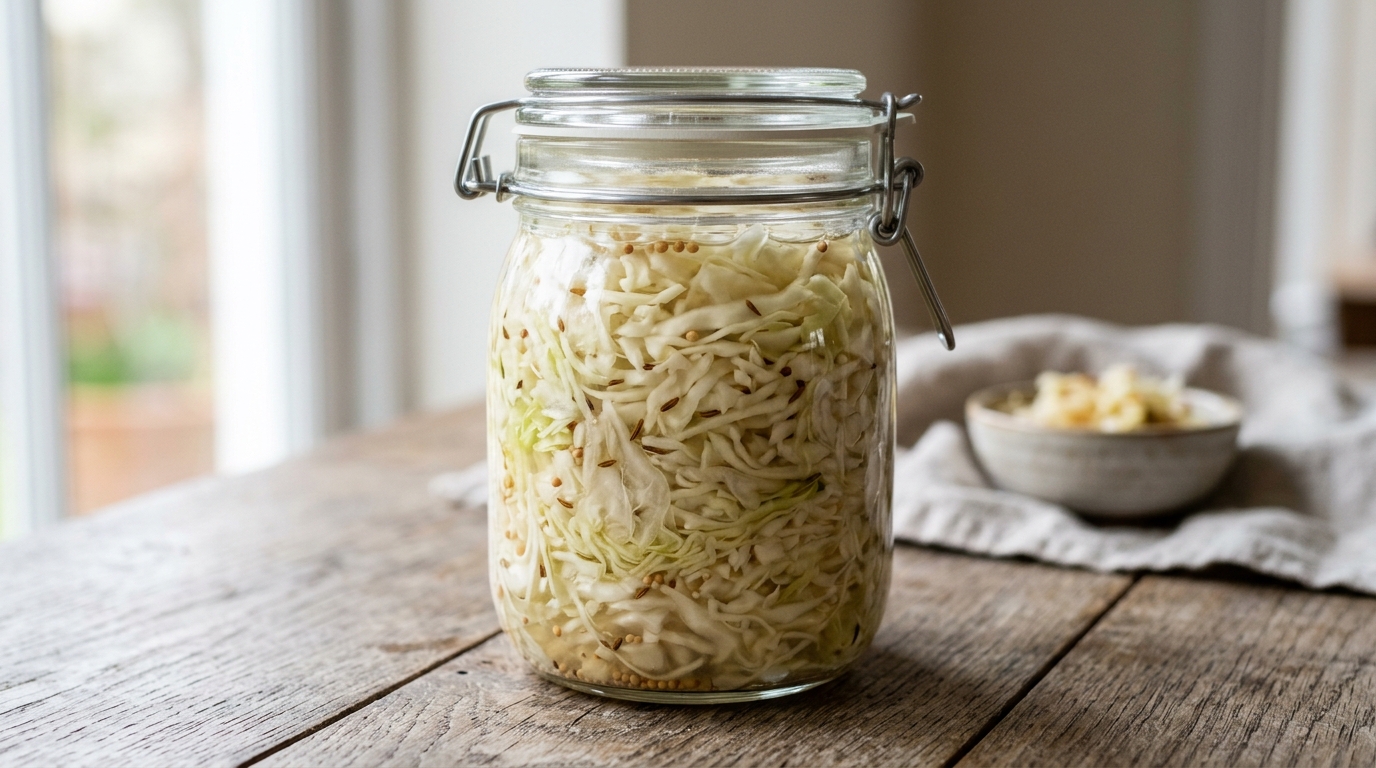
Fermented vegetable products, including Northeastern sauerkraut, represent a traditional food category highly valued for their unique organoleptic properties, nutritional composition, and organic acid profile. Despite this popularity, the commercial distribution and storage of vacuum-packed sauerkraut frequently encounter significant quality challenges, most notably the phenomenon of package swelling. This defect, characterized by the expansion of packaging film and a loss of vacuum integrity, is primarily driven by the microbial production of gases, such as carbon dioxide, within the fermented matrix. The accumulation of these gases compromises product aesthetics and consumer perception while often signaling uncontrolled microbial activity that can simultaneously degrade pH, nitrite levels, ascorbic acid, and overall textural quality. Addressing this critical storage limitation requires innovative, clean-label preservation strategies capable of suppressing gas-producing microorganisms without negatively impacting the sensory or physicochemical integrity of the final product.
These compounds, derived from natural sources, are recognized for their distinct antibacterial and antioxidant properties, yet their direct application in aqueous food systems is limited by issues such as high volatility, poor water solubility, and susceptibility to environmental degradation. By utilizing a zein-rich interior stabilized by an anionic sodium alginate coating through antisolvent self-assembly, the researchers developed a delivery system designed to improve the dispersion, stability, and controlled release of these bioactive agents. The resulting nanoparticles were structurally characterized to confirm the physical state of the encapsulated compounds and their interaction with the protein-polysaccharide carrier matrix, providing a foundation for subsequent efficacy assessments.
To establish the target microorganisms responsible for the defect, the team first isolated and identified gas-producing bacteria from commercially available, swollen-package sauerkraut samples. Following a screening process using liquid media and Durham tubes, two distinct strains were selected for further study: SK1, tentatively identified as Delftia acidovorans, and SK2, identified as Lentilactobacillus parabuchneri. Both isolates demonstrated the capability to induce package swelling when re-inoculated into sterilized sauerkraut, confirming their role as primary causative agents in the defect. Subsequent testing revealed that both strains showed measurable tolerance to the physicochemical conditions typical of sauerkraut storage, including acidic pH and elevated salt concentrations, confirming their potential for persistence throughout the manufacturing and distribution cycle.
The inhibitory potential of the co-loaded nanoparticles against these two strains was evaluated using broth microdilution assays to determine their minimum inhibitory and bactericidal concentrations. On an active-compound mass basis, the co-loaded nanoparticle formulation demonstrated superior antibacterial potency compared to the single-loaded counterparts, achieving growth inhibition at a total concentration of 4.44 micrograms per milliliter and exhibiting lower bactericidal concentrations against both isolates. These results indicate that the co-loaded delivery system requires reduced active-compound doses to exert antimicrobial effects under the tested conditions.
Mechanistic insights into this antibacterial activity were provided by a nucleic acid leakage assay, which monitored the release of intracellular UV-absorbing substances as a proxy for damage to bacterial membrane integrity. After treatment with the co-loaded nanoparticles, both strains exhibited a significant time-dependent increase in absorbance at 260 nanometers, indicating that the formulation caused substantial impairment to the bacterial cell membranes. This effect was notably greater than that observed in treatments with free cinnamaldehyde and curcumin, suggesting that the nanocarrier-mediated delivery improves the availability and sustained contact of the active compounds with bacterial cells in the aqueous environment, thereby facilitating membrane disruption.
To evaluate the real-world preservation performance, the nanoparticles were applied to sauerkraut in an accelerated storage experiment conducted at 37 degrees Celsius. Inoculation challenge tests using sterilized sauerkraut confirmed that the nanoparticle-treated samples exhibited significantly reduced gas accumulation and visual swelling compared to control samples inoculated with the same gas-producing strains. Throughout the storage period, packages treated with the nanoparticles maintained a more stable vacuum appearance, demonstrating that the formulation successfully suppresses the metabolic activity responsible for the gas-producing phenotype of the target bacteria in a complex vegetable matrix.
Monitoring of the package headspace further supported these observations, as samples treated with the nanoparticle formulation displayed substantially lower carbon dioxide accumulation and a slower decline in oxygen levels over the seven-day accelerated period. This pattern correlates with the reduced growth of total viable bacteria and specifically the presumptive gas-producing microbial populations observed in the treated sauerkraut samples. By mitigating microbial gas production, the delivery system provided a protective effect against the physical expansion of the packaging, thereby maintaining the structural and aesthetic quality of the vacuum-packed product.
Long-term quality retention was assessed over 35 days of storage, with measurements including color parameters, browning degree, and various nutritional components. Sauerkraut treated with the nanoparticles exhibited better retention of light, as evidenced by higher L-star values and a lower browning degree compared to untreated control samples and those treated only with the blank zein-alginate carrier.
The study also examined the impact of the formulation on the physicochemical and nutritional quality of the sauerkraut. Throughout the 35-day storage period, nanoparticle treatment slowed the degradation of soluble protein, ascorbic acid, and amino acid nitrogen, indicating that the preservative system successfully reduced the utilization or breakdown of these critical components. Furthermore, the nitrite levels at the end of the storage period were lower in the nanoparticle-treated group, suggesting that the application of these compounds did not promote the undesirable accumulation of nitrites, a common concern in the storage of fermented vegetable products.
Sensory quality was evaluated by a trained panel of students familiar with fermented vegetable products after seven days of accelerated storage. The panel reported significantly higher scores for color, flavor, taste, and texture in the samples treated with the co-loaded nanoparticles compared to those from the control and blank-carrier groups. These results suggest that the preservation strategy not only addresses the critical issue of package swelling but also helps maintain overall consumer acceptability and sensory freshness under accelerated conditions. However, the study authors emphasize that these sensory results reflect the assessments of a specific trained cohort and may not represent the broader population, and real-time evaluation under typical storage and distribution settings remains necessary to determine final shelf-life performance.
In conclusion, the study successfully developed a Zein-Sodium Alginate delivery system for the co-encapsulation of cinnamaldehyde and curcumin, providing a novel approach to managing gas-related quality defects in vacuum-packed fermented vegetables. While these results provide clear evidence for the potential efficacy of ZS@CIN-CUR nanoparticles in reducing microbial-induced deterioration, the researchers conclude that further investigation and real-time shelf-life testing are required to establish the full commercial viability and large-scale applicability of this preservation technology in the fermented vegetable industry.
Optimization and formulation parameters formed a key focus during delivery system design. By systematically varying the carrier proportions, the authors determined that a zein to sodium alginate mass ratio of 1:5 yielded optimal colloidal stability, with the anionic polysaccharide contributing strong electrostatic repulsion and reducing particle size. Using initial feed concentrations of 400 micrograms per milliliter for both cinnamaldehyde and curcumin, the resulting co-loaded nanoparticles attained an average hydrodynamic diameter of 161.7 nanometers, a polydispersity index of 0.158, and a negative surface charge of minus 38.54 millivolts. Quantification through high-performance liquid chromatography confirmed loading contents of 8.88 percent for cinnamaldehyde and 12.79 percent for curcumin. In the preservation trials, this formulation was administered at an application dose of 0.03 grams per kilogram of sauerkraut, delivering 2.66 milligrams of cinnamaldehyde and 3.84 milligrams of curcumin per kilogram of food matrix.
The release characteristics of the entrapped bioactives were subsequently evaluated in filtered sauerkraut juice maintained at 37 degrees Celsius across a 168-hour monitoring period. Both compounds displayed a time-dependent apparent recovery curve, characterized by an initial rapid rise followed by progressive leveling off. Supernatant recovery reached 82.65 percent for cinnamaldehyde and 60.86 percent for curcumin at the conclusion of the test, with the comparatively lower recovery of curcumin indicating stronger retention within the zein core. Kinetic modeling showed that the empirical Weibull function provided the most accurate description of compound release, yielding determination coefficients of 0.9992 for cinnamaldehyde and 0.9987 for curcumin alongside root mean square errors of 0.727. In parallel antioxidant testing, the combined formulation exhibited dose-dependent radical-scavenging activity, reaching 81.87 percent in the ABTS assay and 81.73 percent in the DPPH assay at a concentration of 50 micrograms per milliliter.
Subject of Research: Preservation of fermented sauerkraut using co-loaded antimicrobial bioactive nanoparticles.
Article Title: Cinnamaldehyde/curcumin co-loaded zein/sodium alginate nanoparticles: Sustained release, antibacterial activity, and control of package swelling in fermented sauerkraut
Article References: Tang, P., Kang, Y., Wang, W., & Chen, P. (2026). Cinnamaldehyde/curcumin co-loaded zein/sodium alginate nanoparticles: Sustained release, antibacterial activity, and control of package swelling in fermented sauerkraut. Food Chemistry: X, 40, Article 104794. https://doi.org/10.1016/j.fochx.2026.104794
Image Credits: AI Generated
DOI: 10.1016/j.fochx.2026.104794
Keywords: Sauerkraut, Fermented Vegetables, Food Preservation, Nanotechnology, Zein, Sodium Alginate, Cinnamaldehyde, Curcumin, Antimicrobial Agents, Package Swelling, Microbial Gas Production, Food Stability, Controlled Release, Shelf-life, Food Science, Delftia acidovorans, Lentilactobacillus parabuchneri, Food Quality, Antioxidant Activity, Packaging Technology
News Source: Bethany Barker. (November 18, 2026). Nanoparticle Formulation Reduces Gas-Induced Package Swelling in Fermented Sauerkraut. Scienmag.