• HOME
  • NEWS
  • EXPLORE
    • CAREER
      • Companies
      • Jobs
    • EVENTS
    • iGEM
      • News
      • Team
    • PHOTOS
    • VIDEO
    • WIKI
  • BLOG
  • COMMUNITY
    • FACEBOOK
    • INSTAGRAM
    • TWITTER
Thursday, March 26, 2026
BIOENGINEER.ORG
No Result
View All Result
  • Login
  • HOME
  • NEWS
  • EXPLORE
    • CAREER
      • Companies
      • Jobs
        • Lecturer
        • PhD Studentship
        • Postdoc
        • Research Assistant
    • EVENTS
    • iGEM
      • News
      • Team
    • PHOTOS
    • VIDEO
    • WIKI
  • BLOG
  • COMMUNITY
    • FACEBOOK
    • INSTAGRAM
    • TWITTER
  • HOME
  • NEWS
  • EXPLORE
    • CAREER
      • Companies
      • Jobs
        • Lecturer
        • PhD Studentship
        • Postdoc
        • Research Assistant
    • EVENTS
    • iGEM
      • News
      • Team
    • PHOTOS
    • VIDEO
    • WIKI
  • BLOG
  • COMMUNITY
    • FACEBOOK
    • INSTAGRAM
    • TWITTER
No Result
View All Result
Bioengineer.org
No Result
View All Result
Home NEWS Science News Chemistry

Nanoparticle chomps away plaques that cause heart attacks

Bioengineer by Bioengineer
January 27, 2020
in Chemistry
Reading Time: 2 mins read
0
IMAGE
Share on FacebookShare on TwitterShare on LinkedinShare on RedditShare on Telegram

IMAGE

Credit: Bryan Smith, Michigan State University


Michigan State University and Stanford University scientists have invented a nanoparticle that eats away – from the inside out – portions of plaques that cause heart attacks.

Bryan Smith, associate professor of biomedical engineering at MSU, and a team of scientists created a “Trojan Horse” nanoparticle that can be directed to eat debris, reducing and stabilizing plaque. The discovery could be a potential treatment for atherosclerosis, a leading cause of death in the United States.

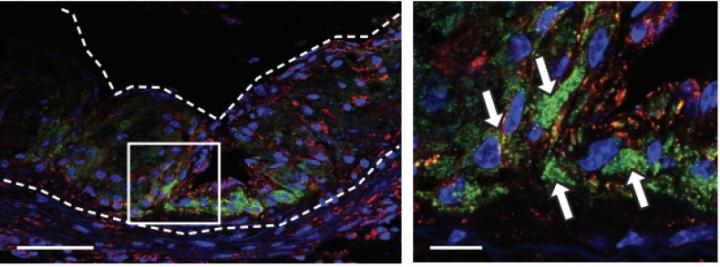
The results, published in the current issue of Nature Nanotechnology, showcases the nanoparticle that homes in on atherosclerotic plaque due to its high selectivity to a particular immune cell type – monocytes and macrophages. Once inside the macrophages in those plaques, it delivers a drug agent that stimulates the cell to engulf and eat cellular debris. Basically, it removes the diseased/dead cells in the plaque core. By reinvigorating the macrophages, plaque size is reduced and stabilized.

Smith said that future clinical trials on the nanoparticle are expected to reduce the risk of most types of heart attacks, with minimal side effects due to the unprecedented selectivity of the nanodrug.

Smith’s studies focus on intercepting the signaling of the receptors in the macrophages and sending a message via small molecules using nano-immunotherapeutic platforms. Previous studies have acted on the surface of the cells, but this new approach works intracellularly and has been effective in stimulating macrophages.

“We found we could stimulate the macrophages to selectively eat dead and dying cells – these inflammatory cells are precursor cells to atherosclerosis – that are part of the cause of heart attacks,” Smith said. “We could deliver a small molecule inside the macrophages to tell them to begin eating again.”

This approach also has applications beyond atherosclerosis, he added.

“We were able to marry a groundbreaking finding in atherosclerosis by our collaborators with the state-of-the-art selectivity and delivery capabilities of our advanced nanomaterial platform. We demonstrated the nanomaterials were able to selectively seek out and deliver a message to the very cells needed,” Smith said. “It gives a particular energy to our future work, which will include clinical translation of these nanomaterials using large animal models and human tissue tests. We believe it is better than previous methods.”

Smith has filed a provisional patent and will begin marketing it later this year.

Note for media: Please include a link to the original paper in online coverage: https://www.nature.com/articles/s41565-019-0619-3

###

Media Contact
Layne Cameron
[email protected]
517-353-8819

Original Source

https://msutoday.msu.edu/news/2020/nanoparticle-chomps-away-plaques-that-cause-heart-attacks/

Tags: Biomechanics/BiophysicsCardiologyEntomologyMedicine/HealthMolecular BiologyParasitology
Share12Tweet8Share2ShareShareShare2

Related Posts

Isolated H2-Reduced Clusters Boost CO2-to-Methanol Catalysis

Isolated H2-Reduced Clusters Boost CO2-to-Methanol Catalysis

March 25, 2026
blank

Physicists Identify Electronic Drivers Behind Flat Band Quantum Materials

March 21, 2026

Würzburg Chemistry Professor Claudia Höbartner Receives Prestigious Honor

March 20, 2026

Scientists Reveal How Magnets Control Metamaterial Behavior

March 20, 2026
Please login to join discussion

POPULAR NEWS

  • blank

    Revolutionary AI Model Enhances Precision in Detecting Food Contamination

    96 shares
    Share 38 Tweet 24
  • Imagine a Social Media Feed That Challenges Your Views Instead of Reinforcing Them

    1003 shares
    Share 397 Tweet 248
  • Uncovering Functions of Cavernous Malformation Proteins in Organoids

    54 shares
    Share 22 Tweet 14
  • Promising Outcomes from First Clinical Trials of Gene Regulation in Epilepsy

    51 shares
    Share 20 Tweet 13

About

We bring you the latest biotechnology news from best research centers and universities around the world. Check our website.

Follow us

Recent News

In-Sensor Cryptography Links Physical Process to Digital Identity

Can Psychosocial Factors Influence Cancer Risk?

Depression Factors in Elderly: Pre vs. Post-COVID Analysis

Subscribe to Blog via Email

Enter your email address to subscribe to this blog and receive notifications of new posts by email.

Join 78 other subscribers
  • Contact Us

Bioengineer.org © Copyright 2023 All Rights Reserved.

Welcome Back!

Login to your account below

Forgotten Password?

Retrieve your password

Please enter your username or email address to reset your password.

Log In
No Result
View All Result
  • Homepages
    • Home Page 1
    • Home Page 2
  • News
  • National
  • Business
  • Health
  • Lifestyle
  • Science

Bioengineer.org © Copyright 2023 All Rights Reserved.