• HOME
  • NEWS
  • EXPLORE
    • CAREER
      • Companies
      • Jobs
    • EVENTS
    • iGEM
      • News
      • Team
    • PHOTOS
    • VIDEO
    • WIKI
  • BLOG
  • COMMUNITY
    • FACEBOOK
    • INSTAGRAM
    • TWITTER
Thursday, May 21, 2026
BIOENGINEER.ORG
No Result
View All Result
  • Login
  • HOME
  • NEWS
  • EXPLORE
    • CAREER
      • Companies
      • Jobs
        • Lecturer
        • PhD Studentship
        • Postdoc
        • Research Assistant
    • EVENTS
    • iGEM
      • News
      • Team
    • PHOTOS
    • VIDEO
    • WIKI
  • BLOG
  • COMMUNITY
    • FACEBOOK
    • INSTAGRAM
    • TWITTER
  • HOME
  • NEWS
  • EXPLORE
    • CAREER
      • Companies
      • Jobs
        • Lecturer
        • PhD Studentship
        • Postdoc
        • Research Assistant
    • EVENTS
    • iGEM
      • News
      • Team
    • PHOTOS
    • VIDEO
    • WIKI
  • BLOG
  • COMMUNITY
    • FACEBOOK
    • INSTAGRAM
    • TWITTER
No Result
View All Result
Bioengineer.org
No Result
View All Result
Home NEWS Science News Chemistry

Nanomicrocell catalysts: A new kind of highly efficient integrated catalyst system

Bioengineer by Bioengineer
April 29, 2019
in Chemistry
Reading Time: 3 mins read
0
IMAGE
Share on FacebookShare on TwitterShare on LinkedinShare on RedditShare on Telegram

IMAGE

Credit: ©Science China Press

Chemical reactions are involving directional migration of electrons and charged intermediates, depending on the redox potentials of different reactive sites. The chemical energy can be converted into electrical energy when the chemical reactions are occurred in fuel cell devices. However, restricted by the high energy barriers of chemical reactions, numerous chemical reactions have to be performed under harsh conditions or in the presence catalysts by changing the reaction paths, even though the Gibbs free energy is much less than zero. Recently, a new kind of integrated catalyst system, denoted as nanomicrocell catalysts, was developed, which opened a new window for development of highly efficient catalysts by markedly reducing the energy barriers of chemical reactions.

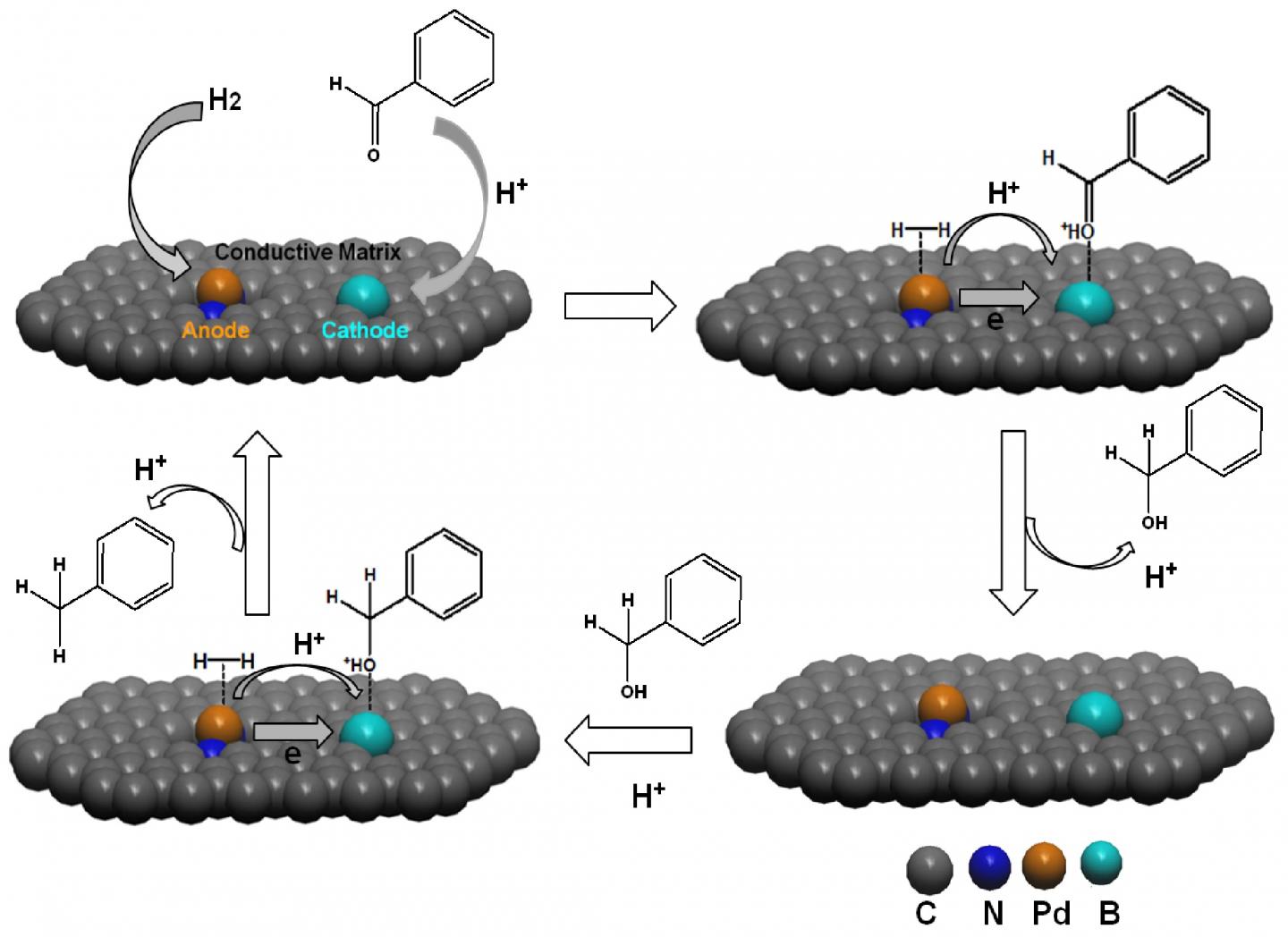
This work was reported in Science Bulletin (2019, 64, 385-390), entitled “Reducing energy barriers of chemical reactions with a nanomicrocell catalyst consisting of integrated active sites in conductive matrices” by Chuan-De Wu et al. from Zhejiang University. Inspired by the natural phenomena, such as steel corrosion, the authors proposed a new kind of integrated catalyst system, denoted as nanomicrocell catalysts, consisting of different redox-active sites with different oxidation-reduction potentials and catalytic properties immobilized on conductive matrices. Similar to traditional fuel cells, the nanomicrocell catalyst system integrates paired anodes and cathodes that are connected by nanosized conductive matrices, which could significantly improve the catalytic efficiency in chemical reactions.

The authors prepared a nanomicrocell catalyst, consisting of boron-and-nitrogen co-doped carbon nanodots (denoted as BNCDs) and immobilized Pd species by coordinating with N atoms, to study the catalytic properties of the proof-of-concept catalyst system. In the nanomicrocell catalyst, BNCDs were used as conductive matrices, immobilized Pd species on N sites as anode and electron-deficient B atoms as cathode. The authors selected catalytic hydrogenation of benzaldehyde as a model reaction to study the roles of different constituent elements in the catalyst system on the catalytic properties. Detailed experimental results showed that the catalytic properties of the nanomicrocell catalyst in hydrogenation of benzaldehyde are highly depending on the selective adsorption and catalytic activation of different reactants by different redox-active electrodes, and transportation efficiency of electrons and charge carriers.

According to the results obtained in this work, the nanomicrocell catalyst system provides a new perspective to illustrate many difficultly understood phenomena in catalytic reactions, and opens up a new window for the designed synthesis of advanced catalysts to improve the catalytic properties by markedly reducing chemical reaction energy barriers. The nanomicrocell catalyst system also provides new way for development of inhibitory catalysts to decelerate chemical reactions in corrosion protection field, and preparation of efficient electrocatalysts and photocatalysts.

###

This work was supported by the National Nature Science Foundation of China (21373180, 21525312 and 21872122).

See the article:

Guo-Peng Zhan, Chuan-De Wu. Reducing energy barriers of chemical reactions with a nanomicrocell catalyst consisting of integrated active sites in conductive matrices. Science Bulletin, 2019, 64(6): 385-390

https://doi.org/10.1016/j.scib.2019.02.004

Media Contact
WU Chuan-De
[email protected]

Related Journal Article

http://dx.doi.org/10.1016/j.scib.2019.02.004

Tags: Chemistry/Physics/Materials Sciences
Share12Tweet8Share2ShareShareShare2

Related Posts

Scientists Achieve Breakthrough in Molecular ‘Sandwich’ Assembly — Chemistry

Scientists Achieve Breakthrough in Molecular ‘Sandwich’ Assembly

May 21, 2026
Advancing In Vivo and In Situ Monitoring: Science Bulletin Highlights Host-Based Antifouling Gold Nanotube Sensor for Selective Detection of Mechanically Sensitive Serotonin Release in Intestinal Mucosa — Chemistry

Advancing In Vivo and In Situ Monitoring: Science Bulletin Highlights Host-Based Antifouling Gold Nanotube Sensor for Selective Detection of Mechanically Sensitive Serotonin Release in Intestinal Mucosa

May 20, 2026

How Magnetic Orientation Could Influence the Building Blocks of Life

May 20, 2026

Breaking a 200-Year-Old Belief: Novel Surface Design Achieves Two Distinct Wetting States on One Substrate

May 20, 2026
Please login to join discussion

POPULAR NEWS

  • blank

    New Study Reveals Plants Can Detect the Sound of Rain

    733 shares
    Share 292 Tweet 183
  • ESMO 2025: mRNA COVID Vaccines Enhance Efficacy of Cancer Immunotherapy

    304 shares
    Share 122 Tweet 76
  • Research Indicates Potential Connection Between Prenatal Medication Exposure and Elevated Autism Risk

    846 shares
    Share 338 Tweet 212
  • Breastmilk Balances E. coli and Beneficial Bacteria in Infant Gut Microbiomes

    58 shares
    Share 23 Tweet 15

About

We bring you the latest biotechnology news from best research centers and universities around the world. Check our website.

Follow us

Recent News

Innovative Reusable Brick Walls Revolutionize Construction Industry

Nonlinear Atomic Tunneling Enhanced by Bright Squeezed Vacuum

Label-Free Super-Resolution Imaging of Live Cells

Subscribe to Blog via Email

Enter your email address to subscribe to this blog and receive notifications of new posts by email.

Join 82 other subscribers
  • Contact Us

Bioengineer.org © Copyright 2023 All Rights Reserved.

Welcome Back!

Login to your account below

Forgotten Password?

Retrieve your password

Please enter your username or email address to reset your password.

Log In
No Result
View All Result
  • Homepages
    • Home Page 1
    • Home Page 2
  • News
  • National
  • Business
  • Health
  • Lifestyle
  • Science

Bioengineer.org © Copyright 2023 All Rights Reserved.