• HOME
  • NEWS
  • EXPLORE
    • CAREER
      • Companies
      • Jobs
    • EVENTS
    • iGEM
      • News
      • Team
    • PHOTOS
    • VIDEO
    • WIKI
  • BLOG
  • COMMUNITY
    • FACEBOOK
    • INSTAGRAM
    • TWITTER
Sunday, May 10, 2026
BIOENGINEER.ORG
No Result
View All Result
  • Login
  • HOME
  • NEWS
  • EXPLORE
    • CAREER
      • Companies
      • Jobs
        • Lecturer
        • PhD Studentship
        • Postdoc
        • Research Assistant
    • EVENTS
    • iGEM
      • News
      • Team
    • PHOTOS
    • VIDEO
    • WIKI
  • BLOG
  • COMMUNITY
    • FACEBOOK
    • INSTAGRAM
    • TWITTER
  • HOME
  • NEWS
  • EXPLORE
    • CAREER
      • Companies
      • Jobs
        • Lecturer
        • PhD Studentship
        • Postdoc
        • Research Assistant
    • EVENTS
    • iGEM
      • News
      • Team
    • PHOTOS
    • VIDEO
    • WIKI
  • BLOG
  • COMMUNITY
    • FACEBOOK
    • INSTAGRAM
    • TWITTER
No Result
View All Result
Bioengineer.org
No Result
View All Result
Home NEWS Science News Chemistry

Nano-scale borate bioactive glass: Next generation material for skin-healing

Bioengineer by Bioengineer
July 6, 2021
in Chemistry
Reading Time: 3 mins read
0
IMAGE
Share on FacebookShare on TwitterShare on LinkedinShare on RedditShare on Telegram

IMAGE

Credit: MA Kun

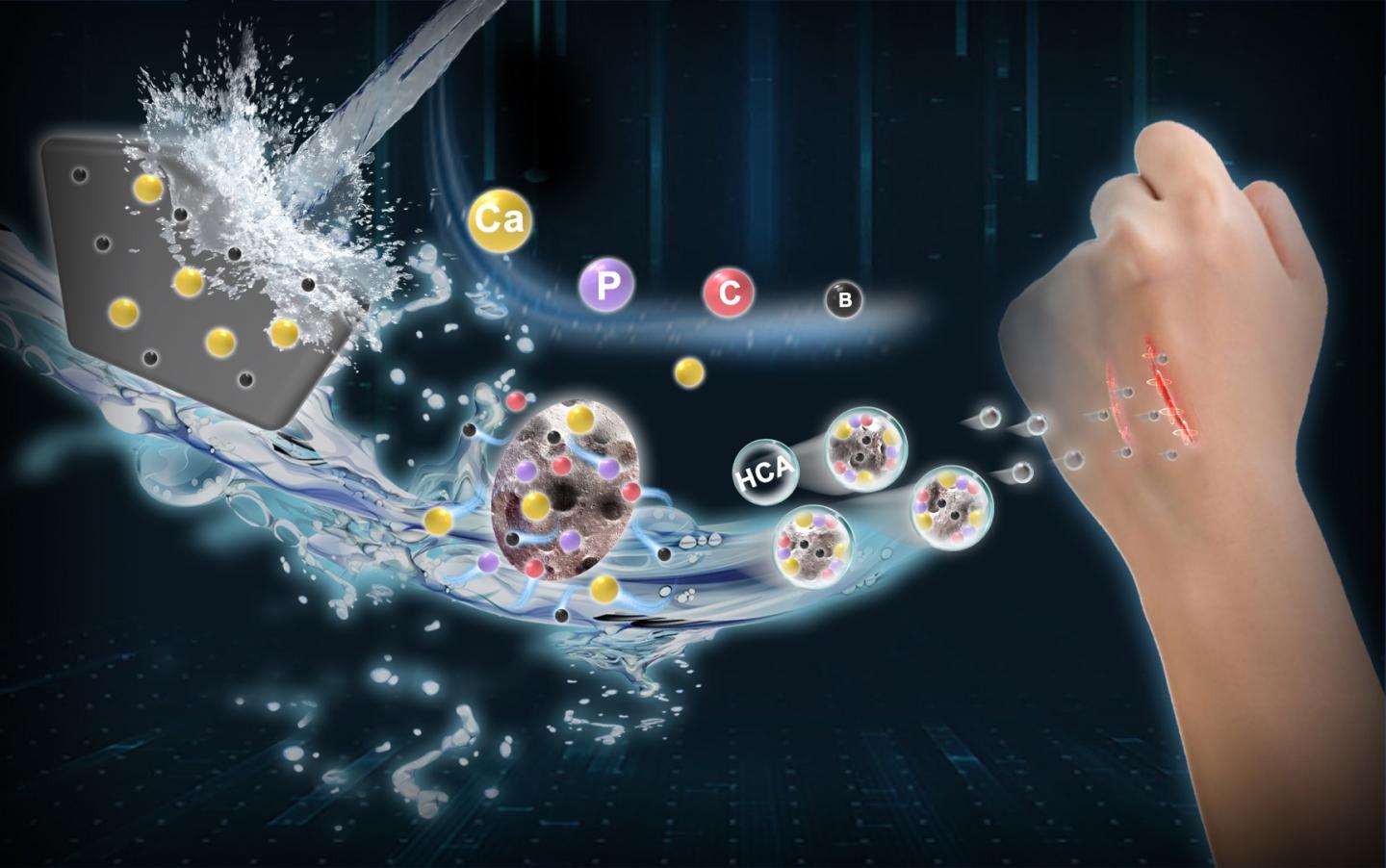
Recently, with the help of a steady-state strong magnetic field experimental device, scientists constructed nano-scale borate bioactive glass (Nano-HCA@BG), which can effectively reduce the biological toxicity of borate bioglass, improve the biocompatibility of the glass, and promote the effect of borate bioglass on skin repair.

Prof. WANG Junfeng from the Hefei Institutes of Physical Science (HFIPS) of the Chinese Academy of Sciences (CAS), collaborating with Prof. ZHANG Teng from Fuzhou University in this study, said, “it is expected to become the next generation of skin wound repair dressings.” Related research was published in Chemical Engineering Journal.

Borate bioglass is a glass with boron element (B) as the glass network matrix. With good dopability and degradability, it has great potential in the field of skin tissue repair. However, It releases a large amount of alkaline ions, and the explosive release of these ions will change the acid-base environment of the tissue around the glass material, thereby inhibiting cell proliferation.

In addition, the effective surface area of micron-sized borate bioglass in contact with tissues at the wound is small, and the ions on the glass surface are not conducive to the deposition of collagen, so scars are easily formed at the wound after healing. Therefore, preparing a nano-scale borate bioglass with no biological toxicity and excellent biological performance is an urgent problem to be solved.

In this study, the researchers used a special mobile phase, for the first time, to pre-treat micron-sized borate bioglass by melting method in vitro. They obtained Nano-scale (~50nm) borate bioglass (Nano-HCA@BG), which was covered with an amorphous hydroxyapatite (HCA) layer.

During the processing, the ions (PO43- and CO32-) in the mobile phase were deposited on the surface of the glass to form the HCA layer, which effectively inhibited the rapid release of boron and calcium in the remaining glass and thereby reduced the biological toxicity of the glass itself to cells.

In addition, HCA, as an important inorganic component in bones, has good biocompatibility, and can accelerate the induction of collagen synthesis in tissues.

The results of in vitro degradation experiments, cell experiments, and animal experiments showed that compared with the existing commercialized bioactive glass, HCA and micron-sized borate bioglass, nano-HCA@BG slow-released boron calcium, and other elements can effectively accelerate wound cells migration and further up-regulation of the expression of vascular-related growth factors in the wound.

Besides, the amorphous HCA layer on the surface of the glass not only reduces the rapid release of the glass, but also promotes the deposition of collagen in the wound, which in turn promotes the healing of the wound more quickly.

###

This research was supported by the National Natural Science Foundation of China and a major project of the Ministry of Science and Technology.

Media Contact
ZHAO Weiwei
[email protected]

Original Source

http://english.hf.cas.cn/new/news/rn/202107/t20210705_273679.html

Related Journal Article

http://dx.doi.org/10.1016/j.cej.2021.130299

Tags: Biomechanics/BiophysicsChemistry/Physics/Materials SciencesMedicine/Health
Share12Tweet8Share2ShareShareShare2

Related Posts

Miniature Sensor Uses Light to Detect Touch — Chemistry

Miniature Sensor Uses Light to Detect Touch

May 8, 2026
Iron Minerals Determine Whether Dissolved Organic Matter Fuels Microbes or Becomes Long-Term Carbon Storage — Chemistry

Iron Minerals Determine Whether Dissolved Organic Matter Fuels Microbes or Becomes Long-Term Carbon Storage

May 8, 2026

Kate Evans Appointed Associate Lab Director for Biological and Environmental Systems Science at ORNL

May 8, 2026

Advancing Multiscale Modeling and Overcoming Operational Challenges in Autothermal COâ‚‚-to-Methanol Reactors

May 8, 2026
Please login to join discussion

POPULAR NEWS

  • Research Indicates Potential Connection Between Prenatal Medication Exposure and Elevated Autism Risk

    840 shares
    Share 336 Tweet 210
  • New Study Reveals Plants Can Detect the Sound of Rain

    727 shares
    Share 290 Tweet 181
  • Scientists Investigate Possible Connection Between COVID-19 and Increased Lung Cancer Risk

    68 shares
    Share 27 Tweet 17
  • Salmonella Haem Blocks Macrophages, Boosts Infection

    61 shares
    Share 24 Tweet 15

About

We bring you the latest biotechnology news from best research centers and universities around the world. Check our website.

Follow us

Recent News

Urdu Fall Risk Questionnaire Adapted for Elderly

Key Pharmacological Markers for HIV Prevention in MSM

Taking 8,500 Steps Daily May Aid Long-Term Weight Management, Study Finds

Subscribe to Blog via Email

Enter your email address to subscribe to this blog and receive notifications of new posts by email.

Join 82 other subscribers
  • Contact Us

Bioengineer.org © Copyright 2023 All Rights Reserved.

Welcome Back!

Login to your account below

Forgotten Password?

Retrieve your password

Please enter your username or email address to reset your password.

Log In
No Result
View All Result
  • Homepages
    • Home Page 1
    • Home Page 2
  • News
  • National
  • Business
  • Health
  • Lifestyle
  • Science

Bioengineer.org © Copyright 2023 All Rights Reserved.