• HOME
  • NEWS
  • EXPLORE
    • CAREER
      • Companies
      • Jobs
    • EVENTS
    • iGEM
      • News
      • Team
    • PHOTOS
    • VIDEO
    • WIKI
  • BLOG
  • COMMUNITY
    • FACEBOOK
    • INSTAGRAM
    • TWITTER
Sunday, May 10, 2026
BIOENGINEER.ORG
No Result
View All Result
  • Login
  • HOME
  • NEWS
  • EXPLORE
    • CAREER
      • Companies
      • Jobs
        • Lecturer
        • PhD Studentship
        • Postdoc
        • Research Assistant
    • EVENTS
    • iGEM
      • News
      • Team
    • PHOTOS
    • VIDEO
    • WIKI
  • BLOG
  • COMMUNITY
    • FACEBOOK
    • INSTAGRAM
    • TWITTER
  • HOME
  • NEWS
  • EXPLORE
    • CAREER
      • Companies
      • Jobs
        • Lecturer
        • PhD Studentship
        • Postdoc
        • Research Assistant
    • EVENTS
    • iGEM
      • News
      • Team
    • PHOTOS
    • VIDEO
    • WIKI
  • BLOG
  • COMMUNITY
    • FACEBOOK
    • INSTAGRAM
    • TWITTER
No Result
View All Result
Bioengineer.org
No Result
View All Result
Home NEWS Science News Biology

Naked prehistoric monsters! Evidence that prehistoric flying reptiles probably had

Bioengineer by Bioengineer
September 28, 2020
in Biology
Reading Time: 3 mins read
0
IMAGE
Share on FacebookShare on TwitterShare on LinkedinShare on RedditShare on Telegram

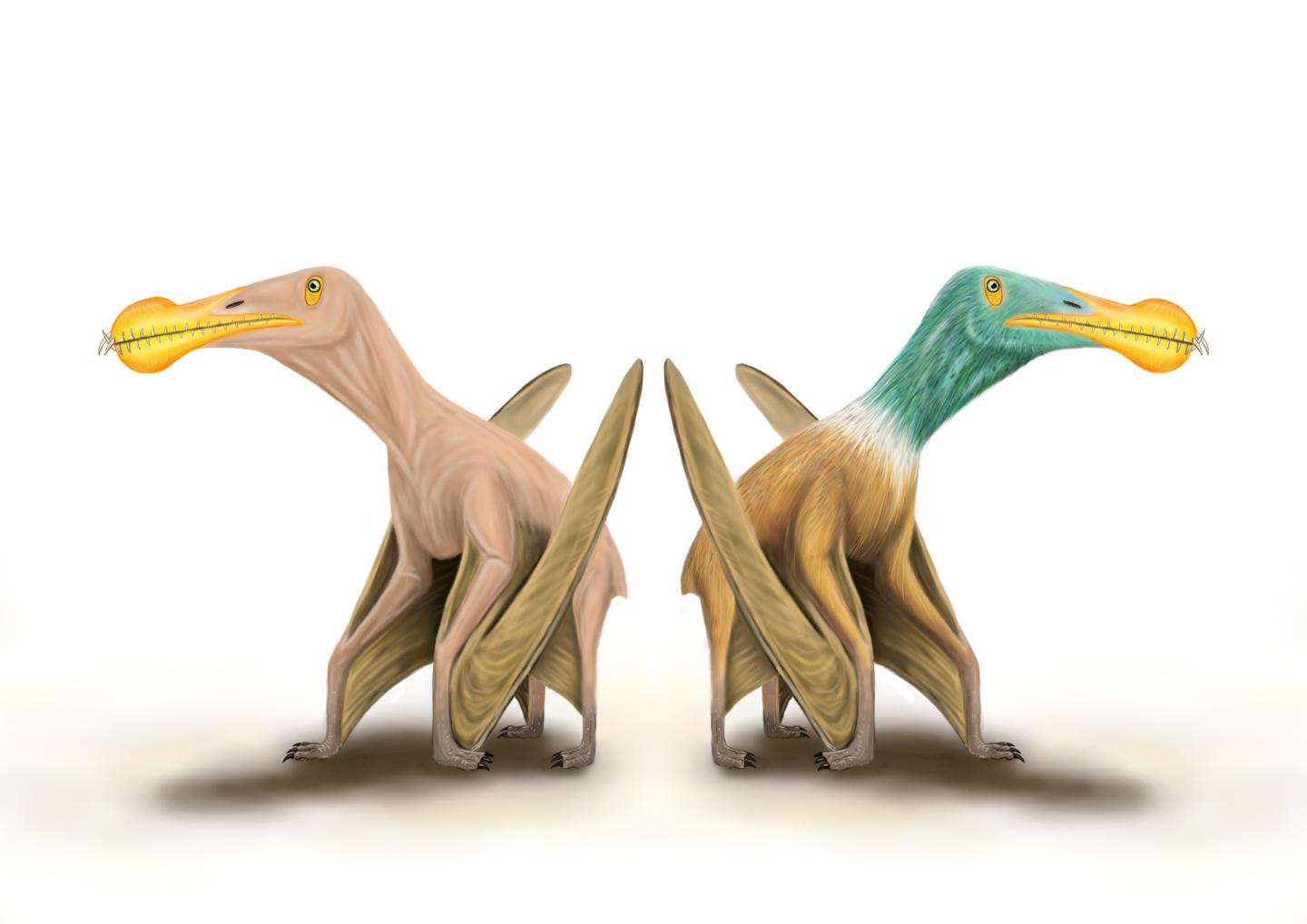
The debate about when dinosaurs developed feathers has taken a new turn with a paper refuting earlier claims that feathers were also found on dinosaurs’ relatives, the flying reptiles called pterosaurs
IMAGE

Credit: Megan Jacobs, University of Portsmouth.

The debate about when dinosaurs developed feathers has taken a new turn with a paper refuting earlier claims that feathers were also found on dinosaurs’ relatives, the flying reptiles called pterosaurs.

Pterosaur expert Dr David Unwin from the University of Leicester’s Centre for Palaeobiology Research, and Professor Dave Martill, of the University of Portsmouth have examined the evidence that these creatures had feathers and believe they were in fact bald

They have responded to a suggestion by a group of his colleagues led by Zixiao Yang that some pterosaur fossils show evidence of feather-like branching filaments, ‘protofeathers’, on the animal’s skin.

Dr Yang, from Nanjing University, and colleagues presented their argument in a 2018 paper in the journal Nature Ecology and Evolution. Now Unwin and Martill, have offered an alternative, non-feather explanation for the fossil evidence in the same journal.

While this may seem like academic minutiae, it actually has huge palaeontological implications. Feathered pterosaurs would mean that the very earliest feathers first appeared on an ancestor shared by both pterosaurs and dinosaurs, since it is unlikely that something so complex developed separately in two different groups of animals.

This would mean that the very first feather-like elements evolved at least 80 million years earlier than currently thought. It would also suggest that all dinosaurs started out with feathers, or protofeathers but some groups, such as sauropods, subsequently lost them again – the complete opposite of currently accepted theory.

The evidence rests on tiny, hair-like filaments, less than one tenth of a millimetre in diameter, which have been identified in about 30 pterosaur fossils. Among these, Yang and colleagues were only able to find just three specimens on which these filaments seem to exhibit a ‘branching structure’ typical of protofeathers.

Unwin and Martill propose that these are not protofeathers at all but tough fibres which form part of the internal structure of the pterosaur’s wing membrane, and that the ‘branching’ effect may simply be the result of these fibres decaying and unravelling.

Dr Unwin said: “The idea of feathered pterosaurs goes back to the nineteenth century but the fossil evidence was then, and still is, very weak. Exceptional claims require exceptional evidence – we have the former, but not the latter.”

Professor Martill noted that either way, palaeontologists will have to carefully reappraise ideas about the ecology of these ancient flying reptiles. He said, “If they really did have feathers, how did that make them look, and did they exhibit the same fantastic variety of colours exhibited by birds. And if they didn’t have feathers, then how did they keep warm at night, what limits did this have on their geographic range, did they stay away from colder northern climes as most reptiles do today. And how did they thermoregulate? The clues are so cryptic, that we are still a long way from working out just how these amazing animals worked.

###

The paper ‘No protofeathers on pterosaurs’ is published this week in Nature Ecology and Evolution.

Media Contact
Emma Gaisford
[email protected]

Related Journal Article

http://dx.doi.org/10.1038/s41559-020-01308-9

Tags: ArchaeologyEvolutionOld WorldPaleontology
Share13Tweet8Share2ShareShareShare2

Related Posts

Ancient Plant Populations Reveal Fresh Insights into Climate Resilience — Biology

Ancient Plant Populations Reveal Fresh Insights into Climate Resilience

May 8, 2026
Rare Brain Disorders in Children Linked to Mutations in Lesser-Known Protein Complex — Biology

Rare Brain Disorders in Children Linked to Mutations in Lesser-Known Protein Complex

May 8, 2026

From Odd Insect to Underwater Predator: The Remarkable Evolution of a Bloodthirsty Fruit Fly

May 8, 2026

SNU Professor Sangwoo Seo’s Team Develops Next-Generation CRISPR Biocontainment Technology to Control Microbial Survival Without DNA Cleavage

May 8, 2026
Please login to join discussion

POPULAR NEWS

  • Research Indicates Potential Connection Between Prenatal Medication Exposure and Elevated Autism Risk

    840 shares
    Share 336 Tweet 210
  • New Study Reveals Plants Can Detect the Sound of Rain

    727 shares
    Share 290 Tweet 181
  • Scientists Investigate Possible Connection Between COVID-19 and Increased Lung Cancer Risk

    68 shares
    Share 27 Tweet 17
  • Salmonella Haem Blocks Macrophages, Boosts Infection

    61 shares
    Share 24 Tweet 15

About

We bring you the latest biotechnology news from best research centers and universities around the world. Check our website.

Follow us

Recent News

Evaluating Digoxin Use in Patients with Symptomatic Rheumatic Heart Disease

Evaluating the Effectiveness and Safety of Digitalis Glycosides in Treating Heart Failure

Urdu Fall Risk Questionnaire Adapted for Elderly

Subscribe to Blog via Email

Enter your email address to subscribe to this blog and receive notifications of new posts by email.

Join 82 other subscribers
  • Contact Us

Bioengineer.org © Copyright 2023 All Rights Reserved.

Welcome Back!

Login to your account below

Forgotten Password?

Retrieve your password

Please enter your username or email address to reset your password.

Log In
No Result
View All Result
  • Homepages
    • Home Page 1
    • Home Page 2
  • News
  • National
  • Business
  • Health
  • Lifestyle
  • Science

Bioengineer.org © Copyright 2023 All Rights Reserved.