• HOME
  • NEWS
  • EXPLORE
    • CAREER
      • Companies
      • Jobs
    • EVENTS
    • iGEM
      • News
      • Team
    • PHOTOS
    • VIDEO
    • WIKI
  • BLOG
  • COMMUNITY
    • FACEBOOK
    • INSTAGRAM
    • TWITTER
Thursday, August 20, 2026
BIOENGINEER.ORG
No Result
View All Result
  • Login
  • HOME
  • NEWS
  • EXPLORE
    • CAREER
      • Companies
      • Jobs
        • Lecturer
        • PhD Studentship
        • Postdoc
        • Research Assistant
    • EVENTS
    • iGEM
      • News
      • Team
    • PHOTOS
    • VIDEO
    • WIKI
  • BLOG
  • COMMUNITY
    • FACEBOOK
    • INSTAGRAM
    • TWITTER
  • HOME
  • NEWS
  • EXPLORE
    • CAREER
      • Companies
      • Jobs
        • Lecturer
        • PhD Studentship
        • Postdoc
        • Research Assistant
    • EVENTS
    • iGEM
      • News
      • Team
    • PHOTOS
    • VIDEO
    • WIKI
  • BLOG
  • COMMUNITY
    • FACEBOOK
    • INSTAGRAM
    • TWITTER
No Result
View All Result
Bioengineer.org
No Result
View All Result
Home NEWS Science News Biology

Nagoya University scientists reveal unprecedentedly versatile new DNA staining probe

Bioengineer by Bioengineer
May 14, 2021
in Biology
Reading Time: 2 mins read
0
IMAGE
Share on FacebookShare on TwitterShare on LinkedinShare on RedditShare on Telegram

New dye breaks new ground in versatility and capability, with applications in super high-resolution imaging and beyond
IMAGE

Credit: Yoshikatsu Sato

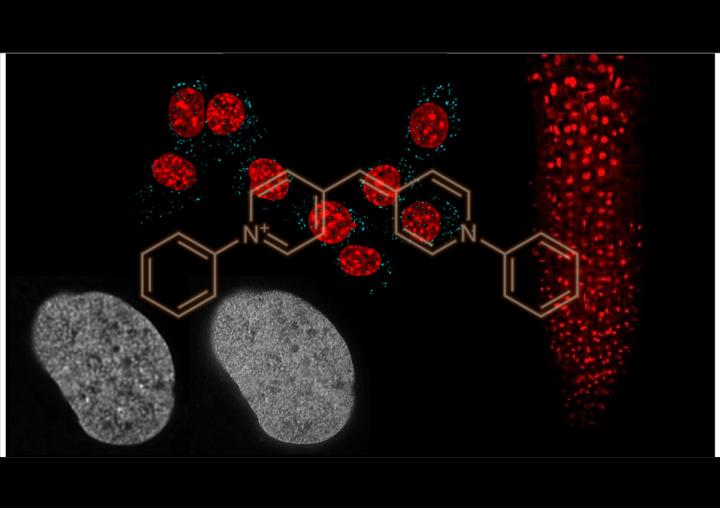
A group of scientists at Nagoya University, Japan, have developed an incredibly versatile DNA fluorescent dye, named ‘Kakshine’ after a former NU student of its members, Dr Kakishi Uno, but it also means to make the nucleus shine brightly, since the nucleus is pronounced ‘Kaku’ in Japanese. Dr Uno, with Dr Yoshikatsu Sato and Nagisa Sugimoto, the other two members of the research team at the Institute of Transformative Bio-Molecules (ITbM), succeeded in developing a DNA binding fluorescent dye with the pyrido cyanine backbone, which satisfied the three principal qualities required of such a dye – that it have high selectivity for DNA, ability to use visible light with limited phototoxicity, and be applicable to a wide range of organisms – in a way that no previous dye has been able to.

Adding to the central set of functions required for such a chemical, Kakshine and its derivatives are highly compatible with cutting-edge microscope techniques. They represent the first dye of its kind to achieve super-resolution imaging of mitochondrial DNA in living cells with STED imaging, a kind of microscopy whose resolution exceeds the diffraction limit of light. Additionally, they also enable deep tissue imaging by two-photon excitation imaging, discrimination of different organelle DNAs with a single dye by fluorescence lifetime imaging.

Kakshine is an exceptionally versatile new dyeing agent which improves upon the capabilities of and solves the shortcomings of current-generation fluorescent dyes in DNA imaging. Moreover, with applications in the medical and life science fields including electrophoresis, quantitative PCR and flow cytometry, Kakshine is expected to make a splash as the next-generation tool for DNA analysis.

###

Media Contact
Dr Yoshikatsu Sato
[email protected]

Related Journal Article

http://dx.doi.org/10.1038/s41467-021-23019-w

Tags: BiochemistryBiologyBiotechnologyCell BiologyDiagnosticsMicrobiologyMolecular Biology
Share13Tweet8Share2ShareShareShare2

Related Posts

Largest-Ever Chromosome-Scale Genome Comparison Maps Animal Biodiversity

Largest-Ever Chromosome-Scale Genome Comparison Maps Animal Biodiversity

August 20, 2026
Insilico Medicine unveils ARDD 2026 program, bringing longevity biotechnology leaders to Boston

Insilico Medicine unveils ARDD 2026 program, bringing longevity biotechnology leaders to Boston

August 20, 2026

International Review Standardizes Selenosugar Terminology and Selenium Metabolism

August 20, 2026

AI Creates a Map of Human Emotions at Scientists’ Request

August 20, 2026
Please login to join discussion

POPULAR NEWS

  • Yangtze River Delta Cities Underestimate Methane Emissions from Natural Gas Use

    29 shares
    Share 12 Tweet 7
  • Largest-Ever Chromosome-Scale Genome Comparison Maps Animal Biodiversity

    29 shares
    Share 12 Tweet 7
  • Deep-learning infrared metasensor enables high-accuracy real-time hyperspectropolarimetric imaging

    29 shares
    Share 12 Tweet 7
  • Study reveals how composition and interfaces shape wave-transparent Si3N4 composite performance

    29 shares
    Share 12 Tweet 7

About

We bring you the latest biotechnology news from best research centers and universities around the world. Check our website.

Follow us

Recent News

Yangtze River Delta Cities Underestimate Methane Emissions from Natural Gas Use

Largest-Ever Chromosome-Scale Genome Comparison Maps Animal Biodiversity

Deep-learning infrared metasensor enables high-accuracy real-time hyperspectropolarimetric imaging

Subscribe to Blog via Email

Enter your email address to subscribe to this blog and receive notifications of new posts by email.

Join 85 other subscribers
  • Contact Us

Bioengineer.org © Copyright 2023 All Rights Reserved.

Welcome Back!

Login to your account below

Forgotten Password?

Retrieve your password

Please enter your username or email address to reset your password.

Log In
No Result
View All Result
  • Homepages
    • Home Page 1
    • Home Page 2
  • News
  • National
  • Business
  • Health
  • Lifestyle
  • Science

Bioengineer.org © Copyright 2023 All Rights Reserved.