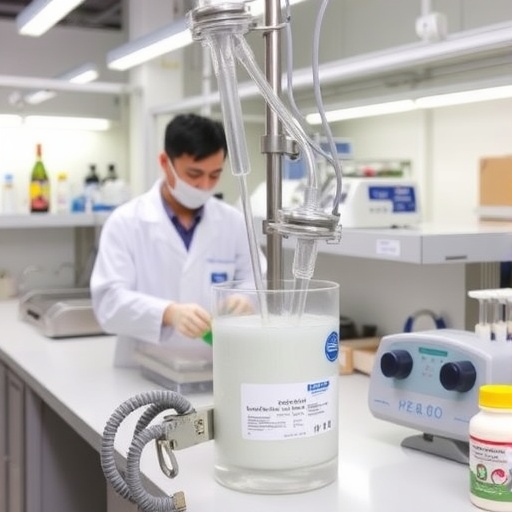
In the intricate world of industrial manufacturing, the suspension of solid particles within liquid media stands as a foundational process. Its significance spans a diverse array of sectors—from the high-precision assembly of battery electrodes to the meticulous formulation of pharmaceutical products. Ensuring the uniform suspension of particles is imperative for maintaining product consistency and operational efficiency. At the heart of these processes lies the method of solid–liquid mixing, a crucial step often guided by classical fluid mechanics and mixing theories.
For decades, the predictive capabilities of Zwietering’s correlation have anchored mixing design strategies. This renowned engineering model estimates the just-suspended speed (N_JS), which dictates the minimal rotational speed an impeller must maintain to prevent solid particles in suspension from settling. According to this model, N_JS escalates with increasing particle size, a greater density differential between the solid and liquid phases, and a reduction in impeller size. Zwietering’s framework has proven notably effective for dilute suspensions, where particle interactions and high-concentration effects have limited impact.
However, as industrial needs evolve toward handling more concentrated, dense slurries—often characterized by high solid loadings—the practical limitations of Zwietering’s correlation have grown increasingly apparent. A research team from Nagoya Institute of Technology (NITech), Japan, spearheaded by Dr. Haruki Furukawa and Dr. Yoshihito Kato, embarked on an in-depth experimental investigation to illuminate the nuanced dynamics of high-density solid–liquid mixing. Their work, recently published in the Journal of the Taiwan Institute of Chemical Engineers, challenges the prevailing mixing paradigms by demonstrating the critical influence of impeller placement within stirred vessels and the interplay between vessel baffling and suspension efficiency.
Through an innovative experimental design, the researchers varied the vertical position of impellers in vessels containing suspensions with concentrations ranging from 20 to 70 wt% solids. These experiments employed both baffled and unbaffled vessel configurations, allowing the team to dissect the hydrodynamic and mixing effects under different flow constraints. Their assessment combined precise torque and power measurements with visual observations of particle suspension states, offering a comprehensive view of the suspension mechanics at play.
One of the standout revelations from this study is the pivotal role of impeller positioning near the solid-liquid interface—the demarcation line where settled particles meet the liquid phase. Contrary to traditional beliefs, situating the impeller closer to this interface expedites particle suspension, achieving full homogeneity in as little as 15 seconds at 140 rpm. In comparison, lower impeller placements required twice as long—up to 30 seconds—to reach the same suspension quality. This finding starkly contrasts with Zwietering’s assumption that lower impeller placements inherently enhance particle lifting and thus minimize N_JS.
The investigation further underscores the influence of vessel baffling on suspension efficiency. Baffles are conventionally introduced to disrupt vortex formation and promote turbulent mixing; however, the team found that unbaffled vessels actually reduced N_JS throughout the tested range of particle concentrations. This finding suggests that unbaffled conditions favor more efficient energy usage without compromising suspension quality, offering an avenue for significant operational cost savings in processes involving dense slurries.
Moreover, the study critically examines power consumption patterns during suspension onset, revealing that reductions in power draw do not consistently match the initiation of full particle suspension in concentrated mixtures. This decoupling indicates that relying on power consumption alone as a proxy for suspension quality may lead engineers to inaccurate conclusions, particularly in industrial applications dealing with complex, high-solids slurries.
Central to the research narrative is the recalibration of Zwietering’s correlation parameters. The classical model, primarily developed for dilute systems, was found to underestimate the rotational speeds needed for complete suspension in high-solid environments, especially given the nonlinear escalation of the concentration exponent observed. This divergence mandates revisiting fundamental mixing design principles and integrating refined parameters that account for dense suspension rheology and hydrodynamics.
Dr. Furukawa emphasizes, “The implications of our results extend beyond academic curiosity. They prompt a redefinition of mixing guidelines, ensuring efficiency and reliability in processes where dense particulate suspensions are prevalent. Our work bridges the gap between classical theory and the practical demands of modern industrial applications.”
The technological ramifications are profound: improved mixing designs inspired by this research can enhance energy efficiency, reduce operational downtime, and foster product uniformity across multiple sectors. Industries engaged in battery manufacturing, pharmaceuticals, ceramics, and chemical processing stand to benefit from these insights, which address the challenges presented by the evolving complexity of slurry formulations.
Complementing the experimental findings, a visual summary of particle suspension dynamics elucidates the rapid suspension achieved with optimal impeller positioning. These insights are not merely academic; they chart a pragmatic path for refining mixing vessel designs and operational protocols to meet the rigorous demands of next-generation manufacturing processes.
Notably, this study’s comprehensive scope and methodological rigor spotlight the interdisciplinary expertise of NITech’s Department of Life Science and Applied Chemistry. Assisted by advanced fluid dynamic analysis and empirical validation, the research contributes to broader fluid mechanics understanding, particularly in the behavior of viscous and viscoelastic fluids laden with dense particulates.
The publication of this work in the October 2026 issue of the Journal of the Taiwan Institute of Chemical Engineers underscores the growing global recognition of research that marries classical chemical engineering with cutting-edge experimental innovation. This study not only enriches theoretical frameworks but serves as a beacon for future investigations aimed at optimizing industrial mixing processes.
As dense slurry processing continues to expand in industrial relevance, the findings from Dr. Furukawa and his team provide a timely and transformative perspective. Their pioneering approach offers a robust foundation for the next wave of technological advancements, ensuring that solid–liquid mixing evolves in step with the increasingly sophisticated requirements of modern industry.
Subject of Research:
Article Title: Effect of impeller placement on solid–liquid mixing at high particle loadings
News Publication Date: October 1, 2026
Web References: https://www.youtube.com/watch?v=HbVsB8Jlyqs
References: DOI: 10.1016/j.jtice.2026.106738
Image Credits: Assistant Professor Haruki Furukawa, Nagoya Institute of Technology, Japan
Keywords
Solid-liquid mixing, particle suspension, just-suspended speed (N_JS), impeller placement, dense slurry, energy efficiency, Zwietering’s correlation, industrial mixing, torque measurement, baffled vessel, unbaffled vessel, chemical engineering research
Tags: battery electrode manufacturing mixingconcentrated slurry mixing strategiesdense suspension mixing guidelineshigh solid loading mixing challengesindustrial suspension processesjust-suspended speed predictionNagoya Institute of Technology researchparticle size effects on suspensionpharmaceutical suspension formulationrotational speed in impeller mixingsolid-liquid mixing in dense slurriesZwietering correlation limitations