

• HOME
  • NEWS
  • EXPLORE
    • CAREER
      • Companies
      • Jobs
    • EVENTS
    • iGEM
      • News
      • Team
    • PHOTOS
    • VIDEO
    • WIKI
  • BLOG
  • COMMUNITY
    • FACEBOOK
    • INSTAGRAM
    • TWITTER
Wednesday, January 14, 2026
BIOENGINEER.ORG
No Result
View All Result
  • Login
  • HOME
  • NEWS
  • EXPLORE
    • CAREER
      • Companies
      • Jobs
        • Lecturer
        • PhD Studentship
        • Postdoc
        • Research Assistant
    • EVENTS
    • iGEM
      • News
      • Team
    • PHOTOS
    • VIDEO
    • WIKI
  • BLOG
  • COMMUNITY
    • FACEBOOK
    • INSTAGRAM
    • TWITTER
  • HOME
  • NEWS
  • EXPLORE
    • CAREER
      • Companies
      • Jobs
        • Lecturer
        • PhD Studentship
        • Postdoc
        • Research Assistant
    • EVENTS
    • iGEM
      • News
      • Team
    • PHOTOS
    • VIDEO
    • WIKI
  • BLOG
  • COMMUNITY
    • FACEBOOK
    • INSTAGRAM
    • TWITTER
No Result
View All Result
Bioengineer.org
No Result
View All Result
Home NEWS Science News Biology

Nagoya forensic scientists recover human DNA from mosquitos

Bioengineer by Bioengineer
July 10, 2017
in Biology
Reading Time: 2 mins read
0
Share on FacebookShare on TwitterShare on LinkedinShare on RedditShare on Telegram
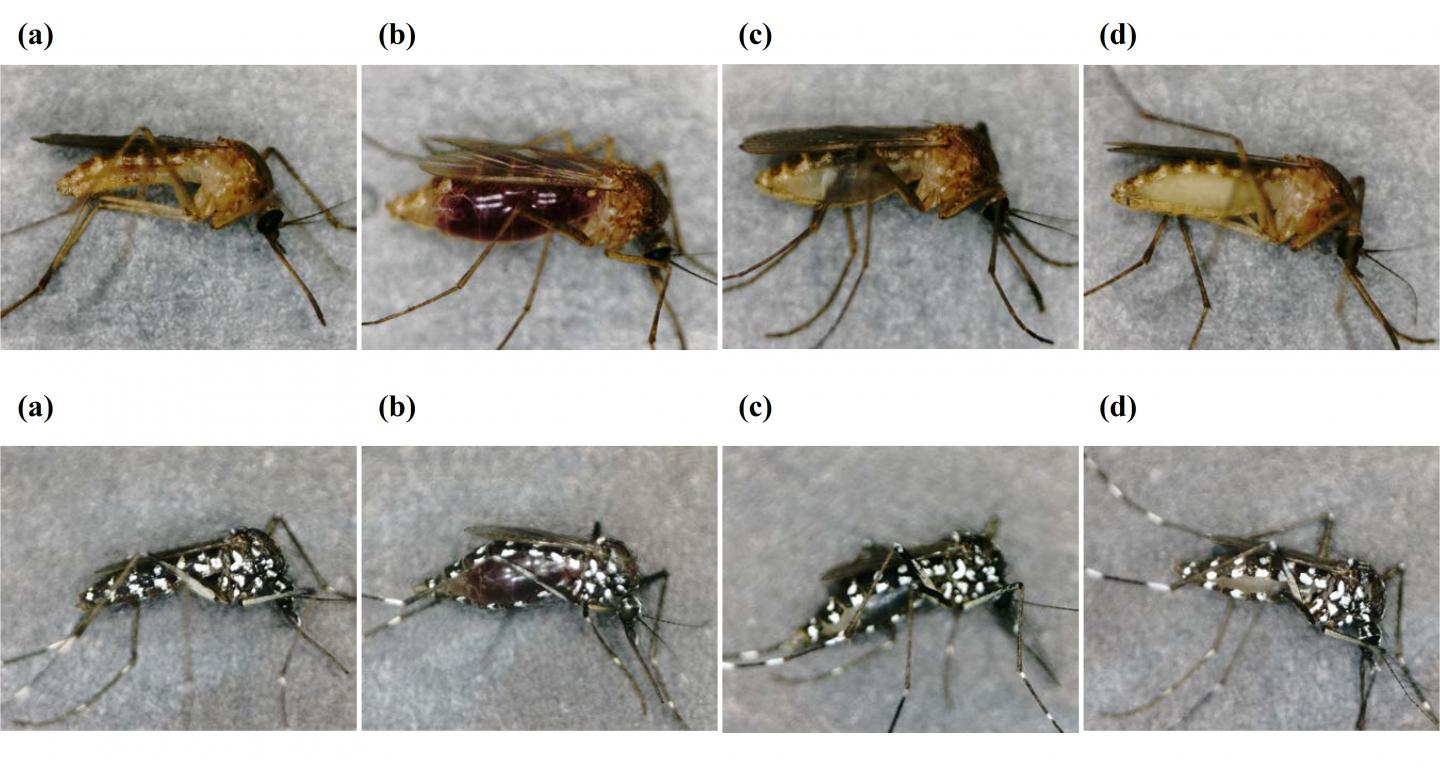
IMAGE

Credit: Toshimich Yamamoto

Nagoya, Japan – Most people would agree that painful mosquito bites are an especially annoying part of summer. Except perhaps forensic scientists, who can examine human blood from a mosquito's stomach and match the DNA to determine who was bitten. This technique can help police work out who was at a crime scene and in the future, might provide evidence that can be used to convict offenders. But questions remain about how long it takes a mosquito to digest human blood and how long before the DNA becomes unrecognizable.

Now a team of forensic scientists at Nagoya University has answered these questions.

"We asked several volunteers to let mosquitos bite them", explains first author Yuuji Hiroshige. "After allowing the mosquitos to digest the blood for a certain amount of time, we extracted the human DNA and used PCR techniques to amplify the sample for quantification and genotyping."

Polymerase chain reaction, or PCR, is a standard tool in forensics for amplifying a minute amount of DNA. A single DNA fragment can be multiplied many thousands or even millions of times. The team can then use the amplified samples to find out how much DNA is left after the mosquito feeds and who it belongs to.

By examining DNA in blood digested by two different species of mosquito over a range of times after feeding, the team was able to trace back blood samples to individual volunteers, even after two days of digesting in the mosquito. After roughly three days the mosquitos completely digested the blood.

Group leader Toshimichi Yamamoto says, "Ours is the first study to systematically apply modern DNA profiling techniques to the challenging forensic analysis of mosquito blood meal. We hope this will help crime scene investigators collect reliable evidence that could be used to guide investigations and support convictions. Although we need to take some steps to improve our methods and obtain more data, with more accurate quantification methods, we might be able to estimate the time after mosquitoes' blood feeding with even greater accuracy."

###

The article, "A human genotyping trial to estimate the post-feeding time from mosquito blood meals" was published in PLOS ONE at https://doi.org/10.1371/journal.pone.0179319

Media Contact

Koomi Sung
[email protected]
@NU__Research

http://www.nagoya-u.ac.jp/en/

Original Source

http://en.nagoya-u.ac.jp/research/activities/news/2017/07/nagoya-forensic-scientists-recover-human-dna-from-mosquitos.html http://dx.doi.org/10.1371/journal.pone.0179319

Share13Tweet8Share2ShareShareShare2

Related Posts

blank

Impact of Sex on Mortality in Sjögren’s Disease

January 14, 2026
blank

Exploring PDR Gene Family and miRNAs in Wheat

January 14, 2026

Genetic Insights into Circadian Adaptation in Endangered Fish

January 13, 2026

Blastocystis Boosts B and K2 Vitamins in Antelope Gut

January 13, 2026
Please login to join discussion

POPULAR NEWS

  • Enhancing Spiritual Care Education in Nursing Programs

    154 shares
    Share 62 Tweet 39
  • PTSD, Depression, Anxiety in Childhood Cancer Survivors, Parents

    147 shares
    Share 59 Tweet 37
  • Robotic Ureteral Reconstruction: A Novel Approach

    73 shares
    Share 29 Tweet 18
  • Study Reveals Lipid Accumulation in ME/CFS Cells

    52 shares
    Share 21 Tweet 13

About

We bring you the latest biotechnology news from best research centers and universities around the world. Check our website.

Follow us

Recent News

Ultrafast Electron Microscopy Reveals Chiral Light Dynamics

Impact of Sex on Mortality in Sjögren’s Disease

Exploring PDR Gene Family and miRNAs in Wheat

Subscribe to Blog via Email

Enter your email address to subscribe to this blog and receive notifications of new posts by email.

Join 71 other subscribers
  • Contact Us

Bioengineer.org © Copyright 2023 All Rights Reserved.

Welcome Back!

Login to your account below

Forgotten Password?

Retrieve your password

Please enter your username or email address to reset your password.

Log In
No Result
View All Result
  • Homepages
    • Home Page 1
    • Home Page 2
  • News
  • National
  • Business
  • Health
  • Lifestyle
  • Science

Bioengineer.org © Copyright 2023 All Rights Reserved.
