• HOME
  • NEWS
  • EXPLORE
    • CAREER
      • Companies
      • Jobs
    • EVENTS
    • iGEM
      • News
      • Team
    • PHOTOS
    • VIDEO
    • WIKI
  • BLOG
  • COMMUNITY
    • FACEBOOK
    • INSTAGRAM
    • TWITTER
Thursday, June 25, 2026
BIOENGINEER.ORG
No Result
View All Result
  • Login
  • HOME
  • NEWS
  • EXPLORE
    • CAREER
      • Companies
      • Jobs
        • Lecturer
        • PhD Studentship
        • Postdoc
        • Research Assistant
    • EVENTS
    • iGEM
      • News
      • Team
    • PHOTOS
    • VIDEO
    • WIKI
  • BLOG
  • COMMUNITY
    • FACEBOOK
    • INSTAGRAM
    • TWITTER
  • HOME
  • NEWS
  • EXPLORE
    • CAREER
      • Companies
      • Jobs
        • Lecturer
        • PhD Studentship
        • Postdoc
        • Research Assistant
    • EVENTS
    • iGEM
      • News
      • Team
    • PHOTOS
    • VIDEO
    • WIKI
  • BLOG
  • COMMUNITY
    • FACEBOOK
    • INSTAGRAM
    • TWITTER
No Result
View All Result
Bioengineer.org
No Result
View All Result
Home NEWS Science News Chemistry

Mystery of immunosuppressive drug’s biosynthesis finally unlocked

Bioengineer by Bioengineer
June 21, 2019
in Chemistry
Reading Time: 2 mins read
0
IMAGE
Share on FacebookShare on TwitterShare on LinkedinShare on RedditShare on Telegram

IMAGE

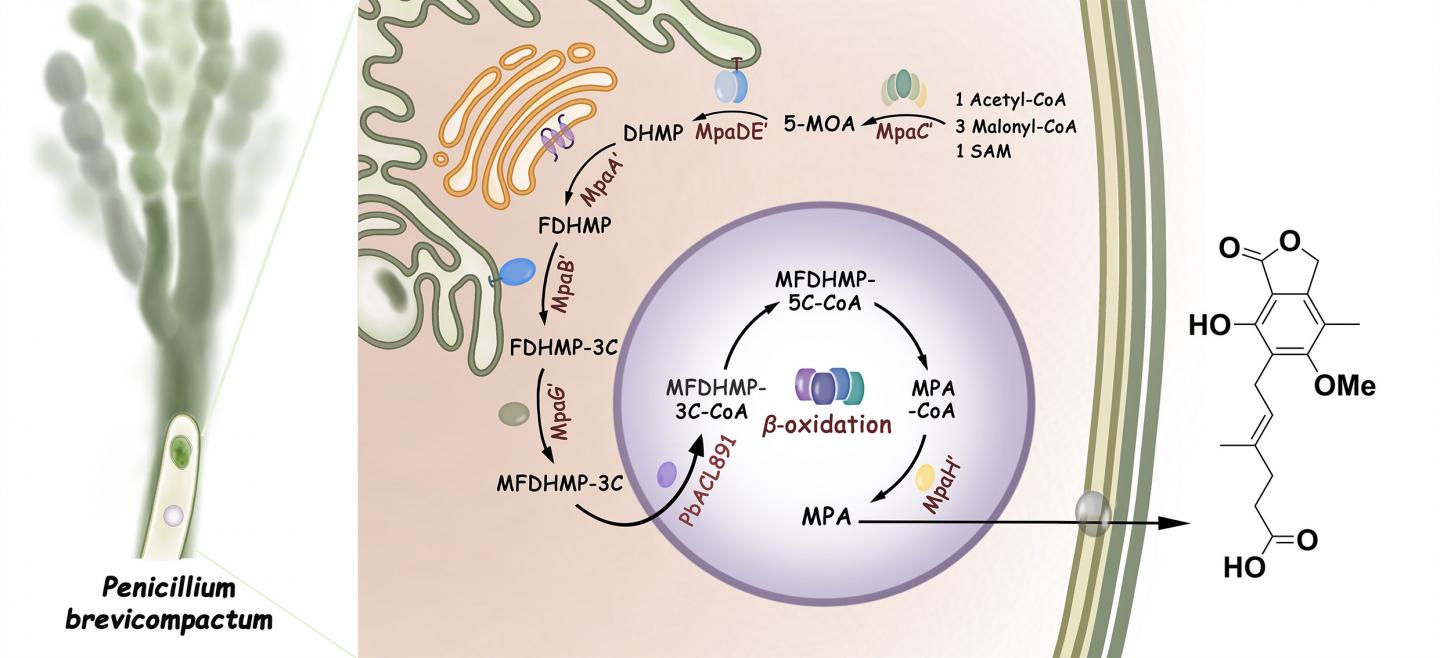
Credit: ZHANG Wei and LI Shengying

Mycophenolic acid (MPA), discovered in 1893, was the first natural antibiotic to be isolated and crystallized in human history. Today, this fungal metabolite has been developed into multiple first-line immunosuppressive drugs to control immunologic rejection during organ transplantation and treat various autoimmune diseases.

However, the biogenesis of such an old and important molecule was an unsolved mystery for more than a century.

Recently, scientists from the Qingdao Institute of Bioenergy and Bioprocess Technology (QIBEBT) of the Chinese Academy of Sciences cracked this intriguing black box by fully elucidating the biosynthetic pathway of MPA. The results were published in Proceedings of the National Academy of Sciences of the United States of America (PNAS).

The researchers revealed that MPA biogenesis requires very unique cooperation between biosynthetic enzymes and β-oxidation catabolic machinery.

Interestingly, the involved enzymes were observed to be compartmentalized in different organelles including cytoplasm, the endoplasmic reticulum, the Golgi apparatus, and peroxisomes.

In this pathway, the oxygenase MpaB’, which is intriguingly homologous to a latex-clearing enzyme, was identified as the long-sought key enzyme responsible for oxidative cleavage of the farnesyl side chain that is structurally similar to rubber.

The resultant carboxylic acid intermediate allows it to be recognized by the fungal β-oxidation machinery located in the peroxisomes. The following successive β-oxidation chain-shortening process is elegantly gated by the peroxisomal acyl-CoA hydrolase MpaH’, thus leading to efficient and specific production of MPA.

The scientists concluded that compartmentalized biosynthesis is likely a very important characteristic of natural product biosynthesis in higher organisms such as fungi and plants.

They hope their work will prompt more research on this phenomenon since there is only very limited knowledge about the subcellular localization of fungal biosynthetic enzymes and their involvement in product formation and intermediate trafficking.

The researchers also hope the insights gained from this study will encourage industrial strain improvements that would lower the cost of this popular immunosuppressive drug as well as novel drug development based on MPA structural derivatization. “Ultimately, we wish that millions of patients will benefit from this basic research,” said LI Shengying, corresponding author of the study.

###

Media Contact
CHENG Jing
[email protected]

Original Source

http://english.cas.cn/

Related Journal Article

http://dx.doi.org/10.1073/pnas.1821932116

Tags: BiologyBiotechnologyCell BiologyImmunology/Allergies/AsthmaPharmaceutical ScienceTransplantation
Share12Tweet8Share2ShareShareShare2

Related Posts

AI and Physics Collaborate to Design Advanced Hydrogen Storage Materials

June 25, 2026

International Team Including Dresden Scientists Develops Novel Designer Proteins for Advanced Study of Living Tissue

June 25, 2026

New Study Uncovers Key Factors Driving Water Chemistry in Nanoscale Environments

June 25, 2026

Plasma Technology Extends Catalyst Lifespan in Hydrogen Production

June 24, 2026
Please login to join discussion

POPULAR NEWS

  • Saying Goodbye to PGY-6: Pediatric Fellowship Realities

    103 shares
    Share 41 Tweet 26
  • Multi-Hospital Study Reveals Long Covid Burden Is Twice as High as Current Estimates

    92 shares
    Share 36 Tweet 23
  • Detection of EDCs in Breast Milk and Infant Urine Up to Six Months Highlights Early Exposure Risks

    77 shares
    Share 31 Tweet 19
  • New Drug Candidate Developed at McMaster Shows Potential for Treating Brain Cancer

    58 shares
    Share 23 Tweet 15

About

We bring you the latest biotechnology news from best research centers and universities around the world. Check our website.

Follow us

Recent News

Tracking Lanthanide-Labeled Microplastics in Plants

POSTECH Researchers Slash Cost of Reconstituted Cell-Free Systems by 95%

AI and Physics Collaborate to Design Advanced Hydrogen Storage Materials

Subscribe to Blog via Email

Success! An email was just sent to confirm your subscription. Please find the email now and click 'Confirm' to start subscribing.

Join 82 other subscribers
  • Contact Us

Bioengineer.org © Copyright 2023 All Rights Reserved.

Welcome Back!

Login to your account below

Forgotten Password?

Retrieve your password

Please enter your username or email address to reset your password.

Log In
No Result
View All Result
  • Homepages
    • Home Page 1
    • Home Page 2
  • News
  • National
  • Business
  • Health
  • Lifestyle
  • Science

Bioengineer.org © Copyright 2023 All Rights Reserved.