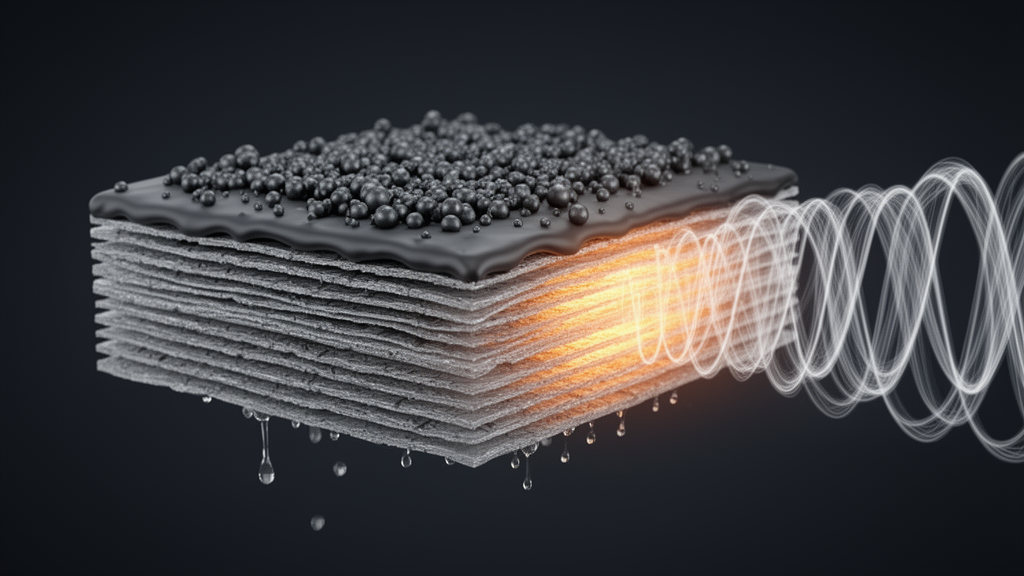
A ternary composite built from MXene, nickel oxide and polypyrrole has been reported to deliver two functions at once: strong microwave absorption and long-lasting corrosion protection. The material, described in the Journal of Materials Science, was assembled through in situ polymerization into a distinctive “sheet-wire” architecture in which NiO nanowires and polypyrrole coatings are uniformly anchored on MXene layers. The work addresses a growing engineering problem, since the spread of 5G communication, radar detection and marine equipment has raised simultaneous demands for electromagnetic interference control and durable metal protection.
Traditional absorbing materials, the authors note, often suffer from high density, poor impedance matching or inadequate corrosion resistance, while binary composites lack sufficient multifunctional synergy. The ternary design was tuned by varying the mass ratio of the three components. The formulation with an MXene:NiO:PPy ratio of 1:1:0.75 showed the best microwave performance, reaching a minimum reflection loss of −36.80 dB at 16.16 GHz with a thickness of 7.6 mm.
According to the study, the enhanced absorption mainly originates from dielectric loss associated with conductive loss, interfacial polarization and dipolar polarization, together with optimized impedance matching and multiple reflection effects within the heterogeneous network.
NiO plays a specific supporting role in this scheme. The researchers report that it contributes mainly by constructing abundant heterogeneous interfaces and regulating the local dielectric environment, thereby promoting interfacial polarization and facilitating impedance matching.
The second function concerns corrosion protection. When the composite was incorporated into waterborne epoxy coatings at a loading of 1.5 wt%, the material provided outstanding long-term corrosion resistance in the reported tests. After 60 days of immersion in 3.5 wt% sodium chloride solution, the coating showed a charge transfer resistance of 1.285 × 10⁵ Ω·cm², a measure of how effectively the coating blocks the electrochemical reactions that drive metal corrosion.
The findings are reported as laboratory measurements on engineered composites and coatings under defined test conditions, including a fixed salt concentration and immersion period. The abstract describes the composite’s performance in these specific tests; broader durability, cost and large-scale manufacturing questions remain outside the scope of the reported results. Nevertheless, the study illustrates a design strategy for multifunctional coatings in which microwave absorption and anticorrosion are pursued simultaneously rather than as separate material systems.
Published on 27 October 2026 in the Journal of Materials Science, the research comes from a team including Qingsong Zhu, Yongtao He, Siyu Hao, Peng Wang and Zimeng He.
Subject of Research: Design of a ternary MXene/NiO/PPy composite for combined microwave absorption and anticorrosion performance in coatings.
Article Title: Rational design of MXene/NiO/PPy ternary composites for bifunctional applications of microwave absorption and anticorrosion
Article References: Zhu, Q., He, Y., Hao, S., Wang, P., & He, Z. (2026). Rational design of MXene/NiO/PPy ternary composites for bifunctional applications of microwave absorption and anticorrosion. Journal of Materials Science. https://doi.org/10.1007/s10853-026-13968-2
Image Credits: AI Generated
DOI: 10.1007/s10853-026-13968-2
Keywords: MXene, NiO nanowires, polypyrrole, microwave absorption, reflection loss, anticorrosion coating, waterborne epoxy, impedance matching, interfacial polarization, charge transfer resistance, electromagnetic interference, composites
News Source: Denise Maddox. (October 27, 2026). MXene-NiO-PPy composite absorbs microwaves and resists corrosion in one material. Scienmag.