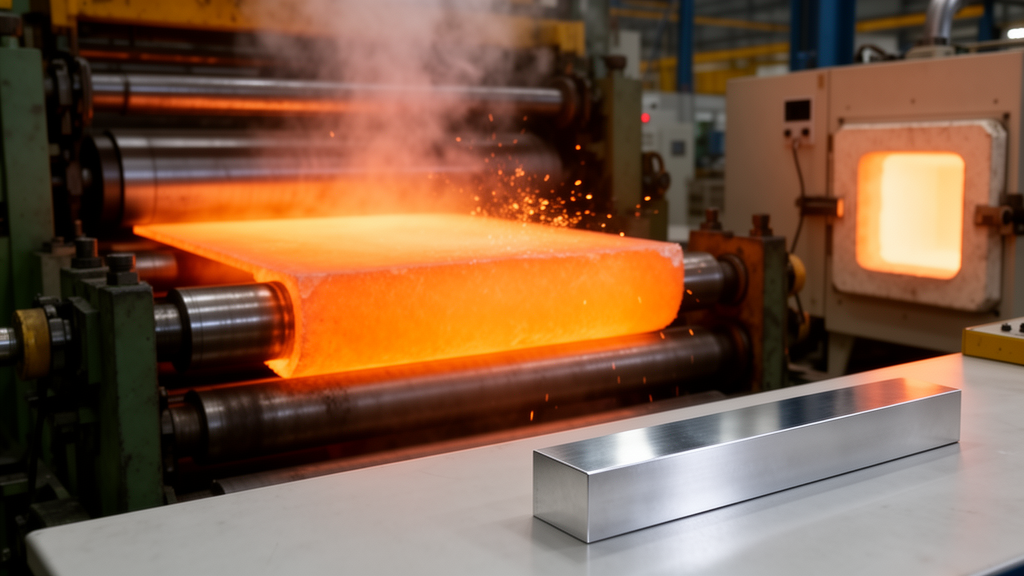
A rare-earth magnesium alloy can be made substantially stronger by combining heavy hot rolling with a subsequent aging treatment, according to a study published in the Journal of Materials Science. Researchers investigated Mg-8Gd-3Y-0.5Zr, a magnesium alloy containing gadolinium, yttrium and a small amount of zirconium, and systematically varied the amount of deformation applied during hot rolling from 25% to 75% before examining how a post-aging treatment changed the material’s microstructure, mechanical strength and electrochemical corrosion performance.
The study found that increasing the rolling reduction promoted the fragmentation and refinement of coarse secondary phases in the alloy and further enhanced dynamic recrystallization. These microstructural changes set the stage for what happened next: during aging, a qualitatively denser population of finely dispersed nanoscale β’ precipitates formed in the alloy matrix.
The amount of pre-deformation proved to be a key lever on precipitation behavior. Higher rolling reductions accelerated the kinetics of β’ precipitation during aging and enhanced the strengthening effect that these nanoscale particles deliver. In other words, the more the alloy was deformed before aging, the faster and more effectively the strengthening precipitates developed.
The mechanical payoff was substantial. After 75% hot rolling followed by peak aging, the alloy achieved a yield strength of 292 MPa and an ultimate tensile strength of 306 MPa. Those values were nearly 100 MPa higher than those of the as-cast alloy, representing a marked improvement over the material’s starting condition.
According to the authors, the improved strength resulted mainly from the combined effects of three mechanisms acting together: grain refinement from dynamic recrystallization, dislocation strengthening from the deformation history, and precipitation strengthening from the fine β’ particles. This synergistic combination, rather than any single mechanism, accounts for the large strength gain.
The corrosion behavior of the alloy also benefited from the treatment. Refined secondary phases and the nanoscale β' precipitates suppressed micro-galvanic corrosion and lowered the alloy's corrosion rate.
The researchers describe these results as revealing the acceleration effect of large deformation on β’ precipitation during aging and its regulatory mechanism of corrosion behavior.
The work was published on 27 October 2026 in the Journal of Materials Science, with Hong Jiang among the listed authors.
Subject of Research: Effects of hot rolling reduction and post-aging on the microstructure, strength and corrosion behavior of an Mg-Gd-Y-Zr rare-earth magnesium alloy.
Article Title: Microstructural evolution and synergistic strengthening mechanisms of Mg-Gd-Y-Zr alloy via hot rolling followed by post-aging treatment
Article References: Jiang, H., Wang, Y., Peng, B., Wu, Y., & Yang, B. (2026). Microstructural evolution and synergistic strengthening mechanisms of Mg-Gd-Y-Zr alloy via hot rolling followed by post-aging treatment. Journal of Materials Science. https://doi.org/10.1007/s10853-026-14000-3
Image Credits: AI Generated
DOI: 10.1007/s10853-026-14000-3
Keywords: magnesium alloy, Mg-Gd-Y-Zr, hot rolling, aging treatment, beta prime precipitates, dynamic recrystallization, precipitation strengthening, grain refinement, yield strength, corrosion resistance, rare-earth metals, micro-galvanic corrosion
News Source: Beatrice Stafford. (October 27, 2026). Hot Rolling and Aging Boost Strength of Rare-Earth Magnesium Alloy. Scienmag.