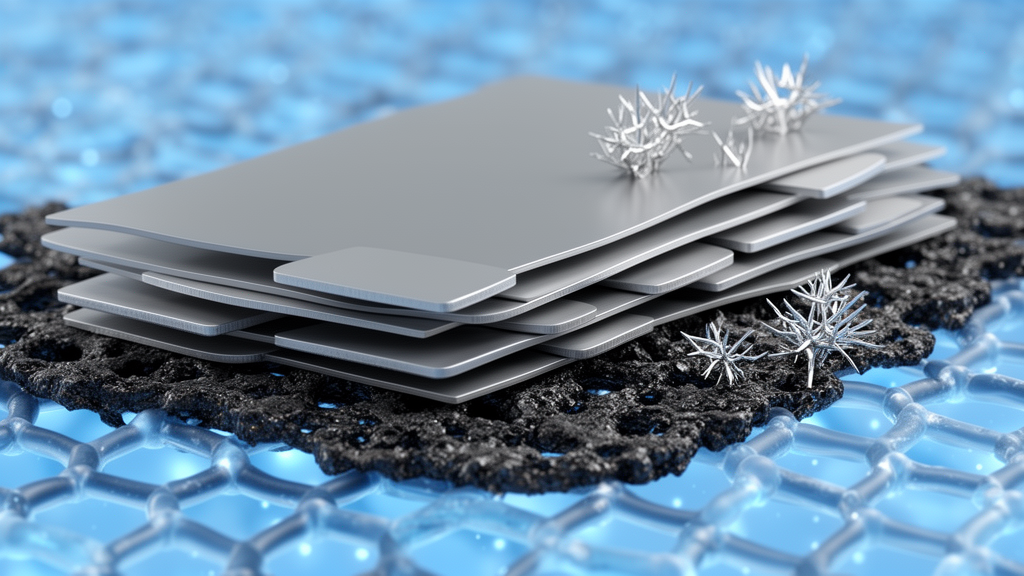
Aqueous zinc-ion batteries have long been celebrated as one of the most promising candidates for large-scale energy storage, combining a low-cost, earth-abundant metal anode with a water-based electrolyte that removes the fire risks haunting lithium-ion technology. Yet the same chemistry that makes them safe and affordable also makes them fragile. During every charge cycle, the zinc anode is besieged by dendrite growth, hydrogen evolution, corrosion and a parade of side reactions that erode Coulombic efficiency and cut cycling life short. A new study published in the journal Ionics by Xinlong Yu, Shuqi Li and Xudong Sun of Northeast Petroleum University in Daqing, China, reports a multifunctional artificial protective layer built from MXene and sulfur-doped graphene that confronts these failure modes simultaneously, and the electrochemical results are striking.
The appeal of the zinc anode is easy to quantify. Zinc offers a high theoretical specific capacity of 820 milliampere-hours per gram, a moderate redox potential of minus 0.76 volts versus the standard hydrogen electrode, and raw material abundance that dwarfs that of lithium. For grid-scale storage, where cost and safety dominate the calculus, these numbers make aqueous zinc-ion batteries an ideal candidate system. The problem is that the anode surface is a hostile reaction zone. Uneven ion flux concentrates zinc deposition into needle-like dendrites that can pierce separators and short the cell, while the aqueous electrolyte drives hydrogen gas evolution and parasitic corrosion that consume both active zinc and electrolyte water with every cycle.
The researchers tackled these problems with a composite coating they call MX/S-GR, a marriage of two two-dimensional materials with complementary chemistry. MXene, the family of transition-metal carbides exemplified here by Ti3C2Tx, carries abundant negatively charged surface functional groups, including oxygen, chlorine and fluorine terminations. Sulfur-doped graphene, abbreviated S-GR in the study, contributes a homogenized interfacial electric field along with sulfur-containing functional groups that act as zincophilic active sites. Together, the two nanosheets form an artificial protective layer on the zinc anode that reshapes the electrochemical environment at the electrode-electrolyte interface.
The mechanism operates on two fronts. First, the negatively charged functional groups on the MXene surface electrostatically repel sulfate anions from the electrolyte, keeping the corrosive SO4 2- species at a distance from the metal surface. At the same time, these terminations promote the desolvation of zinc ions, stripping away the solvation shell that normally slows ion transfer and encourages nonuniform deposition. Second, the sulfur-doped graphene evens out the local electric field across the anode surface, eliminating the field hot spots that seed dendrite nucleation. Its sulfur-containing groups then serve as preferential anchoring points for zinc ions, guiding deposition into a dense, dendrite-free morphology and improving the transport kinetics of Zn2+ through the interface.
The electrochemical evidence is compelling. In symmetric cell tests, where two identical zinc electrodes face each other under galvanostatic cycling, the MX/S-GR-coated zinc anodes ran stably for more than 1000 hours at a current density of 0.5 milliamperes per square centimeter paired with an areal capacity of 0.5 milliampere-hours per square centimeter. Crucially, the coating held up under far harsher conditions as well, sustaining more than 1000 hours at 2.0 milliamperes per square centimeter and 1.0 milliampere-hours per square centimeter. That combination of longevity at both modest and aggressive current densities is precisely the kind of performance envelope that separates laboratory curiosities from practical anode protection strategies.
Symmetric cells, however, only tell half the story. The real test of any anode treatment is whether it lifts the performance of a full battery, where the zinc anode must pair with a cathode through thousands of charge-discharge cycles. The researchers assembled full cells pairing their coated anode with manganese dioxide, MnO2, a workhorse cathode material for aqueous zinc-ion chemistry. The MX/S-GR@Zn||MnO2 full cell cycled stably for more than 2400 cycles at a specific current of 1.0 ampere per gram, retaining a discharge capacity of 104 milliampere-hours per gram. That level of capacity retention after thousands of cycles in an aqueous system underscores how thoroughly the coating suppresses the cumulative damage of dendrites, gas evolution and corrosion.
What makes this approach notable in a crowded field is its multifunctionality. Many anode protection strategies address a single failure mode: some coatings are purely mechanical barriers against dendrites, others focus on regulating the solvation structure of zinc ions, and still others target the hydrogen evolution reaction through electrolyte additives. The MX/S-GR layer integrates electrostatic anion repulsion, desolvation promotion, electric field homogenization and zincophilic nucleation guidance in a single coating. Each function reinforces the others. By repelling sulfate anions, the MXene surface reduces corrosive attack; by promoting desolvation, it speeds ion transfer; by flattening the electric field, the graphene component prevents the local current crowding that births dendrites; and by providing zincophilic sites, it ensures that the zinc that does deposit lands uniformly rather than in dangerous protrusions.
The broader context of zinc anode research makes this integration meaningful. The field has converged on a set of persistent concerns for the zinc metal anode, ranging from dendrite propagation and hydrogen evolution to corrosion, passivation and the formation of byproducts that clog the interface. Strategies span electrolyte engineering, separator modification, crystal face reconstruction, hydrophobic carbon layers, zincophilic metal coatings and polymer films. Two-dimensional materials have featured prominently, with MXene-based protective layers and sulfur-functionalized graphene both appearing in recent literature for batteries and supercapacitors. The Daqing team’s contribution is to combine these two material classes so that their surface chemistries divide the labor: MXene handles the anion and solvation chemistry, while sulfur-doped graphene manages field distribution and nucleation sites.
The implications for scalable energy storage are considerable. Aqueous zinc-ion batteries are being positioned for grid storage, renewable energy buffering and other applications where the energy density ceiling of water-based chemistry matters less than cost, safety and cycle life. An anode coating that extends cycling stability past 2400 full-cell cycles while maintaining over 100 milliampere-hours per gram addresses the central commercialization bottleneck. Because the coating is derived from solution-processable two-dimensional nanosheets, it is compatible with coating routes that could be adapted to electrode manufacturing, though the study does not report scale-up economics.
The work, published in Ionics on 15 October 2026, arrives as part of a wave of interfacial engineering studies that treat the zinc anode surface not as a passive metal electrode but as an actively designable reaction environment. By demonstrating that a single MXene and sulfur-doped graphene layer can suppress dendrite growth, hydrogen evolution, corrosion and other side reactions in one stroke, the Northeast Petroleum University team has added a versatile tool to the zinc anode toolbox. If the multifunctional coating philosophy proves transferable to other electrode systems and manufacturing scales, the humble zinc anode may finally get the durable interface it needs to anchor the next generation of safe, affordable grid batteries.
Subject of Research: A MXene/sulfur-doped graphene protective coating for stabilizing zinc anodes in aqueous zinc-ion batteries
Article Title: Multifunctional artificial protective layer derived from MXene/sulfur-doped graphene for strengthening electrochemical properties of aqueous zinc-ion batteries
Article References: Multifunctional artificial protective layer derived from MXene/sulfur-doped graphene for strengthening electrochemical properties of aqueous zinc-ion batteries. (n.d.). https://doi.org/10.1007/s11581-026-07572-2
Image Credits: AI Generated
DOI: 10.1007/s11581-026-07572-2
Keywords: aqueous zinc-ion batteries, zinc anode, MXene, sulfur-doped graphene, dendrite suppression, hydrogen evolution, corrosion, anode coating, energy storage, electrochemical stability, interfacial engineering, MnO2 cathode
News Source: Neil Sanderson. (October 15, 2026). MXene and Sulfur-Doped Graphene Coating Tames Zinc Dendrites in Water-Based Batteries. Scienmag.