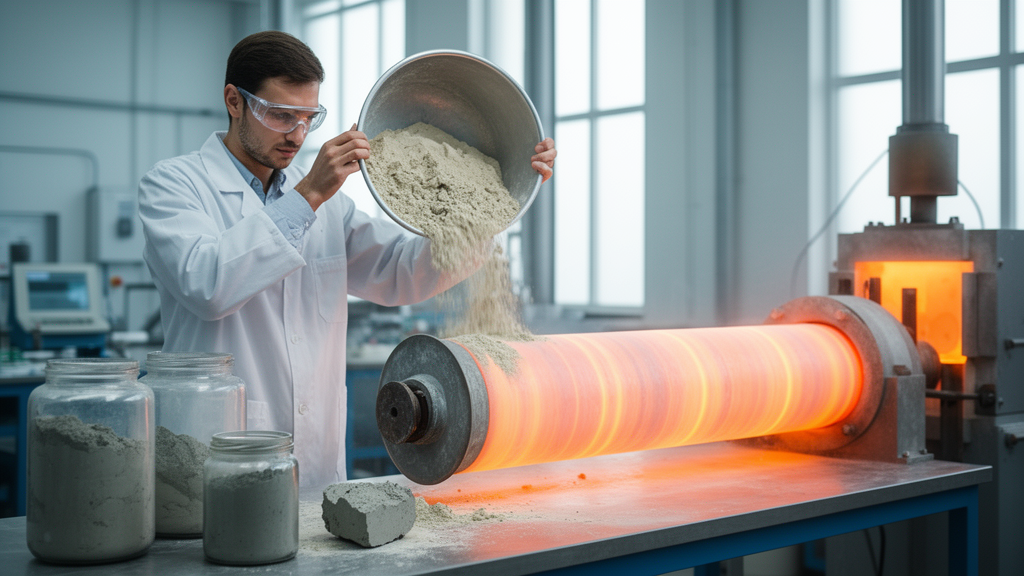
Cement is the binding agent of modern civilization, and it is also one of the largest single sources of industrial carbon dioxide emissions on the planet. The clinker kilns that produce the core ingredient of concrete release roughly eight percent of global CO2, and demand for cement is projected to keep climbing through mid-century as cities expand and infrastructure ages. For years, researchers have searched for a way to cut those emissions without sacrificing the material properties that make concrete so indispensable. Now, a team at EPFL in Switzerland has demonstrated a surprisingly simple mechanical trick that could reshape how the industry produces one of its most promising green alternatives: calcined clay.
Calcined clays are widely regarded as the only supplementary cementitious materials available in sufficient quantity to meet the world’s mid-century cement demand. Unlike fly ash, which is a byproduct of coal combustion and is becoming scarcer as power plants shut down, or slag, which depends on the fortunes of the steel industry, clay is abundant almost everywhere on Earth. When kaolinitic clay is heated to around 800 degrees Celsius, its crystal structure breaks down in a process called dehydroxylation, transforming it into a reactive material that can replace a substantial fraction of clinker in cement blends. The problem is that reaching 800 degrees requires a significant input of thermal fuel, typically natural gas or coal, which eats into the carbon savings the substitution is meant to deliver.
The EPFL team, led by Lei Xu and including Alastair T. M. Marsh, Mehnaz Dhar, and Karen L. Scrivener, took a different approach. Rather than relying on heat alone to disrupt the kaolinite structure, they first subjected the clay to mechanical grinding, a process known as mechanochemical activation. Ball milling and similar techniques introduce structural disorder into the kaolinite lattice, breaking bonds and creating defects that make the material far more responsive to thermal treatment. When the mechanically pre-activated clay was then heated, the researchers found that complete dehydroxylation occurred at just 550 degrees Celsius, a full 250 degrees lower than conventional calcination.
The implications of that temperature reduction are enormous. Lower calcination temperatures mean less fuel, and less fuel means fewer emissions from the activation step itself. But the benefits go beyond simple fuel savings. A 550-degree process is compatible with electrification, meaning it could be powered by renewable electricity rather than fossil fuels. It is also within the range of industrial waste heat, allowing cement plants to recycle thermal energy that would otherwise be lost to the atmosphere. This opens a pathway toward fully decarbonized clay activation that simply does not exist at 800 degrees.
The researchers did not stop at demonstrating the temperature reduction. They also tested the performance of the mechano-thermally activated clay in cement blends and found that it exhibited enhanced reactivity at both early and later ages compared to conventionally calcined clay. In practical terms, this means that concrete made with the activated clay gains strength faster and reaches higher ultimate strength, addressing one of the persistent criticisms of calcined clay cements, which have sometimes been slower to develop mechanical properties than traditional Portland cement.
To quantify the climate impact, the team ran scenario-based modelling under different energy mixes. Under current electricity grids, the mechano-thermal pathway delivers an average mitigation of 22 kilograms of CO2 per tonne of clay processed. If the electricity supply decarbonizes further, that figure rises to more than 43 kilograms per tonne. Even under a fully electrified scenario where the grid is entirely renewable, reducing the calcination temperature still yields mitigation of 18 to 21 kilograms of CO2 per tonne of activated clay, because the mechanical pre-activation step itself consumes energy that must be accounted for.
The scale of potential deployment is what makes this research truly remarkable. The researchers estimate that immediate full-scale adoption of the mechano-thermal pathway could reduce cement-sector emissions by up to 28 million tonnes of CO2 per year. To put that in perspective, that is roughly equivalent to the annual emissions of several mid-sized countries, achieved through a modification of a single processing step in cement manufacture. Given that the cement industry produces around four billion tonnes of product annually, even fractional improvements in the activation process translate into massive absolute reductions.
The scientific basis for the temperature reduction lies in the structural changes that mechanical grinding induces in kaolinite. The mineral consists of stacked layers of silicon-oxygen tetrahedra and aluminium-oxygen hydroxyl octahedra. Mechanical energy disrupts the hydrogen bonds that hold these layers together, creating amorphous regions and increasing the surface area available for reaction. When heat is subsequently applied, the hydroxyl groups that normally require 800 degrees to be driven off can escape at much lower temperatures because the structural barriers have already been partially dismantled. The result is a material that achieves the same degree of activation with far less thermal input.
What makes this research particularly compelling from an industrial standpoint is that it does not require exotic materials or fundamentally new chemistry. Kaolinitic clay is one of the most abundant minerals on Earth, found on every continent and already mined at scale for ceramics, paper coating, and other applications. The mechano-thermal activation process uses equipment that is already familiar to the cement and mining industries, meaning that adoption does not require a complete overhaul of existing infrastructure. The pathway is, in the words of the researchers, scalable, and scalability is precisely what the cement industry needs if it is to meet mid-century decarbonization targets.
The research, published in Communications Engineering, arrives at a critical moment. The cement industry has committed to reaching net zero by 2050, but progress has been slow and the technical challenges are formidable. Calcined clay cements, particularly those developed through the LC3 program that Scrivener has championed for years, are among the few solutions that can be deployed at the scale required. By lowering the energy barrier for clay activation, the EPFL team has removed one of the remaining obstacles to widespread adoption, bringing the industry one step closer to a future where concrete can be produced without the massive carbon footprint that currently accompanies it.
Subject of Research: Mechano-thermal activation of kaolinitic clay for low-carbon cement manufacture
Article Title: Mechano-thermal activation of kaolinitic clay for low-carbon cement manufacture
Article References: Xu, L., Marsh, A. T. M., Dhar, M., & Scrivener, K. L. (2026). Mechano-thermal activation of kaolinitic clay for low-carbon cement manufacture. Communications Engineering. https://doi.org/10.1038/s44172-026-00776-4
Image Credits: AI Generated
DOI: 10.1038/s44172-026-00776-4
Keywords: Mechano-thermal, activation, kaolinitic, clay, low-carbon, cement, manufacture, scientific research
News Source: Denise Maddox. (October 15, 2026). Mechano-thermal activation of kaolinitic clay for low-carbon cement manufacture. Scienmag.