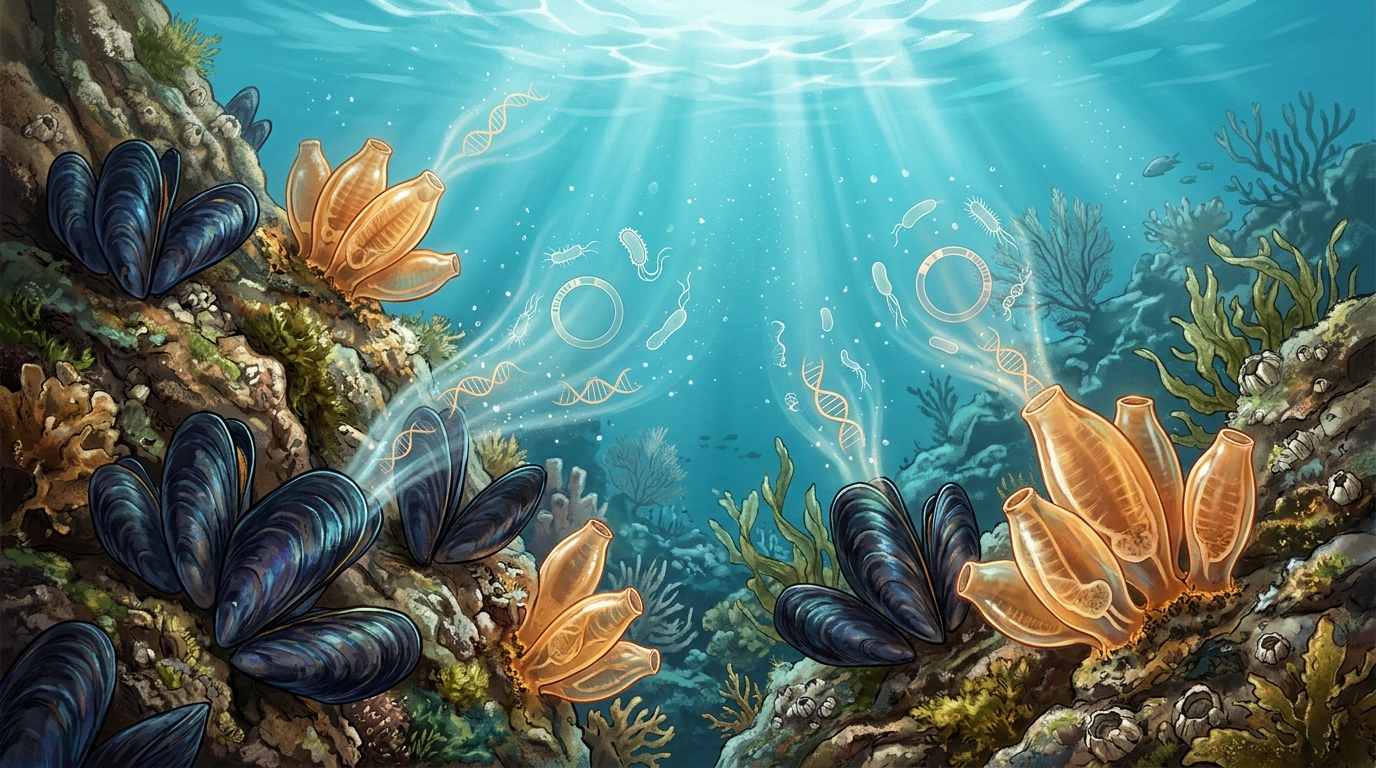
Farmed mussels and invasive sea squirts in the Mediterranean coast carry more antimicrobial resistance genes than the seawater around them, according to a new study comparing three interconnected coastal compartments. The research, published in Frontiers in Microbiomes, examined seawater, commercially farmed Mediterranean mussels (Mytilus galloprovincialis), and the invasive ascidian Styela plicata to understand how host-associated microbiomes contribute to the environmental ecology of antimicrobial resistance, a growing concern for coastal One Health surveillance.
The research team, led by scientists from the Institute of Environmental Diagnosis and Water Studies in Barcelona with collaborators from the Centre for Advanced Studies of Blanes, the Institute of Research and Technology Agroalimentaries La Ràpita, and the Spanish National Research Council in Madrid, collected samples from Mediterranean coastal environments. They analyzed the samples using two complementary techniques: 16S rRNA gene sequencing, which maps the composition of bacterial communities, and high-throughput quantitative PCR targeting 71 antimicrobial resistance determinants, including antimicrobial resistance genes (ARGs) and mobile genetic elements (MGEs). This dual approach allowed the researchers to compare not only which bacteria lived in each compartment but also which resistance genes and mobile elements they carried.
The results revealed a clear divide between host-associated and free-living microbial communities. Microbiomes living inside mussels and ascidians were consistently distinct from the surrounding seawater and remained comparatively stable across sampling periods. Seawater, by contrast, showed greater richness of antimicrobial resistance determinants, meaning it contained a wider variety of resistance genes. However, the mussels and ascidians harbored higher relative abundances of ARGs and MGEs when normalized to 16S, along with several clinically relevant resistance determinants. In other words, while seawater offered more diversity in resistance genes, the filter-feeding invertebrates concentrated them at higher levels.
This pattern matters because both mussels and ascidians are filter feeders, organisms that strain large volumes of water to capture food particles. In doing so, they accumulate bacteria and other microbes from their surroundings, potentially serving as gathering points for resistance genes circulating in coastal waters. The commercially farmed status of the mussels adds another layer of relevance, since these animals are part of the human food chain and their microbial contents could reflect the resistance landscape of the waters where they grow.
The study also found that the composition of targeted antimicrobial resistance profiles differed significantly among the three biotypes but only partially mirrored the structure of the microbiomes themselves. This partial overlap indicates that bacterial community composition alone does not explain how resistance genes are organized across compartments. Two communities with similar bacterial membership could carry different resistance gene repertoires, suggesting that other factors, such as mobile genetic element dynamics or local selective pressures, shape the resistome independently of which bacteria are present.
Putative pathogenic bacterial communities also differed among the biotypes. Mussels were enriched in several human-associated genera, and the abundances of these genera positively correlated with antimicrobial resistance genes. The researchers were careful to note that these associations do not demonstrate genetic linkage or pathogenicity. The coexistence of resistance genes and human-associated bacterial genera within mussels identifies them as ecologically relevant compartments where clinically relevant resistance determinants, mobile genetic elements, and bacterial genera containing recognized human-associated or opportunistic pathogens overlap, but it does not prove that any specific bacterium carries any specific resistance gene or that these organisms cause disease.
The distinction between correlation and causation is important in environmental microbiology. Finding that human-associated genera and resistance genes co-occur at higher abundances in mussels raises questions about how these elements come together. Possible mechanisms include shared mobile genetic elements transferring genes between bacteria, selective pressures from antibiotic contamination favoring both resistance and certain bacterial populations, or simply that the same environmental conditions support both. The study was not designed to distinguish among these possibilities, but the observed patterns provide a foundation for future work on gene transfer in marine invertebrate microbiomes.
The invasive ascidian Styela plicata offered a useful comparison to the farmed mussels. Both are filter feeders occupying similar ecological niches in coastal waters, yet their microbiomes and resistance profiles could be compared directly with seawater and with each other. The finding that both host-associated compartments behaved similarly, concentrating resistance genes and mobile elements at higher relative abundances than seawater, suggests that the filter-feeding lifestyle itself, rather than species-specific traits, may drive the accumulation pattern.
From a surveillance perspective, the findings carry practical weight. Current environmental antimicrobial resistance monitoring often relies on water sampling, which captures the free-living microbial community but may miss resistance genes concentrated in host-associated compartments. The researchers conclude that marine invertebrates complement seawater for environmental AMR surveillance and support their inclusion in integrated coastal One Health monitoring strategies. Adding filter feeders to routine monitoring could provide a more complete picture of where resistance genes accumulate in coastal ecosystems and how they relate to bacterial communities that include human-associated or opportunistic pathogens.
The study was received by the journal in August 2026 and accepted in October 2026. Its authors emphasize that the work addresses a major challenge for coastal One Health surveillance: understanding how host-associated microbiomes contribute to the environmental ecology of antimicrobial resistance. By comparing seawater with two ecologically distinct invertebrate hosts in the same Mediterranean environment, the research demonstrates that resistance gene ecology cannot be fully assessed from water samples alone, and that the animals living in these waters carry their own distinct and concentrated reservoirs of antimicrobial resistance determinants.
Subject of Research: Reservoirs of antimicrobial resistance genes in Mediterranean mussels, ascidians and seawater
Article Title: Host-associated microbiomes act as reservoirs of antimicrobial resistance in Mediterranean coastal waters
Article References: Gionchetta, G., Alacid, E., Zarcero, J., Fernandez-Tejedor, M., Subirats, J., & Turon, M. (2026). Host-associated microbiomes act as reservoirs of antimicrobial resistance in Mediterranean coastal waters. Frontiers in Microbiomes, 5, Article 1974573. https://doi.org/10.3389/frmbi.2026.1974573
Image Credits: AI Generated
DOI: 10.3389/frmbi.2026.1974573
Keywords: antimicrobial resistance, Mediterranean Sea, mussels, ascidians, microbiome, resistome, mobile genetic elements, filter feeders, One Health, coastal surveillance, 16S rRNA sequencing, quantitative PCR
News Source: Juliet Wilcox. (November 3, 2026). Mussels and sea squirts harbor antimicrobial resistance genes in Mediterranean waters. Scienmag.