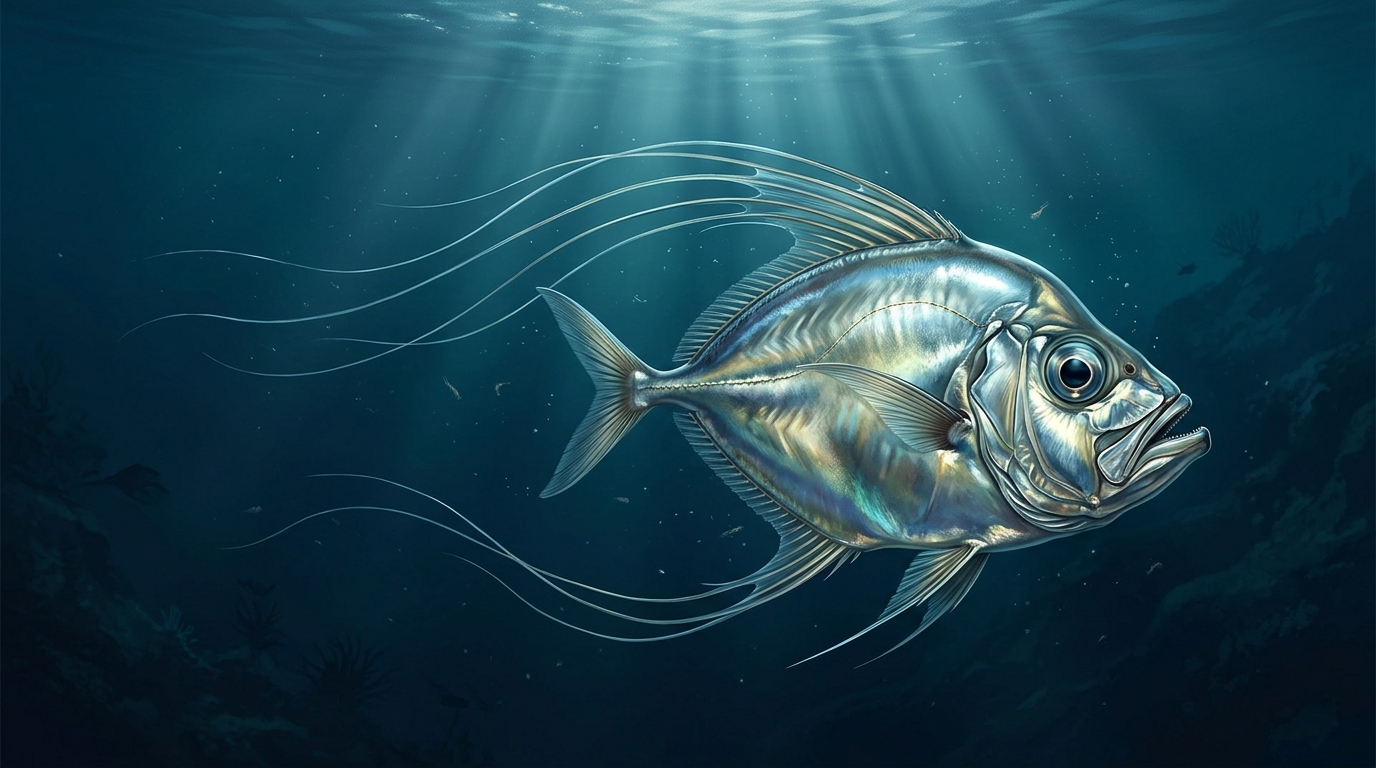
Two small, silvery fish hauled up off the coast of northeastern Taiwan have turned out to be a species never before confirmed in the region: the long-fin mirror dory, Zenopsis filamentosa. The find, documented in a new taxonomic paper in Acta Ichthyologica et Piscatoria, fills a conspicuous gap in the species’ known range between Japan and the South Pacific Ocean, and it settles a decades-old puzzle about a mislabeled photograph from Taiwanese waters.
The specimens were not collected by a research expedition. One, cataloged as NMMB-P35905 and measuring 114.9 millimeters in standard length, was taken off Daxi fishing port in Yilan County on 13 August 2021. The other, NKUST-HO 00002, at 69.7 millimeters, came from waters off Nan-fang-ao fishing port, also in Yilan, on 18 May 2026. Both were landed at local fishing grounds and later deposited in institutional collections at the National Museum of Marine Biology and Aquarium in Pingtung and the National Kaohsiung University of Science and Technology. Because the fish are small, the authors identify both as juveniles.
What made the identification possible was a signature anatomical feature: extraordinarily long filaments trailing from the spinous dorsal fin. In the larger Taiwanese specimen, the longest dorsal-fin filament measures 252.4 percent of standard length; in the smaller one, 200.9 percent. In other words, these trailing threads extend more than twice the length of the fish’s own body. Combined with the absence of bony bucklers above the anal-fin spines, that character matches the diagnosis of Zenopsis filamentosa, a species Kai and Tashiro described only in 2019 from Tosa Bay off Kochi Prefecture, Japan.
The paper includes a full morphological description of the Taiwanese material, supported by photographs of fresh and preserved coloration and by meristic and morphometric tables compared against the original Japanese type series and later records. The Taiwanese fish carry dorsal-fin rays IX, 24–25, anal-fin rays III, 23–24, twelve unbranched pectoral-fin rays on each side, and pelvic-fin rays I, 5. Gill rakers number 10 to 12, and pseudobranchial filaments 17. The body is extremely deep and compressed, rhombus in outline, with strongly convex dorsal and ventral profiles—typical of the dory family Zeidae, a small group of deep-bodied fishes with two genera and six or seven nominal species.
Details of the head and fins reinforce the match. The mouth is superior, strongly oblique and protrusible, with the mandible not fully included when closed. Teeth are small and caniniform, arranged in two irregular rows at the front of the upper jaw and a single row behind, with none on the vomer or palatines. The lateral line arches strongly below the spinous dorsal fin. The dorsal fin bears long spines with the third longest, and the anterior seven spines carry filamentous membranes that are extreme on the second to fourth. Thirteen to fourteen large bucklers run along the dorsal-fin base, while the anal-fin base lacks bucklers above its spines—a distinguishing trait of the species. The pelvic fin is extremely long, reaching about a third of the anal-fin base.
The new record also corrects an old error. Kai and Tashiro had noted that a photograph labeled Zeus faber in Shen’s 1984 work on Taiwanese fishes was in fact a misidentified Zenopsis filamentosa, but that record was omitted from the distribution map in the original species description, and Shen provided no catalog number for the specimen. With no voucher ever indicated, no specimen-based record of the species existed for Taiwan until now. The two newly documented fish therefore represent the first confirmed specimen-based records of Zenopsis filamentosa in Taiwanese waters, and the authors argue they fill a major distribution gap around Taiwan between Japan and the South Pacific.
That broader range now appears to span the western Pacific widely. According to the paper’s distribution summary, the species is known from Japan, the Kyushu–Palau Ridge, Taiwan, Fiji, Tonga, and New Zealand. A distribution map in the article plots the new Taiwanese records as closed symbols against previous records from James and Inada (1990) and Kai and Tashiro (2019). The Taiwanese specimens sit between the Japanese records to the north and the South Pacific records to the south, closing what had been a striking gap in the species’ documented occurrence.
The comparison with earlier records was not without friction. Most measurements of the Taiwanese specimens agree with previous data, but several fall outside known ranges: the smaller specimen shows a distinctly greater body depth, 75.6 percent of standard length against a previously recorded 56.1 to 69.8 percent, and a longer pelvic fin, 68.6 percent against 40.1 to 61.1 percent. Post-orbital length, snout length, head length, and interorbital width also exceed published ranges, while the second, third, and fifth dorsal-fin spines are shorter than previously recorded. The authors flag these discrepancies as warranting further investigation, possibly stemming from differences in measurement methods, and note that the differences do not appear related to growth or geographic population. They also follow earlier authors in counting nine dorsal-fin spines, even though the terminal spine in their specimens is soft and segmented, closely resembling a soft ray.
The paper carries a second, quieter contribution: notes on another dory, Zenopsis stabilispinosa, newly collected from southwestern Taiwan. That specimen, NKUST-HO 00003, 157.0 millimeters in standard length, was taken off Dong-gang fishing port in Pingtung on 14 June 2026 and identified by its seven dorsal-fin spines and an immovable third anal-fin spine. It aligns closely with the type series described by Nakabo and colleagues in 2006, except for slightly fewer bucklers in the ventral series. Intriguingly, its dorsal-fin membrane is elongated beyond 118.5 percent of standard length, with the tip broken—a feature strongly reminiscent of Zenopsis filamentosa. Two specimens depicted in Koeda’s 2019 work also show slightly elongated membranes, though apparently less than standard length. The authors judge the elongated membrane in the new specimen to be an unusual intraspecific variation within Zenopsis stabilispinosa rather than evidence of hybrid identity.
Both new Zenopsis records came from commercial fishing operations in Taiwanese waters, and both required careful comparison of counts, measurements, and fin morphology against type material to confirm their identities. With the Taiwanese gap now closed by actual specimens, the known distribution of Zenopsis filamentosa stands on firmer footing across a vast stretch of the western Pacific.
Subject of Research: First specimen-based record of the long-fin mirror dory Zenopsis filamentosa from Taiwan, with notes on a newly collected Zenopsis stabilispinosa specimen
Article Title: New record of the long-fin mirror dory, Zenopsis filamentosa ( Actinopterygii , Zeiformes , Zeidae ), from Taiwan, with notes on Z. stabilispinosa
Article References: Hsu, Y.-C., Ho, H.-C., Su, Y., & Lin, T.-Y. (2026). New record of the long-fin mirror dory, Zenopsis filamentosa (Actinopterygii, Zeiformes, Zeidae), from Taiwan, with notes on Z. stabilispinosa. Acta Ichthyologica et Piscatoria, 56, 467-474. https://doi.org/10.3897/aiep.56.208815
Image Credits: AI Generated
Keywords: Zenopsis filamentosa, long-fin mirror dory, Taiwan, Zeidae, new record, dorsal-fin filaments, Zenopsis stabilispinosa, western Pacific distribution, fish taxonomy, Yilan County, morphometrics, juvenile specimens
News Source: Drew Townsend. (November 3, 2026). Long-fin mirror dory turns up in Taiwan waters for the first time. Scienmag.