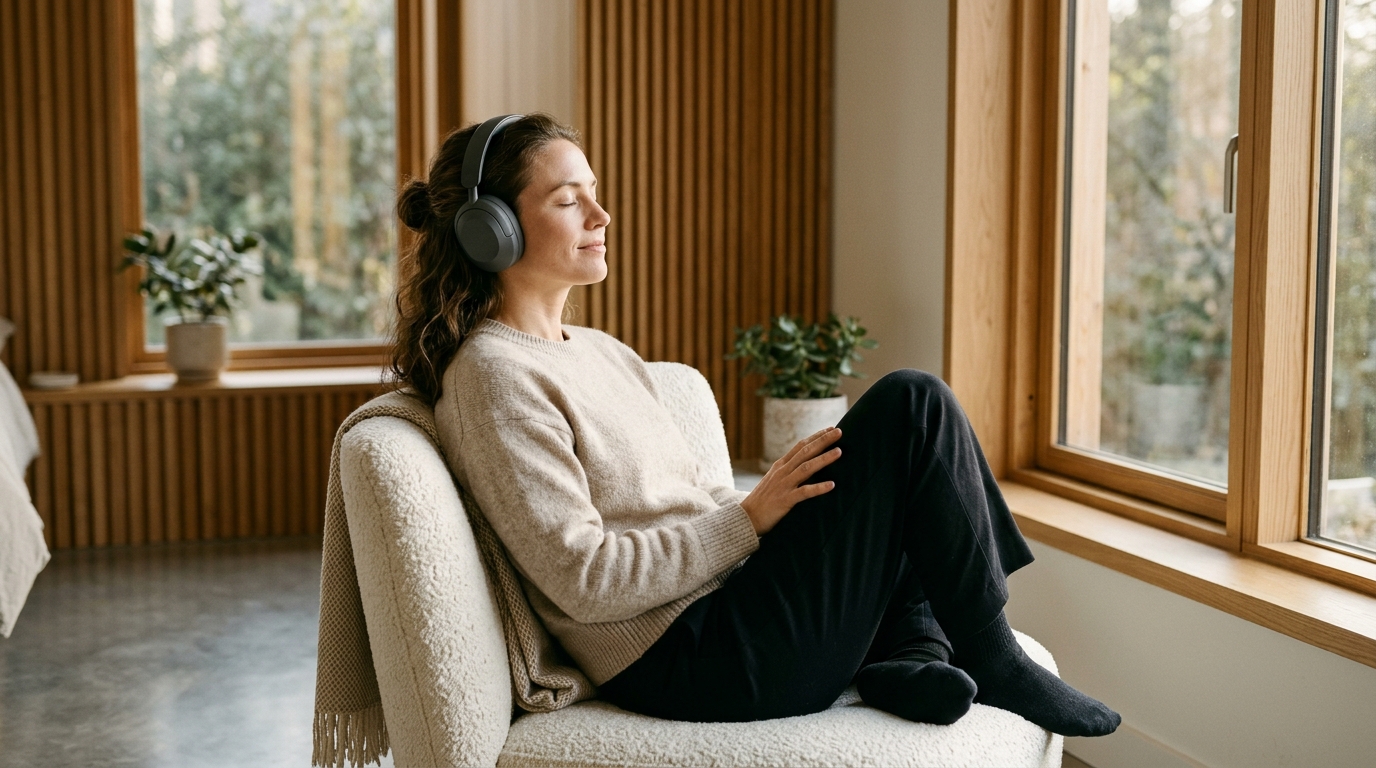
Adding low-key monaural beats to relaxing music reduced anxiety more than the same music on its own, according to two randomized online experiments with people who have moderate trait anxiety. The finding, published in Frontiers in Human Neuroscience, offers some of the first direct evidence that monaural beats embedded in music carry an anxiolytic benefit beyond music alone, and it comes with a striking twist: when the beats were made too loud relative to the music, the benefit not only vanished but reversed.
The research team, led by Tara Venkatesan of Sollos Labs at Universal Music Group and colleagues at the School of Advanced Study and Delft University of Technology, recruited 466 participants across two studies via the Prolific platform. All participants were screened for moderate trait anxiety using the trait subscale of the State–Trait Anxiety Inventory, scoring between 36 and 43. The authors note that this sample was selected on the basis of moderate trait-anxiety scores and should not be interpreted as a clinically diagnosed anxiety disorder sample. Participants listened for 25 minutes and rated their state anxiety, emotional valence and arousal immediately before and after.
Monaural beats are a physical phenomenon, not an illusion. When two pure tones with neighbouring frequencies are summed before reaching the ear, the combined signal carries a physical amplitude envelope that fluctuates at the difference between the two frequencies. Tones at 100 and 104 Hz, for example, produce a beating effect of 4 Hz. Because the modulation is already present in the acoustic signal reaching the cochlea, the auditory system relays a temporally modulated neural response to the brain stem and auditory cortex. This distinguishes monaural beats from binaural beats, which arise only when each ear receives a separate tone and phase-sensitive neurons in the superior olivary complex integrate the bilateral inputs. Comparative studies have found that monaural beats elicit more salient percepts and larger stimulus-locked cortical responses than equivalent binaural beats.
Whether such cortical responses translate into psychological benefit has been far less clear. Prior work on monaural beats showed relaxation-related signals, including reduced skin conductance after an acute stressor with theta-frequency beats and reduced state anxiety compared with a pure tone control, but those studies generally presented beats alone. Some participants report that standalone monaural beats are unpleasant to listen to beyond roughly three to five minutes, which is why beats are frequently blended into music. Yet almost no research had tested whether monaural beats in music outperform the same music without beats, leaving open the possibility that music’s own well-documented anxiolytic effects were doing all the work.
In the first study, 207 participants were randomly assigned to one of four conditions: music alone, or the same 25-minute neo-classical piano piece with monaural beats blended at three different salience levels. The beats were embedded at a 6.67 Hz modulation rate, within the theta range, matched to eighth-notes in the track’s tempo of 100 beats per minute. Carrier frequencies were adjusted with each note onset to keep the modulation stable while producing harmonically consonant pitches in the track’s key of D Major, and both carrier frequencies fell within the same critical band so listeners perceived a single beating stimulus. An adaptive mixing algorithm tracked the short-term loudness of the music in three-second windows and adjusted beat volume accordingly, avoiding the abrupt loudness changes that can sound unpleasant. All stimuli were normalized to an integrated loudness of −20 LUFS-I.
The results showed a clear salience gradient. The Low-Beatmix condition, with beats at a 1:1 amplitude ratio to the music, and the Moderate-Beatmix condition, at 2:1, both produced significantly greater anxiety reductions than music alone, each with a standardized effect of β = −0.46 after Holm-Bonferroni correction (p adjusted = 0.047). The High-Beatmix condition, with beats at 4:1 amplitude, moved in the opposite direction: music alone reduced anxiety more than this heavily beat-laden version, with β = 0.42 at the same adjusted threshold. In raw terms, the music-only group’s mean state anxiety score fell from 34.48 to 30.96, the low- and moderate-beatmix groups fell to 27.30 and 26.35 respectively, while the high-beatmix group actually rose slightly from 35.54 to 36.22. The authors suggest that overly salient beats may counteract the anxiolytic effects seen at lower salience levels, possibly because highly salient beats become aversive, although perceived pleasantness was not directly measured.
Notably, the anxiety benefit did not extend to mood measures in this first study. Time-by-condition interactions were not statistically significant for either valence or arousal, though a valence interaction for the moderate-beatmix condition approached significance in a sensitivity analysis restricted to participants who passed a volume check. Arousal declined over time in all conditions, and no condition changed that trajectory. The sensitivity analysis, which retained 157 participants who passed the volume check, showed a similar overall pattern, with the high-beatmix condition differing from music only at trend level (p adjusted = 0.076).
The second study tested whether the effect generalized beyond a single track. A new sample of 259 participants, screened for moderate trait anxiety and headphone use before randomization, heard one of four stylistically varied tracks—ambient, country-pop, neoclassical and R&B—either with or without monaural beats at the moderate 2:1 ratio. Averaged across tracks, the beatmix conditions produced significantly greater anxiety reductions than music alone (p < 0.0001, β = −0.49), an effect the authors describe as moderate and close to the threshold for strong. The beatmix conditions also produced significantly greater increases in positive valence (p = 0.029, β = 0.28). Mean state anxiety fell from 34.44 to 29.19 in the music-only group and from 36.03 to 26.47 in the beatmix group. As in the first study, arousal showed no significant condition-by-time interaction.
The authors frame these results as preliminary but promising. The theta-frequency range has attracted attention because several electrophysiological studies report stimulus-locked or theta-band neural responses to beats in this range, converging with psychophysiological evidence of lowered heart rate, blood pressure and self-reported anxiety. A recent meta-analysis of binaural beats found medium-to-large effects on anxiety reduction in the theta/delta range (Hedges’ g = 0.69), but comparable evidence for monaural beats embedded in music had been lacking. The new studies address that gap directly, comparing beats-in-music against the identical music without beats rather than against silence or unrelated controls.
Several limitations temper the conclusions. The studies relied entirely on self-reported outcomes from online samples, so the authors cannot determine whether neural entrainment or other frequency-following responses contributed to the observed changes. The design included no non-theta beat-frequency comparison, so specificity to theta-range stimulation remains untested. The first study did not establish a precise dose–response relationship between beat salience and anxiety reduction, and the track set, while stylistically diverse, was not systematically selected to test genres or acoustic characteristics, so the findings should be treated as preliminary evidence of robustness rather than proof of generalizability. Real-world listening also introduces variability in playback equipment, volume, environmental masking and individual hearing differences that may shift perceived beat salience even when the encoded beat-to-music ratio is fixed. The authors suggest that interventions may need calibration procedures to keep beat salience within an effective range, and that future work combining salience manipulations with EEG or magnetoencephalography should test whether salience alters the magnitude of neural responses and whether those responses predict or mediate changes in anxiety and mood.
Subject of Research: Whether theta-frequency monaural beats embedded in music reduce anxiety and improve mood beyond music alone, and how beat salience shapes the effect.
Article Title: Music with monaural beats for anxiety reduction and mood enhancement in individuals with moderate trait-anxiety
Article References: Venkatesan, T., Demetriou, A., Hempel, A., & Micchi, G. (2026). Music with monaural beats for anxiety reduction and mood enhancement in individuals with moderate trait-anxiety. Frontiers in Human Neuroscience, 20, Article 1980343. https://doi.org/10.3389/fnhum.2026.1980343
Image Credits: AI Generated
DOI: 10.3389/fnhum.2026.1980343
Keywords: monaural beats, anxiety, music, theta frequency, auditory beat stimulation, state anxiety, valence, arousal, randomized trial, trait anxiety, mood enhancement, neuroscience
News Source: Glenn Wilkins. (November 6, 2026). Music with Monaural Beats Eases Anxiety More Than Music Alone. Scienmag.