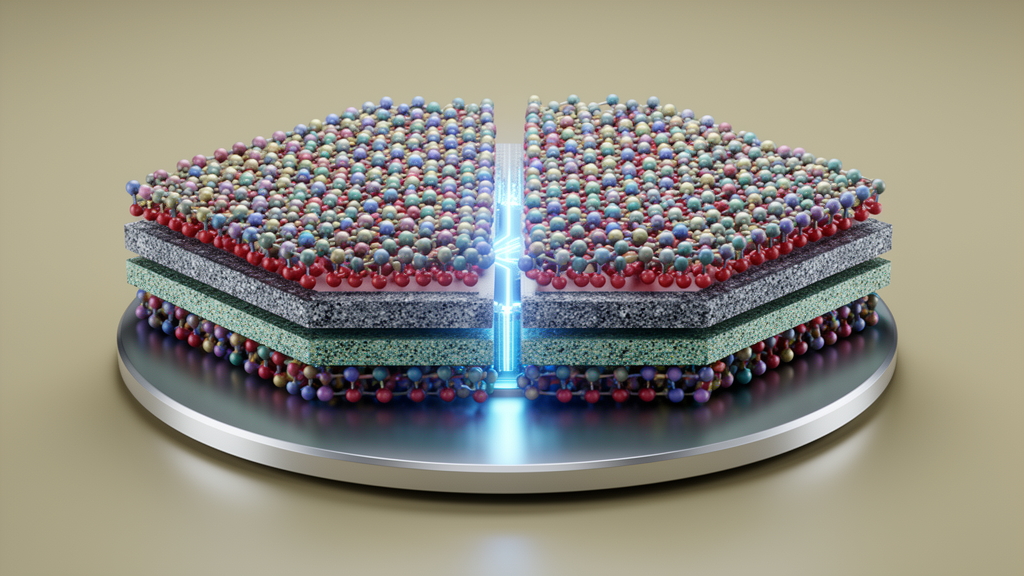
A comprehensive research review by physicists and chemists from the University of KwaZulu-Natal has evaluated the thermodynamic principles, materials architectures, and operating realities governing multiferroic and magnetoelectric thin films across emerging energy technologies. Published in Frontiers in Nanotechnology, the study emphasizes that functional device utility depends fundamentally on the magnitude and operational stability of cross-coupling between order parameters under realistic environmental conditions, rather than on the mere coexistence of ferroic orders within a crystal lattice. Across energy-efficient computing, magnetic-field sensing, vibration scavenging, photoferroic energy conversion, and capacitive storage, thin-film formats provide distinct geometric and physical advantages by transforming modest operating voltages into immense electric fields. Nevertheless, the systematic assessment demonstrates that no existing material platform simultaneously achieves strong room-temperature magnetoelectric cross-coupling, minimal dielectric loss, wide signal bandwidth, resilient cycling endurance, and scalable semiconductor integration, creating a substantial performance gap between fundamental laboratory demonstrations and practical commercial devices.
To establish a rigorous framework for device development, the evaluation distinguishes the thermodynamic foundations of intrinsic, strain-mediated, charge-mediated, and exchange-mediated coupling mechanisms. Intrinsic coupling occurs within a single homogeneous crystallographic phase wherein electric polarization and magnetization interact directly, subject to the fundamental thermodynamic stability bound governing reversible linear susceptibilities. Extrinsic or strain-mediated coupling bypasses this single-phase limit by pairing distinct magnetostrictive and piezoelectric layers in composite architectures, where magnetic fields induce mechanical deformation that transfers elastically across phase boundaries to generate piezoelectric voltages. Interfacial mechanisms operate within nanoscale heterostructures through electric-field-induced screening charge accumulation, orbital reconstruction, or exchange-bias pinning across ferromagnet-antiferromagnet boundaries. Crucially, the analysis insists that the intrinsic material coefficient, expressed in units such as picoseconds per meter, must never be conflated with the composite voltage coefficient, expressed in millivolts or volts per centimeter-oersted, because composite figures of merit reflect geometry-dependent strain transfer, layer thickness ratios, mechanical boundary constraints, and electromechanical resonance rather than homogeneous single-phase response limits.
Bismuth ferrite serves as the principal single-phase platform for ambient-temperature multiferroic operation, combining a robust ferroelectric polarization near one hundred microcoulombs per square centimeter with canted G-type antiferromagnetic ordering well above room temperature. In the bulk rhombohedral crystal phase, formal bismuth lone-pair stereochemistry drives the off-centering electrical polarization along pseudocubic directions, while iron-oxygen superexchange interactions govern magnetic order. A sixty-two nanometer incommensurate spin cycloid averages the macroscopic canted magnetic moment to nearly zero in bulk form, but thin-film epitaxial constraints, chemical doping, and structural boundaries can modify or suppress this cycloidal modulation. Crucially, deterministically manipulating magnetic order with an applied voltage does not occur through a direct one-hundred-and-eighty-degree polarization reversal; instead, it requires routing switching through successive ferroelastic pathways that rotate both the polar axis and the tied antiferromagnetic easy plane, transferring this rotation via interfacial exchange coupling to reverse the magnetization of an adjacent ferromagnetic layer at room temperature.
Alternative single-phase multiferroic systems illustrate the diverse structural mechanisms that evade traditional transition-metal orbital incompatibilities, though each confronts distinct thermal and synthetic constraints. Improper ferroelectrics, including hexagonal manganites and ferrites, separate primary lattice distortions from electrical polarization, driving polar order parasitically through a unit-cell-tripling trimerization mode that accommodates magnetic transition-metal cations without relying on empty d-orbitals. While hexagonal yttrium manganite exhibits ferroelectric transitions around twelve hundred and fifty Kelvin, its magnetic ordering sets in only near seventy Kelvin, restricting pure compounds to model scientific roles. Hexagonal lutetium ferrite extends magnetic ordering toward one hundred and forty to one hundred and fifty-five Kelvin when stabilized through epitaxial growth, yet direct diffraction demonstrates that ambient magnetism remains elusive in simple films.
Composite multiferroic architectures present an effective route to strong room-temperature magnetoelectric transduction by distributing functional requirements across complementary materials. Vertically aligned nanocomposites achieve self-assembled one-three connectivity when immiscible perovskite and magnetic spinel phases spontaneously separate into columnar nanopillars embedded within a surrounding matrix during vapor-phase deposition. This vertical phase geometry offers massive interfacial contact area and mitigates rigid substrate clamping, yet stochastic pillar placement, chemical interdiffusion, and local electrical leakage through conductive magnetic phases complicate individual element addressing in scaled circuits. In contrast, planar two-two laminates combining magnetostrictive alloys like amorphous iron-cobalt-silicon-boron with sputtered aluminum nitride or piezoelectric ceramics dominate macroscopic sensor and harvesting designs. Thin-film cantilevers exploit mechanical resonance to amplify strain-to-voltage conversion by mechanical quality factors, but rigidly bonded substrates continue to absorb significant in-plane deformation, suppressing voltage output by up to an order of magnitude unless relieved through released membrane structures, van der Waals epitaxy on flexible mica, or micromachined cantilevers.
The survey critically evaluates magnetoelectric energy harvesters designed to scavenge ambient alternating magnetic fields, highlighting an acute operational frequency mismatch that limits thin-film implementation. Ambient magnetic stray fields produced around power utility lines and industrial machinery occur predominantly at fifty to sixty hertz, whereas micromachined thin-film cantilever harvesters typically operate at mechanical resonance frequencies in the kilohertz range. For example, an all-thin-film iron-gallium and lead zirconate titanate cantilever resonant at approximately three point eight kilohertz demonstrated a peak power density of over ten microwatts per cubic millimeter under a one oersted drive, but generated only sixty-six point five picowatts of load power and approximately one point seven millivolts across the piezoelectric layer. Because this millivolt-level output falls well below the operational thresholds required for rectifier cold-starts and energy-management circuits, and since the high quality factor narrows bandwidth to less than two hertz, kilohertz thin-film devices cannot provide meaningful harvesting from mains infrastructure without extensive redesign or non-resonant magnetic-force proof-mass architectures.
In digital information processing, multiferroic heterostructures offer compelling theoretical energy savings by replacing dissipative, current-driven writing mechanisms with capacitive, voltage-driven magnetic switching. Standard magnetic memory technologies require spin-transfer or spin-orbit torques that dissipate substantial ohmic energy within conductive channels, resulting in write budgets spanning hundreds of femtojoules to picojoules per cell. In contrast, charging an ideal magnetoelectric capacitor draws energy governed primarily by electrostatic capacitance and terminal voltage, enabling device roadmaps such as magnetoelectric spin-orbit logic to project sub-nanosecond switching at attojoule-level energy bounds. However, rigorous energy accounting across published experimental nanodevices demonstrates that device leakage currents contribute tenths of a nanojoule when maintained over typical switching pulse durations, several orders of magnitude above projected thermodynamic limits. While voltage-controlled magnetic anisotropy and exchange-bias switching establish non-volatile magnetic bit storage, achieving sub-volt operation across durable cycling targets exceeding ten to the twelfth cycles remains unverified in integrated circuits where wiring, sensing, and clocking overheads dominate total consumption.
Electrically programmed magnon transport across insulating multiferroics expands low-power computing concepts by utilizing spin waves rather than charge currents, but practical implementation faces substantial readout energy penalties. In bismuth ferrite channels, the intrinsic coupling between ferroelectric polarization and the in-plane cycloidal spin texture allows non-local spin signals to be modulated and retained after removing the programming electric field. Experimental single-domain transport measurements required milliwatt-level injector power averaged over seconds, with a two-milliwatt injector dissipating approximately two nanojoules per microsecond of read operation. Consequently, while non-volatile ferroelectric programming avoids steady-state standby power, the recurrent energy expenditure demanded by magnon generation and detection currently negates active-stage energy advantages unless injector dissipation can be reduced to microwatt levels without degrading output contrast.
Direct-effect magnetic-field sensors and capacitive energy-storage devices represent contrasting endpoints of the thin-film multiferroic landscape, operating under divergent functional priorities. Resonant magnetoelectric cantilevers incorporating exchange-biased multilayers eliminate bulky external bias magnets and achieve limits of detection approaching picotesla levels, though detecting low-frequency biomagnetic signals requires frequency-conversion techniques like delta-E detuning or carrier modulation to shift signals into high-sensitivity resonance windows. Concurrently, bismuth-ferrite-based relaxor solid solutions with barium titanate and strontium titanate demonstrate high recoverable dielectric energy densities exceeding one hundred joules per cubic centimeter with efficiencies near eighty percent under extreme breakdown fields of several megavolts per centimeter. Crucially, the authors clarify that these exceptional energy-storage figures of merit arise entirely from electric polarization dynamics, high dielectric permittivity, and slim hysteresis loops, without relying on multiferroic magnetic coupling, illustrating how polar oxide materials frequently diverge from cross-coupled functionalities when optimized for specific electrical tasks.
Bridging the persistent divide between isolated material demonstrations and commercial energy technologies requires reconciling high-temperature oxide epitaxy with back-end-of-line complementary metal-oxide-semiconductor processing constraints. Leading multiferroic thin films require single-crystal oxide substrates and deposition or annealing temperatures between five hundred and fifty and eight hundred degrees Celsius to achieve phase purity and full crystallization, conflicting directly with the strict four-hundred to four-hundred-and-fifty-degree thermal limit of modern semiconductor interconnects. Emerging integration routes, including lower-temperature epitaxial growth on metallic buffers and wafer-scale electrochemical membrane release up to twelve inches in diameter, show promise for separating thermal growth budgets from silicon manufacturing. Ultimately, real progress requires moving beyond nominal composition screenings by employing advanced metrology, Bayesian synthesis optimization, and comprehensive durability testing that rigorously tracks terminal energy dissipation, mechanical fatigue, statistical dielectric breakdown, and magnetic retention under realistic device operating conditions.
Subject of Research: Thermodynamic, materials, and device integration requirements for multiferroic thin-film energy applications
Article Title: Multiferroic thin films for energy applications
Article References: Hlongwane, M., Praveenkumar, N., Mdlalose, W. B., Singh, T., & Moodley, M. K. (2026). Multiferroic thin films for energy applications. Frontiers in Nanotechnology, 8, Article 1985102. https://doi.org/10.3389/fnano.2026.1985102
Image Credits: AI Generated
DOI: 10.3389/fnano.2026.1985102
Keywords: multiferroics, magnetoelectric coupling, bismuth ferrite, thin-film heterostructures, energy harvesting, non-volatile memory, MESO logic, spintronics, magnon transport, strain-mediated composites, dielectric energy storage, substrate clamping, CMOS integration, voltage-controlled magnetic anisotropy, exchange bias, piezoelectric transduction
News Source: Denise Maddox. (November 26, 2026). Multiferroic Thin Film Devices Face Critical Performance and Integration Hurdles. Scienmag.