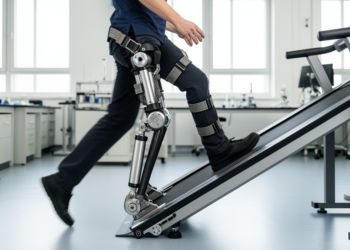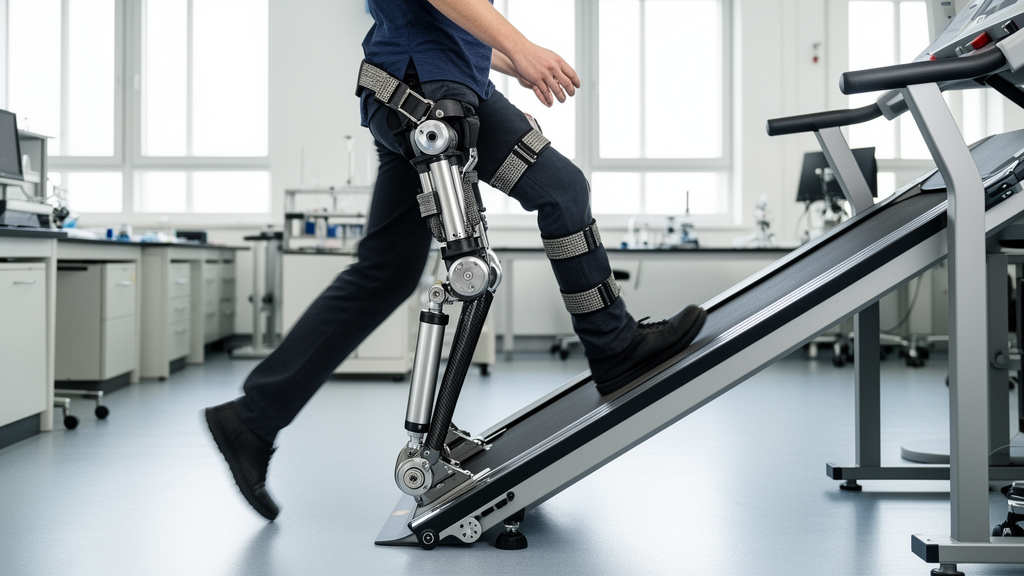
Biomechanical engineers have introduced a two-layered computational design optimization platform that leverages forward dynamics predictive simulation to determine the optimal physical and control configurations for assistive wearable devices without requiring human participants in experimental evaluation loops. Developed in Python and SCONE, the new methodology tackles the computational bottlenecks created by high-dimensional design spaces, which typically render systematic parameter sweeps computationally prohibitive. In a demonstration study, researchers utilized the nested computational framework to design a passive knee exoskeleton incorporating a rotational linear damper and an electronically or mechanically triggered clutch. The simulated intervention aimed to assist able-bodied locomotion across both flat ground and downhill slopes. By predicting neuromuscular adaptations to assistive forces, the simulation platform demonstrated that applying targeted damping resistance during specific phases of gait can dramatically reduce joint contact forces and metabolic effort, providing a quantitative template for building physical prototypes before initiating physical fabrication.
Traditional device development pipelines frequently rely on human-in-the-loop optimization frameworks or inverse dynamics modeling to refine wearable mechanical assistance. While testing physical emulators on human subjects provides direct physiological feedback, the experimental protocol is physically exhausting for participants, exceptionally slow, and intrinsically limited to the specific walking conditions reproduced within a motion-capture laboratory environment. Inverse dynamics offers a computational alternative by tracking recorded kinematics and ground reaction forces, yet it operates under the flawed assumption that user kinematics remain invariant when external forces are applied by wearable orthoses. In contrast, predictive simulation uses forward dynamics driven by neural controllers to anticipate how human neuromuscular control reorganizes in response to device interaction forces. Although forward predictive modeling eliminates the dependency on prerecorded empirical datasets, exploring candidate parameters across multi-dimensional design spaces has historically created an exponential explosion in computational expense when solved over iterative parametric sweeps.
To overcome these dimensional limitations, the newly formulated platform separates the engineering challenge into two coordinated optimization loops. The inner loop, executed within the SCONE software suite using the accelerated Hyfydy forward dynamics simulation engine, resolves the predictive simulation of human movement over ten-second simulation intervals. A two-dimensional musculoskeletal model with nine degrees of freedom and eighteen Hill-type musculotendon units models the human body and incorporates contact spheres beneath each foot to simulate compliant ground interactions. Muscle activations are governed by a modified reflex-based neuromuscular controller, validated for both level and inclined walking. The inner loop employs a Covariance Matrix Adaptation Evolutionary Strategy to optimize forty-five neuromuscular control parameters, seven joint angle offset terms, and a stance load threshold. The objective function of this inner loop explicitly penalizes deviations from a steady walking velocity of one meter per second, excessive metabolic expenditure, extreme ankle deviations, excessive knee joint contact forces, and ground reaction forces exceeding one point four times body weight.
The outer optimization loop functions within Python, utilizing Bayesian optimization via the Scikit-Optimize package to iteratively discover optimal hardware parameters for the assistive wearable device. Bayesian optimization is well-suited for tuning noisy, black-box, and computationally expensive objective functions. The platform models the performance landscape with a Gaussian process using a Matern covariance kernel, updating length scales, covariance amplitude, and noise levels as iterative evaluations proceed. An acquisition function, probabilistically toggled between lower confidence bound, expected improvement, and probability of improvement, strategically selects new design candidates based on prior predictions. The outer cost function balances two critical performance indicators with equal weighting: the normalized biological knee joint load, calculated from the upper quartile of peak stance loads across consecutive strides, and the normalized energetic cost of transport, computed as total metabolic energy expended per unit of distance traveled. Convergence criteria conclude searches when improvements stall below a set threshold across fifteen iterations.
The physical system tested inside this optimization platform was a passive knee exoskeleton model structured upon a previously validated physical frame, featuring a thigh segment weighing one point zero two kilograms and a shank segment weighing one point five seven kilograms. The rotational linear damper applies a resistive torque proportional to the angular velocity of the knee joint according to linear damping dynamics. The optimization problem tasked the Bayesian algorithm with resolving two parameters: the continuous damping coefficient, constrained between zero and twenty Newton-meter-seconds per radian, and the discrete engagement schedule of the clutch mechanism. The gait cycle was segmented into five SCONE-defined phases: Early Stance, Late Stance, Lift Off, Swing, and Landing. Transition rules between these phases were governed by sagittal foot displacement relative to the pelvis and normalized foot contact loading thresholds. Across thirty-one possible phase combinations, the clutch dictated whether the linear damper engaged to deliver resisting torque or remained freely disengaged to allow unimpeded joint motion.
Simulations of unassisted baseline gait established physiological reference benchmarks for both level walking and downhill walking down a five-degree slope. During simulated baseline downhill locomotion, the biological knee joint exhibited marked biomechanical alterations compared to level walking. Maximum knee flexion during the stance phase increased substantially from twenty-three degrees on flat terrain to thirty-six degrees on the slope, reflecting increased joint flexion to absorb gravitational impact. The peak normalized knee joint load climbed from three point six three to four point seven two times body weight, while the normalized Early Stance knee moment increased from zero point five two to one point four six. Crucially, the biological knee joint dissipated far more energy during downhill walking, with normalized negative peak power jumping from negative one point seven eight on level ground to negative four point seven five on the slope, mirroring trends documented in human experimental studies.
When the Bayesian optimizer explored the exoskeleton parameter space, the algorithm converged on the optimal hardware configuration in fifteen iterations for level walking and twenty-eight iterations for downhill gait. Remarkably, the platform selected the identical clutch engagement timing for both locomotor scenarios, specifying damper engagement exclusively during the Early Stance and Late Stance phases while remaining fully disengaged during Lift Off, Swing, and Landing. However, the optimal continuous damping coefficient diverged between the two terrains. The platform identified an optimal damping coefficient of fourteen point eight Newton-meter-seconds per radian for level-ground walking, yielding a minimized total cost function value of zero point seven one. For descending the five-degree incline, the platform identified a higher optimal damping coefficient of sixteen point five Newton-meter-seconds per radian, producing an optimized cost function value of zero point six five, confirming that mechanical energy absorption requirements scale with downward slope steepness.
Application of the optimized damping profiles produced profound kinetic and kinematic reductions across both simulated gaits. The normalized biological knee load peak decreased by thirty-seven percent during level walking and plunged by fifty-three percent during downhill walking. The peak positive knee moment during Early Stance decreased by approximately forty percent on the downward slope, while remaining essentially unchanged on level ground. Concurrently, the damper applied a peak resistive torque of seventeen point nine Newton-meters during level walking and fifty point five Newton-meters during downhill descent, representing forty-five percent and forty-two percent of biological baseline knee moments, respectively. This external energy dissipation curtailed biological negative joint power peaks during Early Stance by ninety-two percent on level ground and by seventy-one percent on the slope, transferring mechanical braking burdens directly to the exoskeleton structure. Peak knee flexion during downhill stance also diminished by thirty-five percent, falling from thirty-six degrees down to twenty-three point five degrees.
Analysis of underlying muscle tendon unit dynamics revealed a condition-dependent reorganization of lower-limb motor control strategies. During assisted level-ground walking, forces across monoarticular vasti extensors and biarticular hamstrings decreased markedly, whereas the biarticular rectus femoris and gastrocnemius muscles exhibited force increases to maintain forward momentum and dynamic stability. Non-knee muscles including the iliopsoas, gluteus maximus, and tibialis anterior experienced lower peak stance forces, while the soleus muscle generated increased force. In contrast, assisted downhill walking elicited an across-the-board suppression of muscular forces among knee-crossing muscle groups. Peak stance forces in the vasti, hamstrings, and gastrocnemius were reduced simultaneously, while rectus femoris force remained comparable to baseline levels. These muscular adaptations demonstrate that the exoskeleton achieves joint unloading not merely through passive structural load carriage, but by reshaping biological recruitment patterns to minimize internal joint compression while preserving forward progression and overall gait stability.
The computational efficiency of the Bayesian optimization architecture proved significantly superior to brute-force parameter evaluation. Mapping the entire design space through exhaustive simulation across forty-one damping values and thirty-one clutch combinations required twelve hundred and seventy-one simulations, totaling between one hundred and eight and two hundred and seventeen hours of compute time on a standard desktop processor. The Bayesian optimizer located identical or near-identical minimum cost solutions within nine to seventeen computational hours, requiring only one hundred and sixty total iterations for level ground and eighty-three iterations for downhill slope across five seeds. Repeated trials across twenty random initialization seeds confirmed high algorithmic stability, exhibiting narrow cost variance and near-identical median values. While physical prototyping and human experimental validation remain necessary to confirm predictive fidelity against soft-tissue compliance and real-world interface dynamics, this predictive simulation platform demonstrates that multi-layered algorithmic optimization can systematically guide wearable robotic design and accelerate physical device development.
Subject of Research: Two-level predictive simulation and Bayesian optimization framework for designing passive knee damper exoskeletons
Article Title: Design optimization platform for assistive wearable devices applied to a knee damper exoskeleton
Article References: Mahmoudi, A., Rinderknecht, S., Seyfarth, A., & Sharbafi, M. A. (2025). Design optimization platform for assistive wearable devices applied to a knee damper exoskeleton. Wearable Technologies, 6, Article e30. https://doi.org/10.1017/wtc.2025.10016
Image Credits: AI Generated
Keywords: wearable robotics, knee exoskeleton, predictive simulation, biomechanical modeling, Bayesian optimization, SCONE software, Hyfydy engine, locomotion biomechanics, damping torque, cost of transport, downhill walking, knee joint load, neuromuscular control, clutch mechanism, CMA-ES, human movement, passive exoskeleton, gait cycle
News Source: Denise Maddox. (November 26, 2026). Predictive Simulation Platform Optimizes Knee Exoskeleton Damper for Level and Sloped Gait. Scienmag.