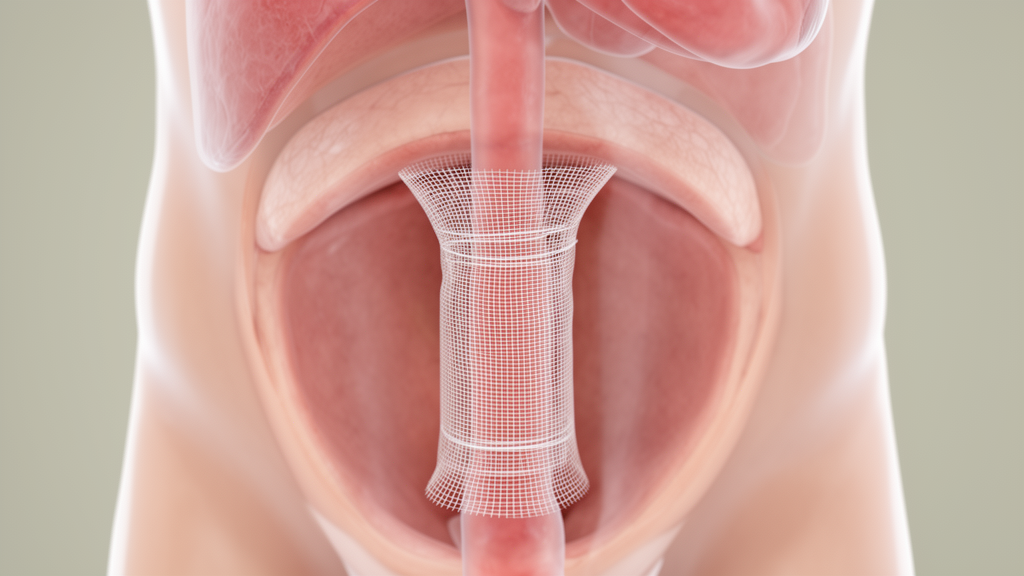
In a retrospective single-center investigation assessing surgical outcomes among individuals undergoing permanent end colostomy for colorectal malignancies, investigators at Oulu University Hospital determined that prophylactic placement of a funnel-shaped chimney mesh resulted in a pronounced divergence between radiological and clinical manifestations of parastomal herniation. While postoperative computed tomography detected parastomal hernias in approximately fifty-nine percent of evaluated individuals during systematic surveillance, the incidence of clinically discernible herniation remained markedly suppressed at approximately five percent across the full clinical cohort. Furthermore, documented manifestations of hernia-related discomfort or functional distress affected merely two percent of the total surgical population, and no patients required operative intervention solely to address parastomal herniation throughout follow-up. These documented findings offer meaningful real-world insight into abdominal wall reinforcement, demonstrating that while subclinical structural disruptions frequently register on cross-sectional diagnostic imaging following colorectal cancer surgery, the actual burden of symptomatic bulging, mechanical impairment, and stoma-specific surgical revision remained exceptionally limited among patients receiving this specialized funnel-configured synthetic mesh prosthesis.
Parastomal hernia represents the most prevalent surgical complication encountered following the creation of a permanent end colostomy, historically demonstrating an occurrence rate surpassing fifty percent when primary operations proceed without dedicated prophylactic reinforcement measures. To mitigate this pervasive postoperative morbidity, reconstructive surgeons previously implemented flat prosthetic materials utilizing a traditional retrorectus keyhole configuration, yet recent clinical investigations demonstrated that such keyhole techniques failed to prevent stomal herniation. Consequently, surgical specialists developed the alternative funnel-shaped chimney mesh design, structured intentionally to overcome the anatomical and mechanical shortcomings inherent to retrorectus slit constructs by accommodating the emerging intestinal conduit through an integrated cylindrical sleeve. Earlier observational series and institutional cohorts suggested that this three-dimensional intra-abdominal geometry could prevent substantial proportions of stoma site herniations without exposing recipients to disproportionate surgical hazards. Moreover, recent evidence derived from the randomized controlled Chimney Trial confirmed significant reductions in both clinical and computed tomography-verified hernia rates at twelve-month and three-year follow-up points compared against unreinforced surgical controls.
To clarify how prophylactic chimney mesh behaves within routine surgical practice outside strictly regulated experimental trials, researchers conducted a comprehensive retrospective cohort investigation encompassing consecutive colorectal cancer patients who underwent curative resection with permanent end colostomy construction at Oulu University Hospital between May 2018 and November 2024. Institutional ethical approval was secured prior to study commencement under ethical committee permission number eighty-one of 2021, with participant consent waived because the investigative framework relied exclusively upon existing institutional registries and clinical documentation. The formal enrollment window originated with the first clinical application of the chimney mesh technique at the tertiary center in May 2018 and terminated in November 2024, thereby guaranteeing that baseline twelve-month surveillance imaging remained accessible when radiologists initiated retrospective radiological evaluations in November 2025. To safeguard observational validity and prevent sample contamination, all individuals previously enrolled in the parallel randomized controlled Chimney Trial were systematically identified and excluded from the present real-world cohort analysis.
The final clinical analysis incorporated a registry population of one hundred and seventy-seven patients who underwent abdominoperineal resection or Hartmann procedures accompanied by prophylactic chimney mesh reinforcement for rectal adenocarcinoma. Among the ninety-six patients with available computed tomography data, the mean age was 68.7 years with a standard deviation of 10.7 years, with men comprising seventy-two individuals and women comprising twenty-four. Regarding systemic health status, seventeen individuals were active smokers and thirty-five were former smokers, while Charlson comorbidity indices demonstrated scores of zero in forty-nine patients, one in twenty-seven, two in ten, three in seven, and four in three patients. American Society of Anesthesiologists scores reflected class one in three individuals, class two in forty-eight, class three in thirty-five, and class four in ten. Primary operations encompassed eighty-four abdominoperineal excisions and twelve Hartmann procedures, accomplished via robotic approaches in fifty-six patients, laparoscopy in twenty-two, open surgery in fifteen, alongside three surgical conversions.
The standardized surgical protocol executed throughout the institutional experience mandated the intraoperative deployment of a dedicated funnel-shaped prophylactic mesh known commercially as Dynamesh IPST. This medical device is fabricated from a composite textile structure integrating polyvinylidene fluoride and polypropylene, purposefully configured for intraperitoneal positioning where an elevated central funnel circumferentially encloses the mobilized bowel loop to reinforce the stoma site against herniation. Surgeons positioned the prosthetic implant during the terminal stages of the colorectal operation, securing the wide planar mesh skirt to the posterior abdominal wall musculature using Securestrap absorbable fixation tackers distributed in an established double crown geometric configuration. By seating the funnel segment closely around the exteriorized colon conduit as it traversed the fascial opening, the operative technique aimed to establish durable anatomical support while preventing adjacent intra-abdominal viscera from migrating along the peritoneal conduit toward the subcutaneous stomal interface under postoperative abdominal pressures.
The designated primary outcome of the investigation focused on computed tomography-confirmed parastomal herniation identified during postoperative radiologic surveillance. Diagnostic computed tomography scans were available for review in ninety-six of the one hundred and seventy-seven total cohort participants, corresponding to fifty-four percent follow-up imaging coverage at a median interval of 12.6 months and an interquartile range extending from 12.1 to 13.7 months from primary surgical extirpation. In total, eighty-six individuals underwent computed tomography at the designated twelve-month surveillance mark, whereas ten additional patients received imaging at alternative follow-up intervals. Cross-sectional examinations were reviewed retrospectively by two hospital radiologists using predefined diagnostic forms adapted from the Chimney Trial protocol, with differing interpretive assessments reconciled through consensus discussions. The radiologists conducted these evaluations without blinding to clinical backgrounds, documenting definitive radiologic herniation in fifty-seven of the ninety-six imaged patients, establishing a computed tomography-verified incidence rate of 59.4 percent alongside a ninety-five percent confidence interval spanning from 49.4 to 68.7 percent.
Detailed radiological categorizations revealed that despite the substantial frequency of computed tomography-detected anomalies, the vast majority of observed protrusions represented structurally minor defects. When classified via the Moreno-Matias radiological framework, fifty of the fifty-seven patients with confirmed herniation, corresponding to 87.7 percent, demonstrated class 1a or class 1b configurations containing exclusively the bowel loop leading to the stoma, comprising twenty class 1a cases and thirty class 1b cases alongside six class two cases and one class three case. Under European Hernia Society criteria, thirty-four individuals exhibited class three defects measuring at least five centimeters, twenty-two exhibited class one defects under five centimeters, and one demonstrated a class four defect, with zero class two defects recorded. Quantitative anatomical measurements established that the mean fascial defect area measured 9.1 square centimeters among hernia cases compared with 5.7 square centimeters among unherniated stomata, while mean hernia sac volume reached 88.5 cubic centimeters and mean distance from the midline was 65.0 millimeters.
In direct contrast to the frequent radiological evidence of structural protrusion, documented clinical manifestations remained exceptionally infrequent across the complete cohort of one hundred and seventy-seven individuals followed over a median clinical duration of 40.7 months with an interquartile range of 28.3 to 52.2 months. Only nine patients, representing 5.1 percent of the surgical collective within a ninety-five percent confidence interval of 2.7 to 9.4 percent, demonstrated a clinically detectable stomal bulge noted during medical record documentation. Even more strikingly, subjective parastomal symptoms were documented in merely four individuals, accounting for just over two percent of the total patient series. Among these symptomatic cases, two patients reported localized physical discomfort or pain, whereas the remaining two individuals presented with noticeable bulging unaccompanied by other symptoms. Furthermore, despite long-term surveillance extending up to several years postoperatively, zero patients in the institutional study underwent subsequent surgical revision or operative repair undertaken exclusively for the clinical indication of parastomal hernia.
Surgical safety assessments revealed that serious stoma-related reoperations occurred in three individuals throughout the extended surveillance window, representing an overall secondary operative rate of 1.7 percent among the one hundred and seventy-seven participants. In the first instance, one patient developed stoma necrosis in the acute postoperative phase, necessitating emergency surgical re-exploration and complete excision of the prophylactic chimney mesh implant; although the terminal stoma was retained at the primary abdominal site without inserting a secondary prosthesis, the patient subsequently developed a parastomal hernia during later follow-up. The second major adverse event involved stomal detachment from the skin border, precipitating an abdominal wall infection that required revision colectomy and conversion to an end ileostomy during early postoperative management. The third reoperation involved an emergent re-exploration performed for internal herniation related to adhesions encircling the intra-abdominal mesh structure, which the surgical team successfully managed through operative adhesiolysis alone while safely preserving the original prosthetic mesh in place.
Interpreting these observed outcomes requires careful consideration of several methodological constraints acknowledged by the study authors, foremost being the single-center retrospective design that inherently introduces potential selection and information biases while constraining broad external generalizability across diverse surgical settings. Furthermore, diagnostic cross-sectional imaging was unavailable for forty-six percent of registered patients because Oulu University Hospital operates as a tertiary referral facility serving approximately half of Finland, causing numerous stable patients to pursue routine postoperative oncology scans at local regional hospitals without recorded explanations for missing centralized scans. Additionally, clinical evaluations and symptom recording relied on routine non-standardized chart notes rather than prospective protocolized physical examinations, potentially underestimating mild or transient discomfort. Overall imaging intervals also exhibited notable chronological dispersion ranging from 1.6 to 30.6 months postoperatively. The authors emphasized that given the vast disparity between sixty-percent radiological defects and low rates of clinical distress or reoperation, subsequent research must prioritize standardized patient-reported outcomes and functional endpoints rather than radiological imaging criteria alone.
Subject of Research: Clinical and radiological outcomes of prophylactic chimney mesh in parastomal hernia prevention
Article Title: Outcomes of prophylactic chimney mesh in parastomal hernia prevention after colorectal cancer surgery: a retrospective single-center cohort study
Article References: Suni, R., Nikki, M., Järvinen, J., Rintala, J., Peroja, P., Ohtonen, P., Rautio, T., & Mäkäräinen, E. (2026). Outcomes of prophylactic chimney mesh in parastomal hernia prevention after colorectal cancer surgery: a retrospective single-center cohort study. Journal of Abdominal Wall Surgery, 5, Article 17597. https://doi.org/10.3389/jaws.2026.17597
Image Credits: AI Generated
Keywords: parastomal hernia, chimney mesh, colorectal cancer surgery, permanent end colostomy, computed tomography, abdominoperineal excision, Hartmann's procedure, Moreno-Matias classification, European Hernia Society, Dynamesh IPST, polyvinylidene fluoride, polypropylene mesh, absorbable tackers, stoma complications, retrorectus keyhole technique, reoperation rates, clinical hernia incidence, Oulu University Hospital
News Source: Ophelia Keating. (November 26, 2026). Prophylactic Chimney Mesh Limits Clinical Parastomal Hernias Despite High Computed Tomography Detection. Scienmag.