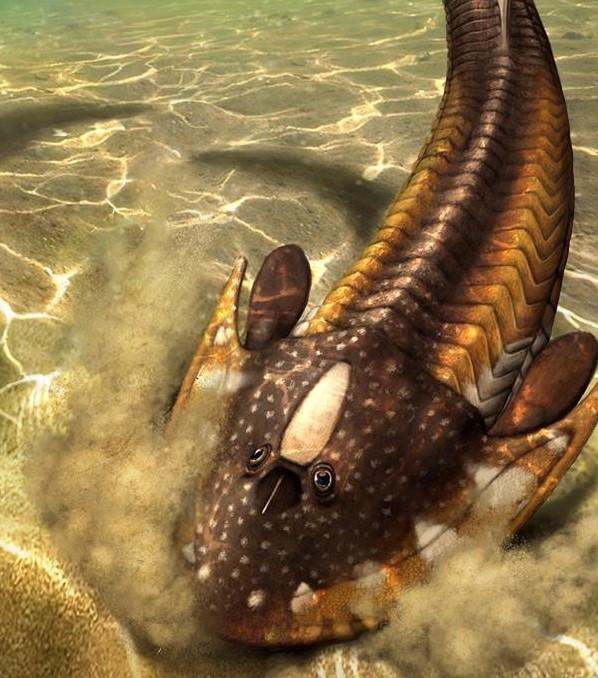
Credit: Hugo Salais (Metazoa Studio)
A team of researchers, led by the University of Bristol, has revealed our most ancient ancestors were ecologically diverse, despite lacking jaws and paired fins.
Long before they evolved out of the water, our ancient ancestors were simple fish-like creatures, but without fins or chins, who survived by filtering nutrients from sediment.
They have long been thought of as the lazy lumps who spent most of their lives resting on or near to the sea floor. The belief was that everything changed with the evolution of jawed vertebrates whose paired fins made them the super-swimmers and active predators, driving their jawless relatives to extinction.
However, a new study published in the journal Current Biology overturns this classical evolutionary story.
Researchers from the University of Bristol used computer simulations to explore how avatars of our extinct ancestors interacted with water currents. These experiments revealed the bizarre spikes and spines that ornamented the heads of these jawless vertebrates were actually hydrodynamic adaptations, passively generating lift from water currents flowing over the body. The varying head shapes of different species allowed them to adapt to different positions, some high, others low, within the water. Our ancient ancestors were already ecologically diverse, long before the evolution of their jawed vertebrate relatives.
Dr Humberto G. Ferron, a postdoctoral researcher from the University of Bristol and one of the paper’s co-authors, said: “The evolution of jaws and fins have classically been seen as the key evolutionary inventions that allowed vertebrates to diversify their lifestyles.
“In this context, jawless ancestors, characterized by the presence of heavy rigid headshields, were assumed to be cumbersome fish-like creatures, living on the bottom of rivers and seas, with poor manoeuvrability.”
The question of how our ancient ancestors made a living has long been a mystery because there are no animals like them alive today. The ‘osteostracans’ (their latin name, meaning bony shells) were heavily armoured, encased in thick bone from snout to tail. They lacked a rear pair of legs and some had none at all; many possessed bizarre horn-like extensions from the front of their heads.
Ferrón and colleagues tackled this problem using state-of-the-art computational engineering techniques that simulate the behaviour of fossil avatars in water currents.
Dr Imran Rahman, from the Oxford University Museum of Natural History, said: “The application of computational fluid dynamics, has allowed us to study the swimming performance of ancient vertebrates and learn more about their position in evolutionary history.
Dr Carlos Martinez Perez, from the University of Valencia (Spain), added: “Our simulations reveal that the different species of osteostracans show equally different hydrodynamic efficiencies. Some of them performed better when moving close to the sea floor or riverbed while others performed better when swimming freely in the water.”
Professor Phil Donoghue, another Bristol co-author, concluded: “The different species’ body shapes are adapted to different environments, revealing distinct lifestyles among these groups of jawless early vertebrates.
“Our results calls into question the prevailing view that these extinct groups of jawless vertebrates were ecologically constrained, and reveals the main evolutionary hypothesis for the origin of jawed vertebrates is more complex than previously thought.”
###
Media Contact
Shona East
[email protected]
Related Journal Article
http://dx.