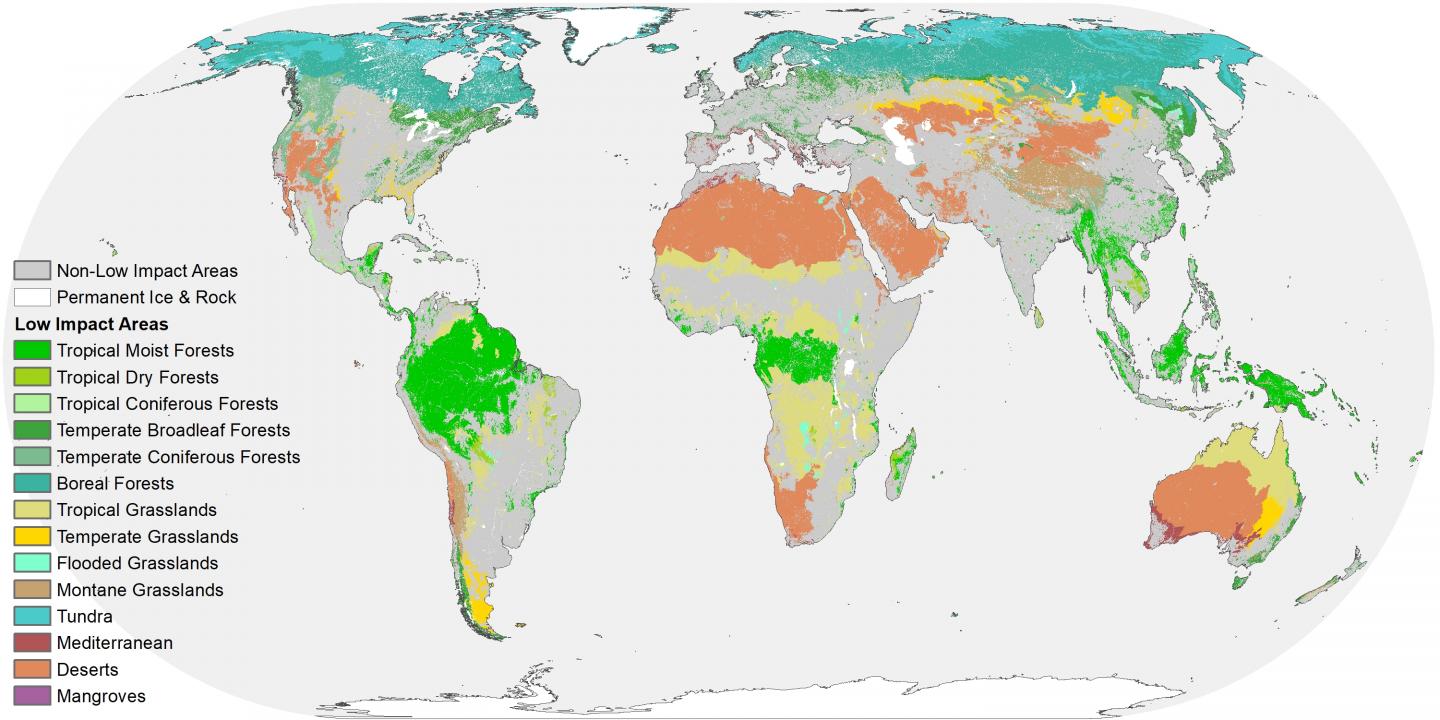
Credit: Andrew Jacobson, Catawba College
Half of the Earth’s land surface not covered with ice remains relatively wild – but many of these “low human-impact” areas are broken into small, isolated pieces, threatening their future.
Those are among the findings of a massive inventory undertaken in 2017 and 2018 by the National Geographic Society and released in early October. The study concludes that despite widespread environmental damage inflicted by human development (e.g. cities and farms), there’s still an opportunity to protect vast, relatively wild regions of the Earth for the benefit of people and other living species.
“It’s not too late to aim high,” said lead author Andrew Jacobson, a geographic information systems professor at Catawba College in North Carolina. Jacobson led a team of researchers using satellite-based mapping techniques to measure human impacts across the globe and to identify areas of lowest human pressure and highest potential for saving intact habitat.
Most of the low impact areas identified by the survey were in the remote boreal forests of northern Canada and Russia, in the highlands of Central Asia, especially Tibet and Mongolia, in the deserts of North Africa and Australia, and in the tropical rain forests of the Amazon Basin of South America.
“This is good news for the planet,” said Jacobson, a scientific and geo-spatial advisor to the Society. “The findings here suggest that roughly half of the ice-free land is still relatively less altered by humans, which leaves open the possibility of expanding the global network of protected areas and building bigger and more connected habitats for species.”
Fragmentation and isolation of wild places
The study focused not only on the location of low human-impact areas but also on their sizes and shapes. Here, the findings were more sobering, showing that many low-impact zones are fragmented into small, isolated pieces, separated either by natural features (water, rocks, ice) or increasingly by human development.
Jason Riggio, a conservation scientist at UC Davis and a co-author of the report, noted the fragility of these fragments. “Half of all segments located in temperate forests, dry tropical forests or tropical conifer forests were within one mile of human disturbance” he said.
Fragmentation can devastate wildlife populations. Animals are cut off from potential mates, food supplies and migration patterns, and they are increasingly exposed to pesticides and other causes of mortality such as roads. Extinction is the eventual result.
“The findings demonstrate that our most diverse systems are among the most threatened and even the low-impact areas, which are often less biologically diverse, are fragmented. If we wish to meet global climate targets and sustainable development goals while averting an extinction crisis, we must encourage greater protection of our remaining natural ecosystems,” said Jonathan Baillie, the National Geographic Society’s executive vice president and chief scientist. Baillie, along with the Society’s geographer, Alex Tait, were the chief advisors and co-authors on the ground-breaking report.
The study, “Global areas of low human impact (‘Low Impact Areas’) and fragmentation of the natural world,” was a first of its kind. Never before had habitat loss and the splintering of habitats into small, isolated fragments been measured simultaneously across the planet while also being compared to natural baseline data, according to the Society.
“This paper shows that it’s late in the game, but not too late,” Jacobson said. “We can still greatly increase the extent of the world’s protected areas, but we must act quickly. Pressures are mounting, and habitat loss and fragmentation are rapidly eroding natural systems and the diversity of species they contain.”
###
Media Contact
Andy Fell
[email protected]
530-752-4533
Original Source
https:/
Related Journal Article
http://dx.