• HOME
  • NEWS
  • EXPLORE
    • CAREER
      • Companies
      • Jobs
    • EVENTS
    • iGEM
      • News
      • Team
    • PHOTOS
    • VIDEO
    • WIKI
  • BLOG
  • COMMUNITY
    • FACEBOOK
    • INSTAGRAM
    • TWITTER
Sunday, July 5, 2026
BIOENGINEER.ORG
No Result
View All Result
  • Login
  • HOME
  • NEWS
  • EXPLORE
    • CAREER
      • Companies
      • Jobs
        • Lecturer
        • PhD Studentship
        • Postdoc
        • Research Assistant
    • EVENTS
    • iGEM
      • News
      • Team
    • PHOTOS
    • VIDEO
    • WIKI
  • BLOG
  • COMMUNITY
    • FACEBOOK
    • INSTAGRAM
    • TWITTER
  • HOME
  • NEWS
  • EXPLORE
    • CAREER
      • Companies
      • Jobs
        • Lecturer
        • PhD Studentship
        • Postdoc
        • Research Assistant
    • EVENTS
    • iGEM
      • News
      • Team
    • PHOTOS
    • VIDEO
    • WIKI
  • BLOG
  • COMMUNITY
    • FACEBOOK
    • INSTAGRAM
    • TWITTER
No Result
View All Result
Bioengineer.org
No Result
View All Result
Home NEWS Science News Biology

MSU researchers use 3-D printing to push knowledge of microbial communities

Bioengineer by Bioengineer
May 24, 2019
in Biology
Reading Time: 3 mins read
0
IMAGE
Share on FacebookShare on TwitterShare on LinkedinShare on RedditShare on Telegram

IMAGE

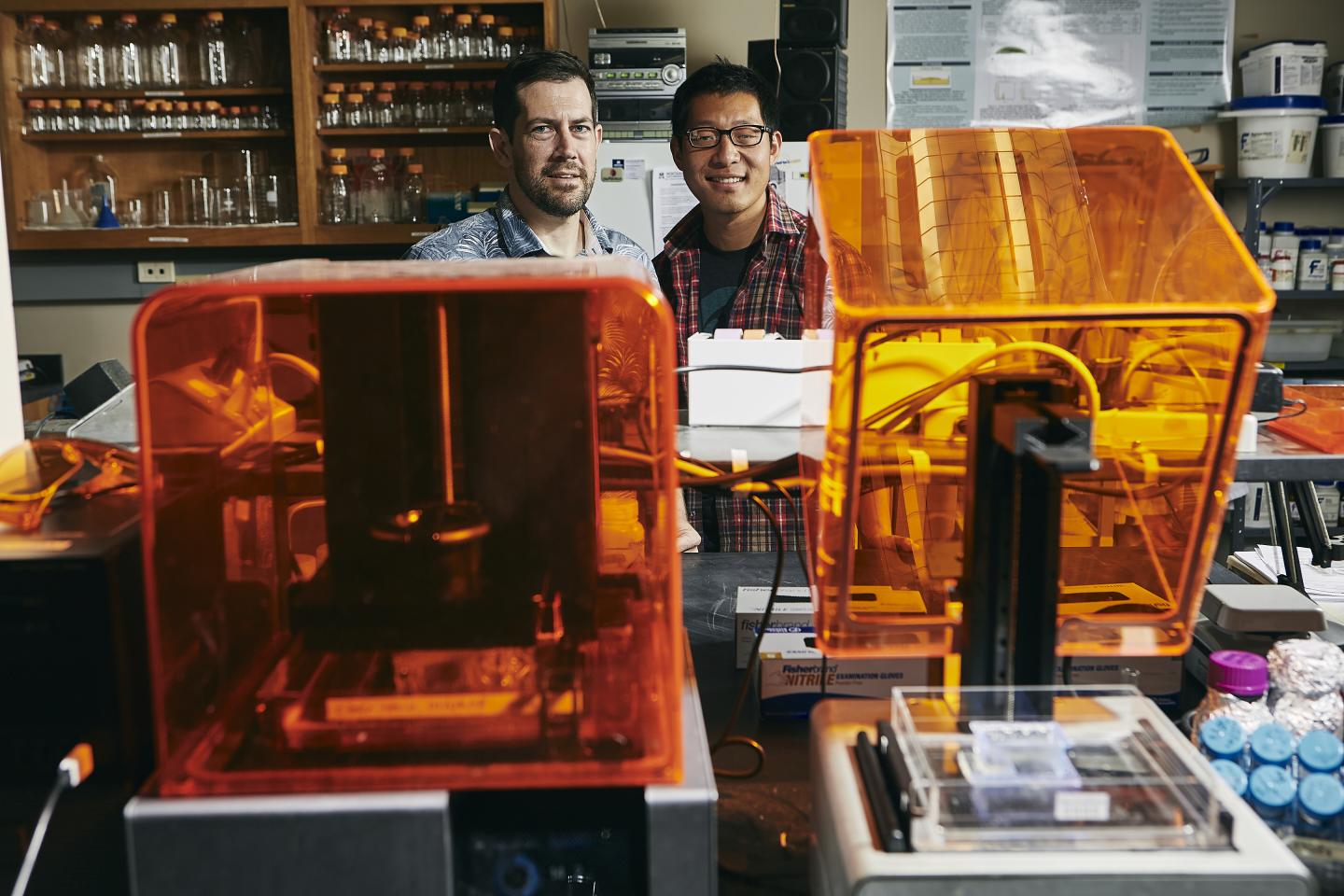
Credit: MSU Photo by Adrian Sanchez-Gonzalez

BOZEMAN — As enthusiasm grows for 3-D printing, hailed by hobbyists and high-tech industry as a new frontier in the creation of custom products, researchers at Montana State University are using the technology for another purpose: studying bacteria.

Backed by a $679,000 grant from the research wing of the U.S. Army, the research could lead to new insights into how microbial communities assemble to create antibiotic-resistant infections on hip implants or remove pollution from groundwater, among other things.

“It’s exciting,” said project co-leader James Wilking, assistant professor in the Department of Chemical and Biological Engineering in MSU’s Norm Asbjornson College of Engineering. “We’re pushing the limits of this technology.”

The project is riding a wave of recent advances in 3-D printers that use lasers to congeal water-based liquids. The result, according to Wilking, is objects that have the consistency of Jell-O and resolution of one micron — roughly 50 times smaller than the width of a human hair.

Until recently, such precise 3-D printers were largely confined to the automotive and aerospace industries because of costs exceeding $1 million. But prices have dropped dramatically in the past decade, making the tools more available for science, Wilking said.

His team, which is co-led by Matthew Fields, director of MSU’s Center for Biofilm Engineering, will use the tool to construct tiny grids of bacteria and study the microbes’ interactions.

All forms of life, whether termites in an earthen mound or grasses on the prairie, assemble to perform basic functions, Fields said, and it’s no different for biofilms, which are microbial communities that structure themselves in thin, slimy mats. Studying biofilms is a challenge because those structures are often spontaneous, ever-changing and situated in living systems like the human body.

Wilking “is making tools that allow us to control the structure, and we can see how that affects the function,” said Fields, who has studied a wide range of biofilms for decades as a professor in the Department of Microbiology and Immunology in MSU’s College of Agriculture and College of Letters and Science. The use of 3-D printers has the potential to generate major breakthroughs in scientists’ understanding of how biofilms work, he said.

For instance, the 3-D printer could congeal alternating sections of a liquid infused with one type of bacteria, then gel the remaining sections with another bacteria, creating a checkerboard that would mimic how the microbes assemble symbiotically to exchange nutrients.

Scott McCalla, assistant professor in the Department of Mathematical Sciences in the College of Letters and Science, will use sophisticated mathematical modeling to study the patterns that the bacteria form as they grow within the constructed matrix, potentially leading to further insights about the microbes’ behavior. Advanced 3-D mathematical models are a relatively new field, he said.

Wilking said he has watched eagerly for years as the pieces have come together to make the current project possible. The Army grant is the biggest confirmation yet that the research concept’s time has come, he said.

“These are the most interesting projects, the ones that satisfy curiosity and benefit society,” he said.

###

Media Contact
James Wilking
[email protected]

Original Source

https://www.montana.edu/news/18747/msu-researchers-use-3-d-printing-to-push-knowledge-of-microbial-communities

Tags: Biomedical/Environmental/Chemical EngineeringBiotechnologyResearch/DevelopmentTechnology/Engineering/Computer Science
Share13Tweet8Share2ShareShareShare2

Related Posts

Evolution-Inspired Biosensors Revolutionize Lipid Tracking in Real Time — Biology

Evolution-Inspired Biosensors Revolutionize Lipid Tracking in Real Time

July 2, 2026
New Study Reveals How to Reduce Risk of Dangerous Wildlife Encounters This Summer — Biology

New Study Reveals How to Reduce Risk of Dangerous Wildlife Encounters This Summer

July 2, 2026

Hepatic IFRD1 Alleviates Metabolic Dysfunction-Linked Steatohepatitis Through the GLUD1/α-KG Pathway

July 2, 2026

Intricate Food Webs Support Ecosystem Health and Stability

July 2, 2026
Please login to join discussion

POPULAR NEWS

  • Detection of EDCs in Breast Milk and Infant Urine Up to Six Months Highlights Early Exposure Risks

    77 shares
    Share 31 Tweet 19
  • Saying Goodbye to PGY-6: Pediatric Fellowship Realities

    103 shares
    Share 41 Tweet 26
  • New Drug Candidate Developed at McMaster Shows Potential for Treating Brain Cancer

    58 shares
    Share 23 Tweet 15
  • KTU Researchers Explore Ultrasound’s Role in Enhancing Blood Flow Beyond Diagnostics

    53 shares
    Share 21 Tweet 13

About

We bring you the latest biotechnology news from best research centers and universities around the world. Check our website.

Follow us

Recent News

Quasi-Bound States Boost Quantum Well Photoresponse

Lysine Pyruvylation Links Glycolysis to Epigenetics

Multiphysics Coupling: Single vs. Multiple DeepONet Branches

Subscribe to Blog via Email

Success! An email was just sent to confirm your subscription. Please find the email now and click 'Confirm' to start subscribing.

Join 83 other subscribers
  • Contact Us

Bioengineer.org © Copyright 2023 All Rights Reserved.

Welcome Back!

Login to your account below

Forgotten Password?

Retrieve your password

Please enter your username or email address to reset your password.

Log In
No Result
View All Result
  • Homepages
    • Home Page 1
    • Home Page 2
  • News
  • National
  • Business
  • Health
  • Lifestyle
  • Science

Bioengineer.org © Copyright 2023 All Rights Reserved.