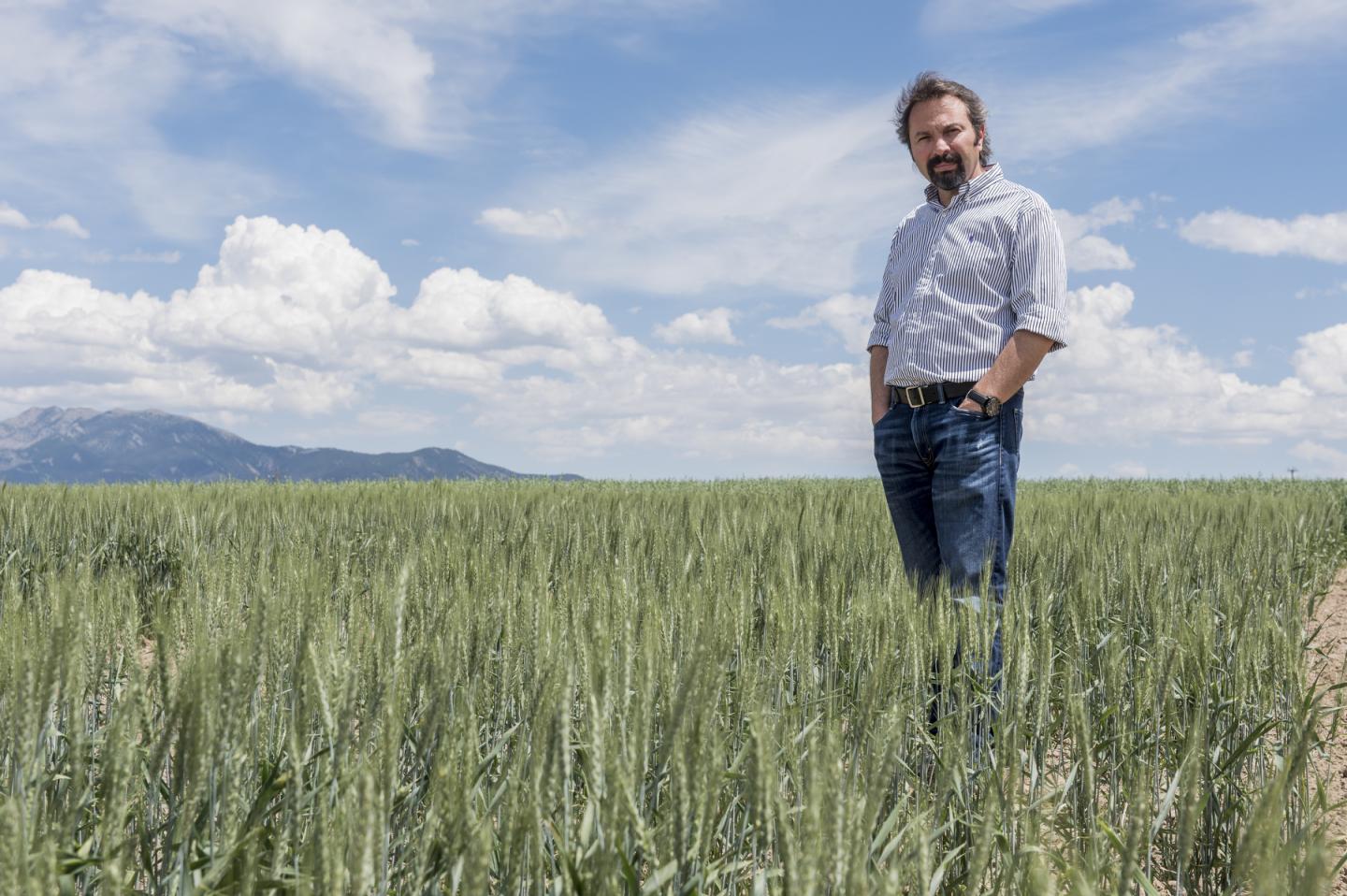

Credit: MSU Photo by Adrian Sanchez-Gonzalez
BOZEMAN – A Montana State University faculty member dedicated to researching cereal genetics and genomics for Montana farmers is part of an international research team that published an article detailing the entire sequence of the wheat genome of bread wheat. The International Wheat Genome Sequencing Consortium published the article in the prestigious journal Science this week. It is the result of 13 years of collaborative international research.
The article will pave the way for the production of wheat varieties better adapted to climate challenges, with higher yields, enhanced nutritional quality and improved sustainability, according to the consortium.
Hikmet Budak, Winifred Asbjornson Plant Sciences Chair in the MSU College of Agriculture and a member of the IWGSC board of directors, was one of more than 200 scientists from 73 research institutions in 20 countries who authored the research article.
"The publication has so many implications not only in science, but in countries facing food insecurity all over the world," Budak said. "This could lead to higher incomes for farmers, better nutrition for world populations and new wheat varieties. The research also offers immense potential for the scientific world to create new discoveries when it comes to agricultural food production and security."
At MSU, Budak and colleagues in the Department of Plant Sciences and Plant Pathology recently sequenced a Montana barley cultivar, Hackett, and they're currently working on sequencing a Montana winter wheat cultivar, Yellowstone.
Sequencing the bread wheat genome was long considered an impossible task, due to its enormous size – five times larger than the human genome – and complexity – bread wheat has three sub-genomes, and more than 85 percent of the genome is composed of similar elements. The article presents the reference genome of the bread wheat variety Chinese Spring. The DNA sequence ordered along the 21 wheat chromosomes is the highest quality genome sequence produced to date for wheat.
According to the Food and Agriculture Organization, in order to meet future demands of a projected world population of 9.6 billion by 2050, wheat productivity must increase by 1.6 percent each year. In order to preserve biodiversity, water and nutrient resources, the majority of this increase must be achieved through crop and trait improvement on currently cultivated land.
A key crop for food security, wheat is the staple food of more than a third of the global human population and accounts for almost 20 percent of the total calories and protein consumed by humans worldwide, more than any other single food source, according to the FAO.
With the reference genome sequence now completed, crop breeders have at their disposal new tools to address these challenges as they will be able to identify more rapidly genes and regulatory elements underlying complex agronomic traits such as yield, grain quality, resistance to fungal diseases and tolerance to abiotic stress. In turn, they can produce hardier wheat varieties.
It's expected that the availability of a high-quality reference genome sequence will boost wheat improvement over the next decades, with benefits similar to those observed with maize and rice after their reference sequences were produced, according to the IWGSC.
"The publication of the wheat reference genome is the culmination of the work of many individuals who came together under the banner of the IWGSC to do what was considered impossible," said Kellye Eversole, executive director of the IWGSC. "The method of producing the reference sequence and the principles and policies of the consortium provides a model for sequencing large, complex plant genomes and reaffirms the importance of international collaborations for advancing food security."
###
The IWGSC, which includes 2,400 members in 68 countries, is an international, collaborative consortium established in 2005 by a group of wheat growers, plant scientists, and public and private breeders. The goal of the IWGSC is to make a high-quality genome sequence of bread wheat publicly available in order to lay a foundation for basic research that will enable breeders to develop improved varieties.
Media Contact
Hikmet Budak
[email protected]
406-994-6717
@montanastate?lang=en
http://www.montana.edu
Original Source
http://www.montana.edu/news/17915/msu-plant-sciences-faculty-part-of-international-discovery-in-wheat-genome-sequence