A new analysis suggests that the movement of plankton and plankton-eating fish play a central role in driving local spikes of extreme biological productivity in tropical coral reefs, creating “sweet spots” of abundant fish. Renato Morais of James Cook University in Townsville, Australia, and colleagues present these findings in a study publishing November 2nd in the open-access journal PLOS Biology.
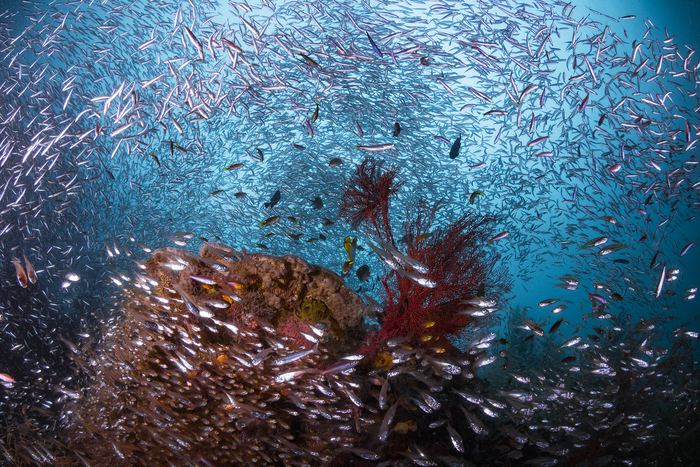
Credit: Emry Oxford, CC BY 4.0 (https://creativecommons.org/licenses/by/4.0/)
A new analysis suggests that the movement of plankton and plankton-eating fish play a central role in driving local spikes of extreme biological productivity in tropical coral reefs, creating “sweet spots” of abundant fish. Renato Morais of James Cook University in Townsville, Australia, and colleagues present these findings in a study publishing November 2nd in the open-access journal PLOS Biology.
Although some ecosystems are limited by their intrinsic productivity (from photosynthesis, for example), previous research has shown that mobile resources like plankton can serve as vectors that transfer energy and nutrients from offshore ecosystems to coral reef ecosystems. Such transfers of resources between ecosystems are known as spatial subsidies, and they enable ecosystems to surpass the limits of their intrinsic capabilities for biological productivity, resulting in more abundant life. However, the extent to which the movement of plankton and plankton-eating fish boost abundance in tropical marine ecosystems has been unclear.
To help clarify and quantify this role, Morais and colleagues integrated and analyzed extensive data from visual fish counts. One dataset covered the tropical waters of the Indian Ocean and much of the Pacific, while the other fish count data came from three specific tropical locations that were representative of the diversity of coral reef ecosystems found in the larger dataset.
The analysis revealed that plankton-eating fish do indeed play a major, widespread role as vectors of spatial subsidies to tropical coral reefs. By feeding on offshore plankton, they deliver extra resources to reef ecosystems and thereby drive local periods of extreme biological productivity—including for their own predators. In these “sweet spots,” plankton-eating fish are responsible for more than 50 percent of the total fish production, and people might find conditions there optimal for bountiful fishing.
The researchers note that their findings hold particular significance for the future of tropical reef fisheries. Coral reefs continue to degrade, and offshore productivity is expected to decline, so sweet spots that concentrate these dwindling resources may increase in importance for fishers.
Morais adds, “How do tropical oceans sustain high production and intense coastal fisheries despite occurring in nutrient-poor oceans? Spatial subsidies vectored by planktivorous fishes dramatically increase local reef fish biomass production, creating ‘sweet spots’ of fish concentration. By harvesting oceanic productivity, planktivorous fishes bypass spatial constraints imposed by local primary productivity, creating ‘oases’ of tropical marine biomass production.”
#####
In your coverage, please use these URLs to provide access to the freely available article in PLOS Biology: http://journals.plos.org/plosbiology/article?id=10.1371/journal.pbio.3001435
Citation: Morais RA, Siqueira AC, Smallhorn-West PF, Bellwood DR (2021) Spatial subsidies drive sweet spots of tropical marine biomass production. PLoS Biol 19(11): e3001435. https://doi.org/10.1371/journal.pbio.3001435
Author Countries: Australia, Malaysia
Funding: Funded by the Australian Research Council through a Laureate Fellowship (FL190100062 to DRB). Also contributed to funding: James Cook University (Postgraduate Research Scholarship to RAM, ACS and PSW, and HDR Competitive Research Training Grant to RAM), the Lizard Island Reef Research Foundation (Lizard Island Doctoral Fellowship to RAM), the Ocean Geographic Society (Elysium Heart of the Coral Triangle Expedition to RAM), the National Geographic Society (CP-137ER-17 to PSW). The funders had no role in study design, data collection and analysis, decision to publish, or preparation of the manuscript.
Journal
PLoS Biology
DOI
10.1371/journal.pbio.3001435
Method of Research
Observational study
Subject of Research
Animals
COI Statement
Competing interests: The authors have declared that no competing interests exist.