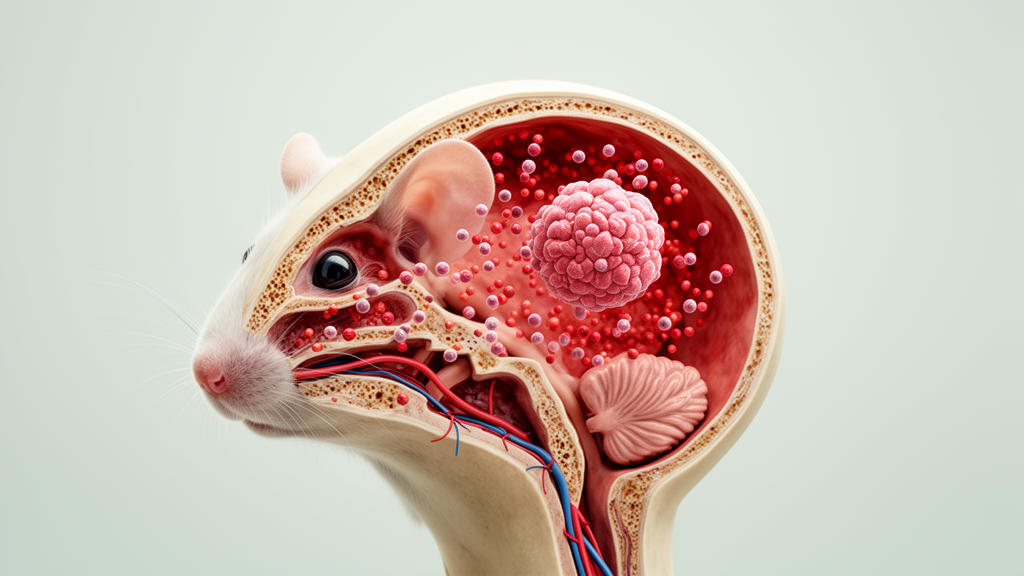
Organized germinal center-like structures inside mouse skull bone marrow can respond to antigens derived from the central nervous system and influence immunity against experimental glioma, according to a research highlight in Cell Research. In the mouse tumor experiments, blocking communication between helper T cells and B cells disrupted these structures, reduced lymphocyte accumulation within tumors and shortened survival. Combining a CD40 agonist with interleukin-21 and interferon-gamma produced the opposite pattern, strengthening skull B-cell responses, increasing immune infiltration and cytotoxic activity in tumors and prolonging survival. The findings establish a local experimental role for skull marrow, not a clinical treatment strategy for human brain tumors.
Skull bone marrow is anatomically positioned to communicate with tissues surrounding the brain. Vascular channels and diploic veins connect the marrow with the dura mater, providing routes for the exchange of cells and soluble molecules. Cerebrospinal fluid can access niches in skull marrow, while the marrow supplies myeloid cells and immature B cells to the meninges and, under some conditions, to the central nervous system parenchyma. Organized lymphoid hubs containing germinal center B cells have also been found around meningeal venous plexuses. Together, these connections support the possibility that the skull houses an immune compartment closely linked to the brain, although the new experiments concern mice and do not show that an equivalent structure has the same function in people.
Park and colleagues first compared bone marrow from the skull, sternum and femur. Skull marrow was enriched in interleukin-21-positive, CXCR5-positive follicular helper T cells, known as Tfh cells. These cells expressed markers associated with a type 1 helper T-cell response and formed clusters with B cells in discrete regions of the skull. Skull marrow also contained increased numbers of class-switched and germinal center-like B cells, immunoglobulin G-positive plasmablasts and antibody-secreting cells. Detailed characterization identified aggregates containing T cells, B cells, antigen-presenting cells, CXCL13, B-cell activating factor, follicular dendritic cells and activation-induced cytidine deaminase-expressing B cells. The study therefore identified an organized lymphoid environment rather than a uniform increase in scattered immune cells.
Functional analysis showed that germinal center-like B cells and antibody-secreting cells in skull marrow underwent clonal expansion and somatic hypermutation. These responses depended on CD4-positive T cells, interleukin-21 and signaling through the CD40-CD40L pathway. The results support a specialized microenvironment capable of supporting a local humoral immune response. They also narrow an important limitation on the finding: skull marrow did not appear to produce these responses independently of the wider immune system. Its lymphoid structures are best understood as a local site of immune activity connected to peripheral immune compartments, not as a self-contained replacement for conventional secondary lymphoid organs.
The investigators next asked whether material originating in the nervous system could activate the skull compartment. They used mice in which neurons expressed a secreted form of ovalbumin, a model protein, and detected the antigen in skull marrow. Antigen-specific CD4-positive T cells and B cells were activated there. This experiment shows that centrally derived material can reach skull marrow and participate in an antigen-specific adaptive response under experimental conditions. It does not establish that every nervous-system antigen produces the same outcome. Other research cited in the highlight found that brain-derived proteins reach skull-associated niches under physiological conditions and are sampled by resident immune cells, but those antigen-sampling B cells displayed a predominantly tolerogenic transcriptional program. In addition, developing B cells reactive to the central nervous system antigen myelin oligodendrocyte glycoprotein have been selectively eliminated in the adjacent meninges. Antigen access alone therefore does not guarantee activation; the anatomical setting and biological conditions of encounter remain important questions.
Gut microbiota and dietary antigens also contributed to the generation of immunoglobulin A-producing and germinal center-like B-cell populations in skull marrow, but they did not fully account for their presence. The evidence therefore links the compartment to influences arising beyond the brain while separately showing that nervous-system-derived antigens can activate it. These results do not identify a single mechanism that determines whether a response becomes productive or tolerogenic. They also leave unresolved whether inflammation or tissue injury changes that balance, and whether comparable responses occur during infection, autoimmunity or neurodegeneration. The study was not designed to answer those questions, and the mouse antigen systems cannot establish how often related structures or responses arise in human disease.
To examine relevance to brain cancer, the researchers implanted CT2A glioma cells intracranially in mice. T-cell and B-cell responses increased within skull marrow following tumor implantation. In a separate set of experiments, CT2A tumor cells expressed a defined model antigen and were combined with antigen-specific lymphocytes; the investigators then detected early activation of tumor-reactive T and B cells in skull marrow. These responses persisted in mice lacking conventional secondary lymphoid organs, although they were diminished and remained dependent on cells recruited from the periphery. The result shows that skull marrow can support a local adaptive response in experimental glioma while still relying partly on the broader immune system. It also indicates that marrow responses can precede or accompany broader immune activation rather than requiring a conventional lymph node to be located inside the skull.
Intervention experiments directly tested whether the skull compartment affected tumor immunity. Local blockade of CD40L disrupted the germinal center-like structures in skull marrow, reduced intratumoral lymphocyte accumulation and diminished activation of CD8-positive T cells, while shortening survival. Conversely, combining a CD40 agonist with interleukin-21 and interferon-gamma enhanced skull B-cell responses, increased immune-cell infiltration and cytotoxic activity within tumors, and prolonged survival in the experimental glioma model. These results are causal evidence within the tested mouse system: changing signaling among skull-associated helper T cells and B cells altered immune readouts and disease outcomes. They remain findings about implanted murine tumors, some of which used cells engineered to express defined antigens, rather than evidence of therapeutic efficacy in patients.
How the mechanism applies to naturally arising human glioblastoma remains uncertain. Glioblastoma is generally considered immunologically cold, with an environment dominated by myeloid cells and relatively limited productive T-cell immunity. Evidence nevertheless exists for a connection between skull-associated immunity and human tumors: tumor-reactive CD8-positive T cells have been identified in cranial bone marrow from patients with glioblastoma, including T-cell receptor clonotypes shared between cranial marrow and matched tumors. That finding does not establish how much those cells contribute to controlling cancer. Immune checkpoint blockade has also had disappointing results in large clinical trials, with nivolumab failing to improve overall survival compared with bevacizumab in recurrent glioblastoma. These observations are compatible with a contribution from skull-associated immunity, but they show that the presence of tumor-reactive lymphocytes does not necessarily translate into an effective antitumor response.
The experimental design also limits direct extrapolation to spontaneous central nervous system tumors. The researchers established tumors by intracranial transplantation, and some experiments relied on defined model antigens to resolve antigen-specific T- and B-cell activation. These controlled systems make mechanistic analysis possible, but they may not reproduce the conditions of tumors that develop naturally within the central nervous system. It remains unresolved whether skull-associated responses are similarly engaged by tumors with lower immunogenicity, whether comparable antigen-responsive lymphoid structures exist in the human skull, and how their contribution compares with that of lymph nodes, the spleen, meninges and other brain-border tissues. What the study establishes is that mouse skull marrow can contain organized lymphoid hubs capable of responding to nervous-system-derived antigens and altering immunity against experimental glioma. What it does not establish is when such responses become functionally important in people or whether manipulating the pathway can control human brain tumors.
Subject of Research: Antigen-responsive lymphoid structures in mouse skull bone marrow and their role in experimental glioma immunity
Article Title: A neighborhood watch within the skull
Article References: Zanluqui, N. G., Latour, Y. L., & McGavern, D. B. (2026). A neighborhood watch within the skull. Cell Research. https://doi.org/10.1038/s41422-026-01310-z
Image Credits: AI Generated
DOI: 10.1038/s41422-026-01310-z
Keywords: skull bone marrow, experimental glioma, germinal center-like structures, follicular helper T cells, B-cell activation, antigen-specific immunity, brain tumor immunity, immune tolerance, mouse models, neighborhood, watch, within
News Source: Nathaniel Bowman. (October 21, 2026). Mouse glioma study links skull marrow immune hubs to tumor control. Scienmag.