• HOME
  • NEWS
  • EXPLORE
    • CAREER
      • Companies
      • Jobs
    • EVENTS
    • iGEM
      • News
      • Team
    • PHOTOS
    • VIDEO
    • WIKI
  • BLOG
  • COMMUNITY
    • FACEBOOK
    • INSTAGRAM
    • TWITTER
Sunday, April 26, 2026
BIOENGINEER.ORG
No Result
View All Result
  • Login
  • HOME
  • NEWS
  • EXPLORE
    • CAREER
      • Companies
      • Jobs
        • Lecturer
        • PhD Studentship
        • Postdoc
        • Research Assistant
    • EVENTS
    • iGEM
      • News
      • Team
    • PHOTOS
    • VIDEO
    • WIKI
  • BLOG
  • COMMUNITY
    • FACEBOOK
    • INSTAGRAM
    • TWITTER
  • HOME
  • NEWS
  • EXPLORE
    • CAREER
      • Companies
      • Jobs
        • Lecturer
        • PhD Studentship
        • Postdoc
        • Research Assistant
    • EVENTS
    • iGEM
      • News
      • Team
    • PHOTOS
    • VIDEO
    • WIKI
  • BLOG
  • COMMUNITY
    • FACEBOOK
    • INSTAGRAM
    • TWITTER
No Result
View All Result
Bioengineer.org
No Result
View All Result
Home NEWS Science News Health

Motor learning for precise motor execution

Bioengineer by Bioengineer
September 25, 2018
in Health
Reading Time: 2 mins read
0
Share on FacebookShare on TwitterShare on LinkedinShare on RedditShare on Telegram
IMAGE

Credit: Tokyo Metropolitan Institute of Medical Science

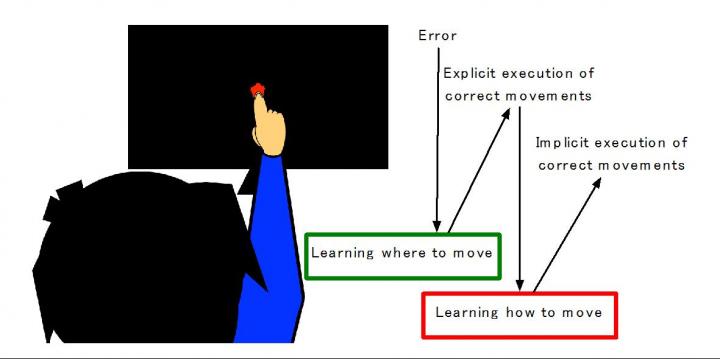
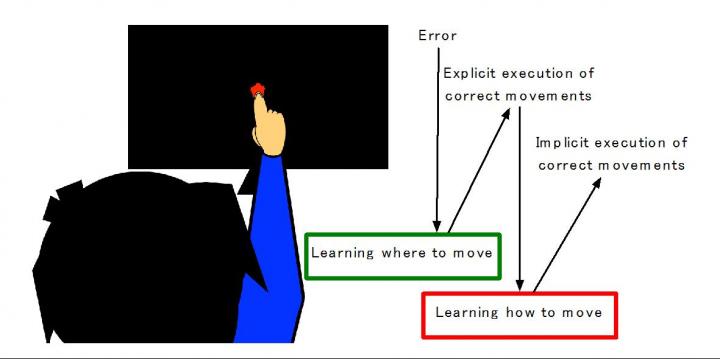
It is generally accepted that precise motor control in our daily life depends on acquisition of an internal model. One motor learning for an internal model is necessary for execution of precise movements in our daily life. There are two hypothetical internal models for motor learning: where to move (i.e. calculation of destination for a given motor command) or how to move (i.e. calculation of motor command for a target). There has been long-standing controversy over "which internal model is actually working in our brain?", for more than 30 years.

Takeru Honda, PhD, a lead author of this study, and his coauthors thought that both internal models are necessary to execute precise movement. If we learn where to move, our brain has to update the mapping from the motor command to the destination of movement. If we learn how to move, our brain has to update the mapping from the target (destination) to the proper motor command. The subjects repeatedly made a reaching movement to touch a target on a touchscreen with the index finger. Then they wore a prism glasses to have their sights shifted rightward. During initial 10 trials after wearing the prism glasses, they were not able to touch the target precisely. Instead, they touched points shifted rightward from the target. After repetitive trials, they eventually learned to touch the target precisely. In this paradigm, the authors found learning elicited by correct touching on the targets and hidden learning elicited by error between the touch position and the target position. They also provided a theory and a simple empirical formulation. Their results show that learning where to move is necessary for explicit execution of correct movements, while learning how to move is necessary for implicit execution of correct movements. Furthermore, their theory predicts that cerebellar damages induce an impairment of "where to move" or an impairment of "how to move". Indeed, we found both types of deficits in cerebellar patients by evaluating them by clinical indexes which we developed.

Therefore, the applications of this finding may help to develop clinical tests to evaluate learning capabilities of different types of cerebellar patients. The test will help to measure effects of various rehabilitations or novel therapies for cerebellar ataxia. In sports field, the present results will also help to develop effective methods of training for top athletes.

###

Media Contact

Takeru Honda
[email protected]

http://www.igakuken.or.jp/

Related Journal Article

http://dx.doi.org/10.1073/pnas.1716489115

Share12Tweet8Share2ShareShareShare2

Related Posts

Social Media Boosts Family Caregivers’ Positive Experiences

April 26, 2026

Advancing Adoptive Cell Therapies for B Lymphoma Through Glycocalyx Engineering

April 26, 2026

Sex Differences in Post-Hip Surgery Fall Fear

April 26, 2026

Multidimensional Stress Impacting Rural China’s Elderly Mental Health

April 26, 2026
Please login to join discussion

POPULAR NEWS

  • Research Indicates Potential Connection Between Prenatal Medication Exposure and Elevated Autism Risk

    822 shares
    Share 329 Tweet 206
  • New Study Reveals Plants Can Detect the Sound of Rain

    686 shares
    Share 274 Tweet 171
  • Scientists Investigate Possible Connection Between COVID-19 and Increased Lung Cancer Risk

    66 shares
    Share 26 Tweet 17
  • Salmonella Haem Blocks Macrophages, Boosts Infection

    60 shares
    Share 24 Tweet 15

About

We bring you the latest biotechnology news from best research centers and universities around the world. Check our website.

Follow us

Recent News

Metal–Organic Framework Breaks Methanol/DMC Azeotrope

Social Media Boosts Family Caregivers’ Positive Experiences

Advancing Adoptive Cell Therapies for B Lymphoma Through Glycocalyx Engineering

Subscribe to Blog via Email

Success! An email was just sent to confirm your subscription. Please find the email now and click 'Confirm' to start subscribing.

Join 81 other subscribers
  • Contact Us

Bioengineer.org © Copyright 2023 All Rights Reserved.

Welcome Back!

Login to your account below

Forgotten Password?

Retrieve your password

Please enter your username or email address to reset your password.

Log In
No Result
View All Result
  • Homepages
    • Home Page 1
    • Home Page 2
  • News
  • National
  • Business
  • Health
  • Lifestyle
  • Science

Bioengineer.org © Copyright 2023 All Rights Reserved.