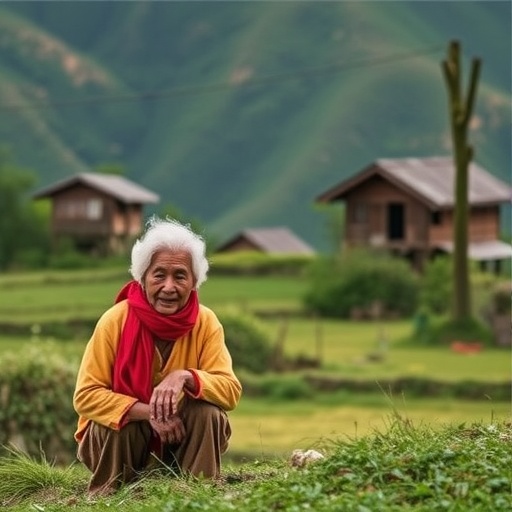
In the sprawling rural landscapes of China, an untold story is emerging—one of silent struggles, layered pressures, and the invisible mental health battles faced by older adults. The latest study led by Dai, Sun, and Wang, set to appear in BMC Geriatrics, unpacks the complex dimensions of stress experienced by this often overlooked demographic. This ground-breaking research offers a nuanced exploration of how multidimensional stress impacts the mental well-being of rural older adults, a topic with profound implications for public health policy and gerontological interventions.
At the heart of this inquiry lies a recognition that stress among older adults in rural China is not monolithic. Rather, it is multifaceted, arising from diverse sources such as financial insecurity, social isolation, health limitations, and caregiving burdens. By adopting a typological approach, the researchers identified distinct patterns of stress exposure, mapping out a spectrum from mild, manageable strains to severe, pervasive stress profiles. This typology challenges the traditional one-dimensional frameworks of stress measurement, presenting a more intricate picture that resonates closely with the lived realities of these communities.
China’s rural populations have long faced unique socio-economic challenges—limited access to healthcare, shrinking family support due to urban migration, and pervasive poverty. These conditions exacerbate stress, particularly among the oldest members who often lack the physical and economic means to cope effectively. The study’s innovative methodology incorporated multidimensional assessment tools that combined subjective self-reports with objective indicators, enabling a robust analysis that captures subtleties missed by conventional surveys.
Mental health among rural older adults in China has historically received insufficient attention, often overshadowed by more immediate economic and physical health concerns. However, this research highlights a compelling correlation between the identified stress typologies and various mental health outcomes, including anxiety, depression, and cognitive decline. Importantly, the findings suggest that certain stress clusters are more predictive of poor mental health, enabling targeted interventions that could prevent the progression of psychological distress.
The implications of these findings reach far beyond academia. They underscore the urgent need for culturally sensitive mental health services tailored to rural older adults’ specific stress profiles. Interventions leveraging community health workers and integrating traditional social support mechanisms with modern psychological care models could address multifactorial stressors holistically. Such strategies could help reverse the current neglect of rural mental health and foster resilience among aging populations.
Crucial to the study’s impact is its sample size and geographic diversity, encompassing multiple provinces known for varying rural characteristics. This breadth enhances the generalizability of conclusions, positioning the research as a national blueprint for understanding rural aging stress dynamics. It also illuminates regional disparities, revealing how local economic conditions and social infrastructures modulate stress experiences significantly.
Technologically, the study utilized advanced statistical clustering techniques to distill typologies from complex datasets, marrying qualitative insights with quantitative precision. This methodological innovation allows for dynamic models of stress that evolve with emerging demographic trends and socio-political shifts within rural China. Such adaptability is vital, given the rapid transformations Chinese rural societies are undergoing amidst modernization and policy reforms.
Beyond the immediate geographic context, this research carries global significance as many countries grapple with aging rural populations increasingly vulnerable to multidimensional stress. The paper’s framework offers a transferable model, encouraging comparative studies across diverse cultural and economic settings. Understanding how stress typologies correlate with mental health outcomes internationally could foster global health initiatives that prioritize mental well-being among older adults.
Furthermore, this investigation broadens the conceptualization of stress itself. It moves beyond the simplistic cause-and-effect paradigm to explore stress as an interactive, systemic phenomenon reflecting intersections between economic, social, and physiological domains. This sophisticated perspective acknowledges the cumulative burden of stress and its capacity to induce changes at the neurobiological level, deepening the understanding of aging-related mental health vulnerabilities.
One of the most striking revelations concerns the interplay between familial dynamics and stress levels. The erosion of traditional family structures, driven by younger generations seeking opportunities in cities, exacerbates feelings of abandonment and loneliness among rural seniors. The study documents how this demographic shift intensifies emotional stress, with cascading effects on mental health, highlighting an urgent socio-cultural challenge facing contemporary China.
Healthcare accessibility and quality emerge as another critical factor influencing stress patterns. The research illustrates how limited medical resources and out-of-pocket healthcare costs place substantial financial strain on rural older adults, compounding their stress load. This dual economic and health-related stress amplifies susceptibility to mental disorders, underscoring the need for policy reforms prioritizing affordable, age-sensitive rural healthcare.
Mental health stigma remains a formidable barrier to recognizing and addressing these challenges. By illuminating the intricate nature of stress among rural elderly populations, the study advocates for destigmatization strategies that empower individuals to seek psychological assistance without fear of social exclusion. Public awareness campaigns, culturally congruent education programs, and community engagement are recommended pathways toward normalizing mental health discourse in rural settings.
The research also explores the protective factors that might buffer the impact of multidimensional stress. Social networks, religious participation, and engagement in physical activities emerged as salient themes associated with reduced stress severity and better mental health indicators. These insights point to the potential of leveraging existing community structures and promoting active lifestyles as cost-effective interventions to enhance resilience.
By shedding light on the nuanced typologies of stress, the study invites policymakers, healthcare providers, and researchers to recalibrate their approach to aging populations. It calls for a paradigm shift towards integrated care models that address not only physical ailments but also the psychological, social, and economic dimensions that jointly shape older adults’ well-being in rural environments.
In conclusion, Dai, Sun, and Wang’s comprehensive investigation into multidimensional stress among rural older adults in China marks a pivotal advancement in geriatric mental health research. It not only broadens scientific understanding but also presents actionable pathways to alleviate the silent epidemic of stress and its mental health consequences. As rural China undergoes rapid demographic and social transitions, the findings serve as a clarion call for urgent, targeted action to foster healthier, happier aging in some of the world’s most vulnerable communities.
Article Title: Multidimensional stress among rural older adults in China: status, typology, and mental health associations
Article References:
Dai, X., Sun, B. & Wang, L. Multidimensional stress among rural older adults in China: status, typology, and mental health associations. BMC Geriatr (2026). https://doi.org/10.1186/s12877-026-07516-5
Image Credits: AI Generated
Tags: caregiving burdens in rural elderlyfinancial insecurity among rural elderlygerontological interventions in rural areashealth limitations and agingmental well-being of older adultsmultidimensional stress in elderlypublic health policy for elderlyrural China’s mental health challengessocial isolation in rural Chinasocio-economic challenges in rural Chinastress patterns in older adultstypological approach to stress