• HOME
  • NEWS
  • EXPLORE
    • CAREER
      • Companies
      • Jobs
    • EVENTS
    • iGEM
      • News
      • Team
    • PHOTOS
    • VIDEO
    • WIKI
  • BLOG
  • COMMUNITY
    • FACEBOOK
    • INSTAGRAM
    • TWITTER
Tuesday, May 19, 2026
BIOENGINEER.ORG
No Result
View All Result
  • Login
  • HOME
  • NEWS
  • EXPLORE
    • CAREER
      • Companies
      • Jobs
        • Lecturer
        • PhD Studentship
        • Postdoc
        • Research Assistant
    • EVENTS
    • iGEM
      • News
      • Team
    • PHOTOS
    • VIDEO
    • WIKI
  • BLOG
  • COMMUNITY
    • FACEBOOK
    • INSTAGRAM
    • TWITTER
  • HOME
  • NEWS
  • EXPLORE
    • CAREER
      • Companies
      • Jobs
        • Lecturer
        • PhD Studentship
        • Postdoc
        • Research Assistant
    • EVENTS
    • iGEM
      • News
      • Team
    • PHOTOS
    • VIDEO
    • WIKI
  • BLOG
  • COMMUNITY
    • FACEBOOK
    • INSTAGRAM
    • TWITTER
No Result
View All Result
Bioengineer.org
No Result
View All Result
Home NEWS Science News Biology

Mother tongue versus father tongue: a new study reconciles the two hypotheses

Bioengineer by Bioengineer
November 3, 2018
in Biology
Reading Time: 2 mins read
0
Share on FacebookShare on TwitterShare on LinkedinShare on RedditShare on Telegram
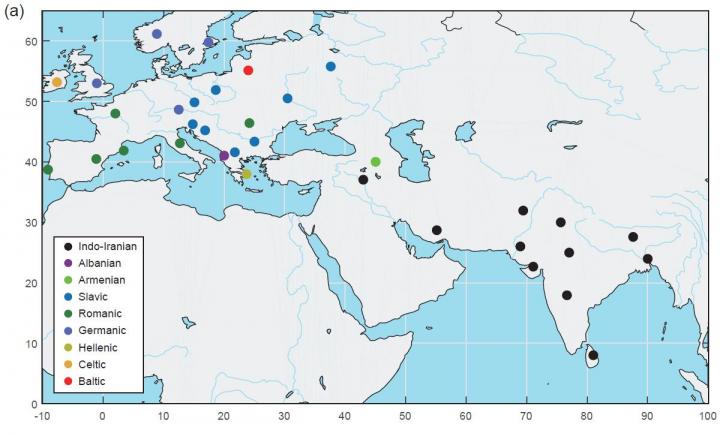
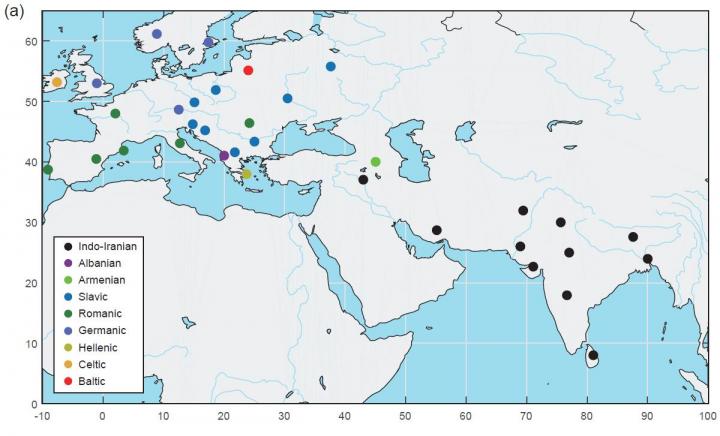
IMAGE
Credit: ©Science China Press

Mother or father who has a stronger influence on their children’s language has puzzled linguists for many years? Mother tongue hypothesis refers to that the language usage follows matrilineal inheritance. Father tongue hypothesis refers to that paternal lines dominate the local language in an already-populated region, which was proposed based on other genetic and anthropological researches.

The team of researchers, led by population geneticist Li Jin, found that in Indo-European populations, the paternal lineages (Y-chromosome) were correlated to the vocabulary (lexicon) of their languages, meanwhile the maternal lineages were associated with their pronunciations (phoneme). For the study, the authors explored the genetic-linguistic relationship of 34 populations speaking different Indo-European (IE) languages. They assembled compositions of the Y-chromosomal and mtDNA haplogroups or paragroups from these IE populations, which reflect paternal and maternal lines, respectively. These haplogroups or paragroups were defined using stable mutations so that they are all formed already in the Paleolithic Age (over 10,000 year). For comparing the IE languages, the basic word list and phonemic inventory they used reflect the vocabulary system and sound system in a language, respectively.

The team found that that the change in lexicon reflects the differences in paternal lines, while phonemic dissimilarity reflects the differences in maternal lines, after removing the effect of geography. Such observations of unbalanced correlations were consistent with different size of lexical dataset, and were successfully evaluated for their robustness based on alternative statistical approaches.

Dr. Menghan Zhang, the first author of this paper indicated that the unbalanced correlation between genetics and linguistics can be explained by male-dominant population contact, and the strategy of language learning by local females which is similar to the second language acquisition.

Referring to the study, authors admitted that this study was on the basis of correlation analysis, but not the causal inference. However, they also proposed one hypothetical scenario of language evolution that father could affect the usage of words, while mother could pass down her pronunciations.

###

The research was published in the National Science Review.

Title: Reconciling the father tongue and mother tongue hypotheses in Indo-European populations

Authors: Menghan Zhang, Hong-Xiang Zheng, Shi Yan, Li Jin

https://doi.org/10.1093/nsr/nwy083

Media Contact

Menghan Zhang
[email protected]

http://www.scichina.com/

Related Journal Article

http://dx.doi.org/10.1093/nsr/nwy083

Share16Tweet8Share2ShareShareShare2

Related Posts

New Insights into How Smoking Causes Lung Stiffness — Biology

New Insights into How Smoking Causes Lung Stiffness

May 19, 2026
Breakthrough Cancer Treatment Effective Across All Organ Types — Biology

Breakthrough Cancer Treatment Effective Across All Organ Types

May 18, 2026

Butyrate Alleviates Temporomandibular Joint Pain via Epigenetic Mechanisms

May 18, 2026

How Hibernation Impacts Visual Processing in Squirrels’ Brains

May 18, 2026
Please login to join discussion

POPULAR NEWS

  • Research Indicates Potential Connection Between Prenatal Medication Exposure and Elevated Autism Risk

    845 shares
    Share 338 Tweet 211
  • New Study Reveals Plants Can Detect the Sound of Rain

    731 shares
    Share 292 Tweet 182
  • Salmonella Haem Blocks Macrophages, Boosts Infection

    62 shares
    Share 25 Tweet 16
  • Breastmilk Balances E. coli and Beneficial Bacteria in Infant Gut Microbiomes

    58 shares
    Share 23 Tweet 15

About

We bring you the latest biotechnology news from best research centers and universities around the world. Check our website.

Follow us

Recent News

AI Revolutionizes Mental Health Care: New Reichman University Study Led by Prof. Anat Shoshani Unveils Therapy at Your Fingertips

Persistent Inequities Continue to Impact Cardiovascular Disease Burden and Care

New Insights into How Smoking Causes Lung Stiffness

Subscribe to Blog via Email

Enter your email address to subscribe to this blog and receive notifications of new posts by email.

Join 82 other subscribers
  • Contact Us

Bioengineer.org © Copyright 2023 All Rights Reserved.

Welcome Back!

Login to your account below

Forgotten Password?

Retrieve your password

Please enter your username or email address to reset your password.

Log In
No Result
View All Result
  • Homepages
    • Home Page 1
    • Home Page 2
  • News
  • National
  • Business
  • Health
  • Lifestyle
  • Science

Bioengineer.org © Copyright 2023 All Rights Reserved.