Feeders or flowers? Researchers compare microbes
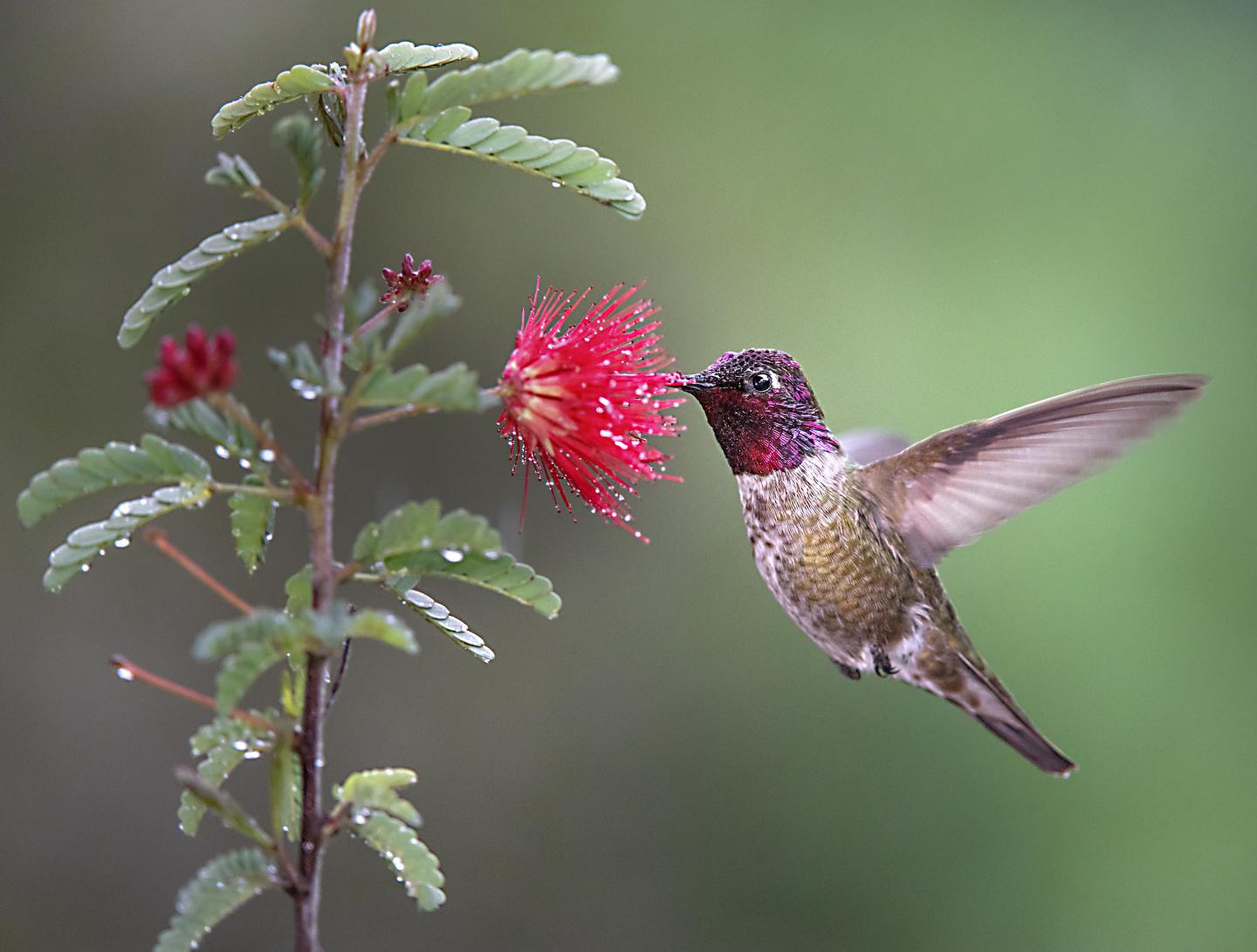
Credit: Scott Logan/Wild Wings Ecology
Many people set up hummingbird feeders in their yards to nurture and watch these high-energy pollinators. But could the sugar water they provide be impacting these tiny feathered friends?
A study led by the University of California, Davis, is one of the first to address the potential for sugar water from hummingbird feeders to act as a vector for avian — or even zoonotic — pathogens. It found that the majority of microbes growing in feeders do not likely pose a significant health hazard to birds or humans.
The research, published March 6 in the Proceedings of the Royal Society B, explored the microbial communities that dwell in sugar water from feeders and compared them to those found in flower nectar and samples from live hummingbirds.
“Although we found high densities of both bacteria and fungi in sugar water samples from feeders, very few of the species found have been reported to cause disease in hummingbirds,” said community ecologist and co-author Rachel Vannette, an assistant professor in the UC Davis Department of Entomology and Nematology. “However, a tiny fraction of those microbes has been associated with disease, so we encourage everyone who provides feeders for hummingbirds to clean their feeders on a regular basis and to avoid cleaning feeders in areas where human food is prepared.”
DIET AFFECTS MICROBES
The UC Davis scientists conducted their research at a private residence in Winters, California, attracting two hummingbird species, Calypte anna (Anna’s hummingbird) and Archilochus alexandri (black-chinned hummingbird) to drop-net feeder traps.
They assessed how water type influences microbial growth. When feeders were exposed to birds, they found that deionized water supports the most fungal growth while tap water or bottled water supports the most bacterial growth.
They also found that birds, feeder sugar-water, and flowers hosted distinct bacterial and fungal communities.
“The microbes that hummingbirds are eating depend a lot on bird diet — if they have access to feeders or are just consuming floral nectar,” Vannette said. “We don’t know what the consequences are for bird health or gastrointestinal flora, but we think that there should be more studies examining this, as many, many people use feeders, and the birds are opportunistic and drink from feeders.”
AVIAN POLLINATORS
Hummingbirds (family Trochilidae) are one of the world’s few avian pollinators. Nearly 15 percent of hummingbird species are threatened or endangered.
“Although our study does not directly inform hummingbird health outcomes, shifts in microbial composition in bird diets may influence bird microbiomes as a consequence,” said co-author Lisa Tell, a professor in the UC Davis School of Veterinary Medicine’s Department of Medicine and Epidemiology. “In the future, it will be important to understand how consumed microbial populations could potentially influence the health of free-ranging hummingbirds, particularly with regards to human-caused effects on wildlife.”
Tell said the best food source for hummingbirds is floral nectar. If feeders are offered, best practices entail routine and thorough cleaning that does not result in harmful residues.
###
The paper, “Microbial Communities in Hummingbird Feeders Are Distinct from Floral Nectar and Influenced by Bird Visitation,” is the work of first author Casie Lee, a UC Davis School of Veterinary Medicine student; Tiffany Hilfer, an undergraduate student and global disease biology major; Tell and Vannette.
Lee led the field experiment and performed bird observations and laboratory work during a summer project funded by the Students Training in Advanced Research, or STAR, and Merial Veterinary Scholars Programs, mentored by Vannette and Tell.
Media Contact
Kat Kerlin
[email protected]
Original Source
https:/
Related Journal Article
http://dx.