• HOME
  • NEWS
  • EXPLORE
    • CAREER
      • Companies
      • Jobs
    • EVENTS
    • iGEM
      • News
      • Team
    • PHOTOS
    • VIDEO
    • WIKI
  • BLOG
  • COMMUNITY
    • FACEBOOK
    • INSTAGRAM
    • TWITTER
Saturday, May 16, 2026
BIOENGINEER.ORG
No Result
View All Result
  • Login
  • HOME
  • NEWS
  • EXPLORE
    • CAREER
      • Companies
      • Jobs
        • Lecturer
        • PhD Studentship
        • Postdoc
        • Research Assistant
    • EVENTS
    • iGEM
      • News
      • Team
    • PHOTOS
    • VIDEO
    • WIKI
  • BLOG
  • COMMUNITY
    • FACEBOOK
    • INSTAGRAM
    • TWITTER
  • HOME
  • NEWS
  • EXPLORE
    • CAREER
      • Companies
      • Jobs
        • Lecturer
        • PhD Studentship
        • Postdoc
        • Research Assistant
    • EVENTS
    • iGEM
      • News
      • Team
    • PHOTOS
    • VIDEO
    • WIKI
  • BLOG
  • COMMUNITY
    • FACEBOOK
    • INSTAGRAM
    • TWITTER
No Result
View All Result
Bioengineer.org
No Result
View All Result
Home NEWS Science News Biology

Moss: a bio-monitor of atmospheric nitrogen deposition in the Yangtze River Delta

Bioengineer by Bioengineer
November 18, 2019
in Biology
Reading Time: 2 mins read
0
IMAGE
Share on FacebookShare on TwitterShare on LinkedinShare on RedditShare on Telegram

IMAGE

Credit: Tao Huang


Atmospheric reactive nitrogen (N) deposition has more than doubled over the past century.  It is very important to estimate the rates and sources of N deposition because it’s considered as a main factor of ecosystem structure changes, such as soil acidification, water eutrophication and biodiversity losses, especially in countries with high N deposition, such as China. However, it is very difficult to obtain monitoring data of atmospheric N deposition because of the complexity of N species and the diversity of deposition forms.

Mosses are very widespread. Almost all of nitrogen for mosses growth are from air and rainfall. Therefore, many researchers investigate N deposition levels and its effects by using moss, especially in Europe and Southwest China. However, whether mosses can be used to monitor atmospheric N deposition in the Yangtze River Delta (YRD) region has yet to be determined.

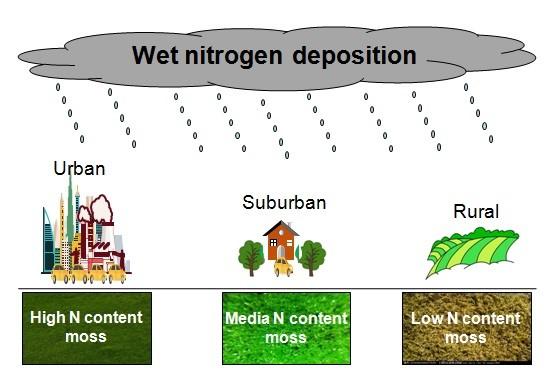
“We collected rainwater and moss tissue at six monitoring sites in the YRD with three land-use types–urban, suburban, and rural and analyzed moss (Haplocladium microphyllum) N content, wet N deposition rate, and their N isotope signatures.” says Dr. Tao Huang, from the School of Geography, Nanjing Normal University.

Based on this study, they found a significant linear relationship between moss N content and wet N deposition rate. In addition, they also determined a consistent decreasing trend for moss N content and wet N deposition from urban to suburban to rural areas. The more negative N isotopic signature of suburban and rural mosses indicated N is mainly released from agricultural ammonia, while the less negative N isotopic signature of urban mosses highlighted a main influence from fossil fuel combustion and traffic emissions. The findings are published in Atmospheric and Oceanic Science Letters.

“The important revelation of our study is that the epilithic moss Haplocladium microphyllum can bio-monitor the rates and sources of atmospheric N deposition in the YRD, making up for the lack of monitoring data of N deposition,” concludes Dr. Huang.

###

Media Contact
Ms. Zheng Lin
[email protected]
86-108-299-5053

Original Source

http://159.226.119.58/aosl/EN/news/news21.shtml

Related Journal Article

http://dx.doi.org/10.1080/16742834.2019.1688629

Tags: AgricultureAtmospheric ScienceEarth ScienceForestryPlant SciencesPollution/Remediation
Share12Tweet8Share2ShareShareShare2

Related Posts

Single mother must adapt swiftly — the survival of her colony depends on it — Biology

Single mother must adapt swiftly — the survival of her colony depends on it

May 15, 2026
Why Are Nearly Everyone Right-Handed? It Might Be Linked to How We Learned to Walk — Biology

Why Are Nearly Everyone Right-Handed? It Might Be Linked to How We Learned to Walk

May 15, 2026

Excessive Neuronal Activity Initiates Severe Autoimmune Brain Disorder

May 15, 2026

Precision Anti-Aging Strategies Focus on Eliminating Harmful Senescent Cells While Preserving Beneficial Ones

May 15, 2026
Please login to join discussion

POPULAR NEWS

  • Research Indicates Potential Connection Between Prenatal Medication Exposure and Elevated Autism Risk

    843 shares
    Share 337 Tweet 211
  • New Study Reveals Plants Can Detect the Sound of Rain

    730 shares
    Share 291 Tweet 182
  • Salmonella Haem Blocks Macrophages, Boosts Infection

    62 shares
    Share 25 Tweet 16
  • Breastmilk Balances E. coli and Beneficial Bacteria in Infant Gut Microbiomes

    58 shares
    Share 23 Tweet 15

About

We bring you the latest biotechnology news from best research centers and universities around the world. Check our website.

Follow us

Recent News

Pembrolizumab and Lenvatinib Trial for Mucosal Melanoma

Carboplatin ± Nivolumab in Metastatic TNBC Trial

New Numeracy Screener Developed for Preschoolers

Subscribe to Blog via Email

Enter your email address to subscribe to this blog and receive notifications of new posts by email.

Join 82 other subscribers
  • Contact Us

Bioengineer.org © Copyright 2023 All Rights Reserved.

Welcome Back!

Login to your account below

Forgotten Password?

Retrieve your password

Please enter your username or email address to reset your password.

Log In
No Result
View All Result
  • Homepages
    • Home Page 1
    • Home Page 2
  • News
  • National
  • Business
  • Health
  • Lifestyle
  • Science

Bioengineer.org © Copyright 2023 All Rights Reserved.