A 2024 deep-sea survey of the Southern Mid-Atlantic Ridge has yielded two new species of mushroom soft coral, identified through a combined analysis of colony anatomy, microscopic skeletal structures and mitochondrial DNA. The animals were named Neoanthomastus longistylus and Anthomastus mirabilis. Eight specimens were collected from separate sites along the ridge at depths ranging from 1,553 to 2,151 metres.
The study provides the first documented occurrence of the genera Neoanthomastus and Anthomastus on the Southern Mid-Atlantic Ridge, while also adding two species to a coral subfamily for which molecular and morphological information remains sparse. The specimens were collected during China’s Ocean 83 cruise aboard the R/V Shenhai Yihao, using the Jiaolong human-operated vehicle. Each animal was photographed at its collection site, recovered to the ship and photographed again on board.
Five specimens were assigned to N. longistylus and three to A. mirabilis. Type material was deposited in the Key Laboratory of Marine Eco-Environmental Science and Technology at the First Institute of Oceanography in Qingdao, China. Taxonomic identification was based on both features visible in intact colonies and details of their internal anatomy.
Researchers used stereomicroscopy to examine the shape and color of each capitulum, or cap, and stalk; they counted and measured the autozooids, the large retractile polyps distributed over the cap, and dissected colonies into tentacles, pharynx, anthocodial wall, cap surface, stalk and holdfast. After cleaning and drying, those sclerites were examined by scanning electron microscopy and classified according to established coral taxonomic criteria. Neoanthomastus longistylus takes its name from its elongated stalk.
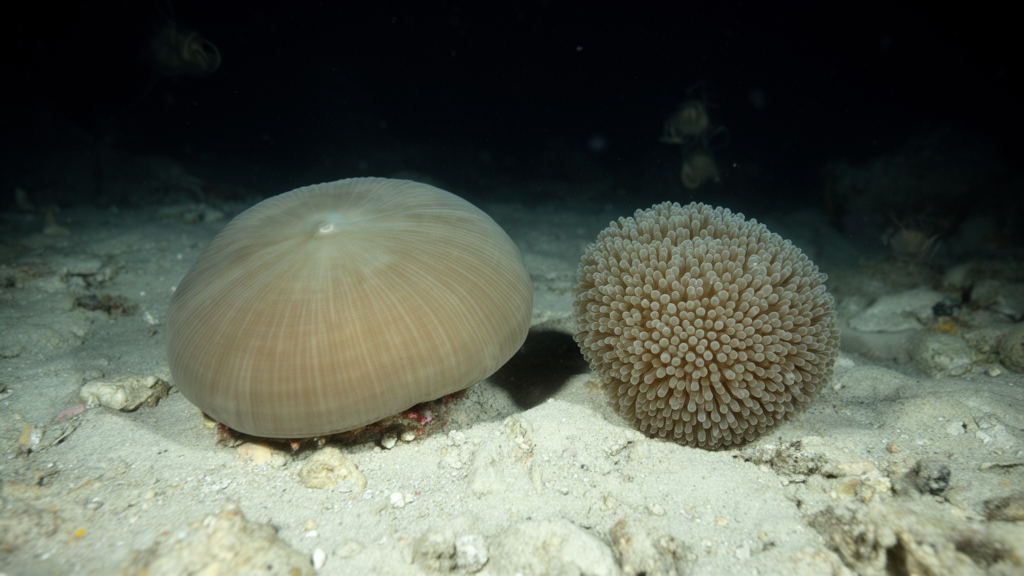
Its holotype has a spheroidal capitulum 17 millimetres in diameter and 15 millimetres high, supported by a conspicuously striated stalk that reaches 45 millimetres in height and narrows toward the cap. The stalk is at least three times longer than its maximum width and approximately 2.5 times longer than the capitulum. The specimen carries 28 large autozooids arranged evenly across the cap, together with small red siphonozooids on the capitulum and upper third of the stalk.
Among the five N. longistylus specimens examined, total colony height ranged from 50 to 120 millimetres and the number of autozooids ranged from nine to 28. The sclerites of N. longistylus provide a detailed combination of characters that separates it from named relatives. Its tentacles contain only straight rods and rods with one curved end.
The species resembles N. giganteus in its long stalk and restriction of siphonozooids to the upper stalk, but differs in its abundant tentacular, pharyngeal and capitular sclerites, unilaterally curved tentacular rods and absence of the spiny dumbbells found in N. giganteus. Anthomastus mirabilis has a more compact form, with a prominent spherical capitulum supported by a short, thick stalk. The holotype stands 42 millimetres high.
Its cap measures 33 millimetres in diameter and 20 millimetres in height, while the cylindrical stalk is 20 millimetres wide and 22 millimetres high. Twenty-two large autozooids are distributed over the capitulum; some were fully retracted in the preserved specimen, while others retained contracted tentacles. The siphonozooids are numerous and inconspicuous among the autozooids.
Live colonies were bright red, becoming vermilion in ethanol, and the tentacle tips were yellowish-white. The specific epithet mirabilis, meaning “wonderful” or “astonishing,” refers to the striking red, spherical colony and its elongated autozooids. Its tentacular sclerites include plates, rods, dumbbells and a few rods with short transverse axes.
The pharynx contains mainly platelets with a distinct median waist, along with a few crosses, while the anthocodial wall includes rods, clubs, dumbbells, multiradiates and crosses. Spindles are absent throughout the capitulum, stalk and holdfast. This absence is important because spindles are a central diagnostic feature of A. grandiflorus, which otherwise has a broadly similar external form.
A. mirabilis also has more varied tentacular sclerites than A. nanhaiensis and A. tongi, and the presence of pharyngeal sclerites distinguishes it from A. bayeri. Complete mitochondrial genomes supplied an independent test of the species’ placement. The circular genome of N. longistylus measured 19,102 base pairs and encoded 14 protein-coding genes, two ribosomal RNA genes and one transfer RNA gene.
The genome of A. mirabilis was longer, at 20,435 base pairs, and contained 17 protein-coding genes, two ribosomal RNA genes and one transfer RNA gene. A. mirabilis carried two copies each of ND6, ND3 and ND4L. Targeted sequencing in three specimens confirmed that each pair occurs at distinct locations in the mitochondrial genome.
The copies were completely identical at the nucleotide level, with no frameshift mutations, disrupted stop codons or non-synonymous substitutions. For the broader phylogenetic analysis, the researchers examined two independent datasets: 47 partial mitochondrial mtMutS sequences, including eight generated for the new species, and 35 complete mitochondrial genomes, including six from the study material. Maximum-likelihood and Bayesian analyses produced congruent tree topologies for both datasets.
Together, the analyses divided Anthomastinae into five clades, placed N. longistylus within the Neoanthomastus clade and A. mirabilis within the Anthomastus clade, and supported the framework established by earlier phylogenetic research. Comparisons based on 14 mitochondrial protein-coding genes found small distances to the closest sampled relatives: 0.0339% between N. longistylus and N. stellatus and 0.0205% between A. mirabilis and A. grandiflorus. Those very small mitochondrial distances do not contradict the species distinctions because anthozoan mitochondrial DNA is known to evolve slowly.
The genetic data were therefore used principally to assess evolutionary placement, while the combination of colony, polyp and sclerite characteristics supplied much of the evidence separating the animals from named species. The authors also note that generic boundaries within Anthomastinae remain incompletely resolved, particularly among Anthomastus, Neoanthomastus and Pseudoanthomastus. Broader molecular sampling, scrutiny of potentially inaccurate annotations in public sequence databases and additional morphological descriptions will be required to refine the taxonomy.
Even with those limitations, the two new records establish the genera on the Southern Mid-Atlantic Ridge and provide a baseline for future ecological assessments of the ridge’s under-sampled coral fauna.
Subject of Research: Morphology, mitochondrial genomes and phylogenetic placement of two new mushroom soft coral species from the Southern Mid-Atlantic Ridge
Article Title: Morphology and phylogeny of two new species of deep-sea mushroom soft corals ( Octocorallia , Corallidae , Anthomastinae ) from the Southern Mid-Atlantic Ridge
Article References: Li, X., Xu, N., Ge, M., Hu, X., Li, M., Wang, Z., Zhang, X., & Xu, Q. (2025). Morphology and phylogeny of two new species of deep-sea mushroom soft corals (Octocorallia, Corallidae, Anthomastinae) from the Southern Mid-Atlantic Ridge. Zoosystematics and Evolution, 101(4), 2103-2121. https://doi.org/10.3897/zse.101.163559
Image Credits: AI Generated
Keywords: deep-sea corals, mushroom soft corals, Southern Mid-Atlantic Ridge, new species, Anthomastinae, Neoanthomastus, Anthomastus, mitochondrial genomes, phylogenetics, sclerite morphology, Morphology, phylogeny
News Source: Drew Townsend. (October 20, 2026). Morphology and DNA identify two new mushroom corals on Southern Mid-Atlantic Ridge. Scienmag.