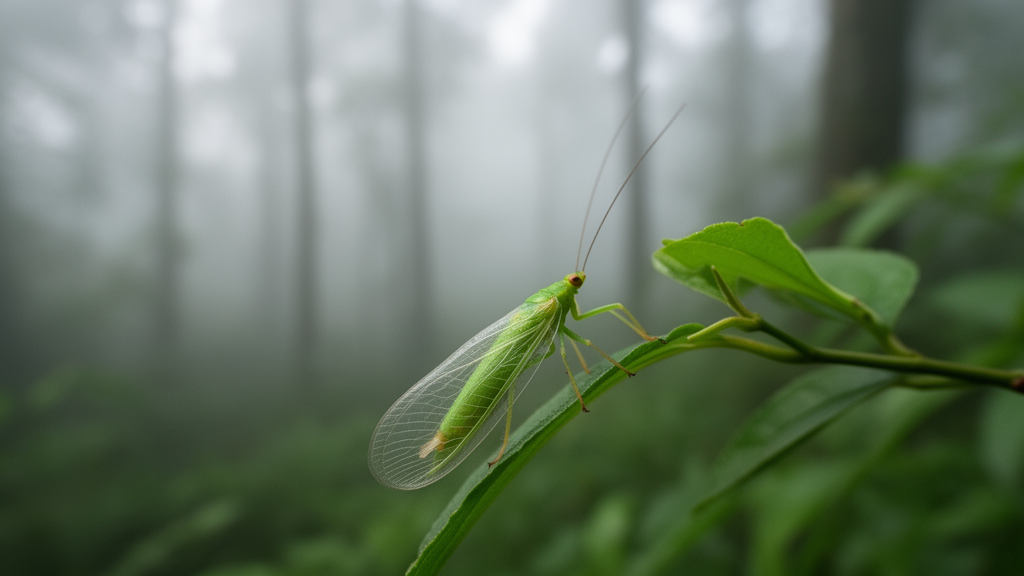
A taxonomic morphology study described four new species of the planthopper genus Andes from southern China: A. cuneatus, A. luchunensis, A. orbiculatus and A. scalpratus. Their formal description raises the number of Andes species recorded in China from 14 to 18.
The study examined dry specimens collected by sweeping in Yunnan and Fujian provinces. Type specimens are deposited in the Institute of Entomology at Guizhou University in Guiyang. Researchers measured body length from the apex of the vertex to the tip of the forewing, measured the vertex from its apical transverse carina to the tip of its basal emargination, and expressed all measurements in millimeters. Male genital segments were removed, macerated in 10% sodium hydroxide, washed and transferred to glycerol. External morphology and drawings were examined with a Leica MZ 12.5 stereomicroscope, while habitus images were obtained with KEYENCE VHX-6000 and VHX-1000 systems.
Andes cuneatus was established from specimens collected in Mengla County and the Gaoligongshan National Nature Reserve in Yunnan. Its name refers to a wedge-shaped process on the apical part of the periandrium. Male body length ranged from 6.2 to 6.8 millimeters for four specimens, and female length ranged from 6.8 to 7.3 millimeters for four specimens. Diagnostic features include a dark-brown general color, an asymmetric anal segment with a larger right lobe, paired spinose processes near the base of the periandrium, a thick dorsal process, a bifurcated fishtail-shaped apical process and a short endosoma without a spinose process. The authors distinguish the species from A. truncatus by differences involving the proportions of the vertex, the shape of the gonostyli and the apical processes of the periandrium.
Andes luchunensis, named for Lüchun County in Yunnan, was collected in the Huanglianshan National Nature Reserve. Its general color is yellowish brown, the basal half of each forewing bears a claw-shaped marking, and the apical two-fifths to four-fifths of the gonostyli are widened. The male periandrium has two bifurcated spinose processes at the apical part of its ventral margin, while the endosoma bends dorsally and bears three apical spinose processes. Male body length was 7.2–7.5 millimeters for nine specimens, and female length was 7.5–8.6 millimeters for seven specimens. The species differs from A. pallidus in coloration, the number of bifurcated spinose processes and the structure of the apical endosoma.
Andes orbiculatus was described from Wanmulin Provincial Nature Reserve in Fujian. The name refers to a circular lamellar process extending from the proximal ventral margin of the periandrium. Other diagnostic traits include wide yellowish-brown markings and three dark-brown spots on the basal half of the forewing, a lanceolate medioventral process and a strongly asymmetrical anal segment whose left lobe extends downward. Male body length measured 5.7–6.3 millimeters for seven specimens, while female length measured 6.2–6.6 millimeters for seven specimens. The authors distinguish it from A. truncatus by the shape of the medioventral process, asymmetry of the anal tube and non-truncate gonostyli.
Andes scalpratus, collected in Xichou County in Yunnan, has an arc-shaped medioventral process and knife-shaped apical parts of the gonostyli in lateral view. Its aedeagus has three processes, and the apical quarter of the endosoma is densely covered with small teeth. Male body length was 6.7–7.3 millimeters for seven specimens, and female length was 7.8–7.9 millimeters for three specimens. Its name refers to the sharp-edged appearance of the gonostyli. The authors compare the species with A. furcutus, reporting differences in the medioventral process, gonostyli and apical endosoma, which lacks the two processes present in A. furcutus.
The paper also updates a key to the males of Andes species occurring in China. The key incorporates external features such as forewing markings, coloration and the form of the vertex and frons, alongside male terminalia including the pygofer, gonostyli, periandrium and endosoma. The four newly described species are placed among previously recognized species through combinations of these characters. The Andes genus is species-rich and contains 121 described species across the Palaearctic, Oriental, Australian and Afrotropical regions, according to the background cited by the authors.
The paper reports 37 genera and 308 species of Cixiidae recorded from China, compared with approximately 256 genera and 2,660 species worldwide. Within the Andini tribe, which the authors state contains 142 described species globally, the four additions increase the previously reported Chinese fauna by 14%. The authors interpret this increase as suggesting that the tribe may be more species-rich in China than previously suspected, although their conclusions are based on the newly described material and existing records rather than a comprehensive survey of all Chinese habitats.
Host-plant associations remain uncertain for most of the new species. Previous work had proposed that Andes species probably feed on dark, damp mosses or ferns. Adults of A. luchunensis were observed resting on a fern leaf in Huanglianshan National Nature Reserve, which the authors present as suggesting that ferns may serve as hosts for at least that species. The observation does not establish a feeding association or host relationship for the other three newly described species, and the study’s specimen-based taxonomic conclusions are geographically limited to the documented collection sites in Yunnan and Fujian.
Subject of Research: Taxonomic description of four new Andes planthopper species from Yunnan and Fujian, China
Article Title: Four new species of the planthopper genus Andes ( Hemiptera , Auchenorrhyncha , Cixiidae ) from China, with an updated key to species
Article References: Lv, S.-S., Zhi, Y., Yang, L., Long, J.-K., Chang, Z.-M., Zhang, Y.-B., & Chen, X.-S. (2026). Four new species of the planthopper genus Andes (Hemiptera, Auchenorrhyncha, Cixiidae) from China, with an updated key to species. Deutsche Entomologische Zeitschrift, 73(1), 15-29. https://doi.org/10.3897/dez.73.173015
Image Credits: AI Generated
Keywords: Andes planthoppers, new species, taxonomy, morphology, Hemiptera, Cixiidae, insect identification, Yunnan, Fujian, China, Four, species
News Source: Drew Townsend. (October 20, 2026). Morphological study describes four new Andes planthopper species from southern China. Scienmag.