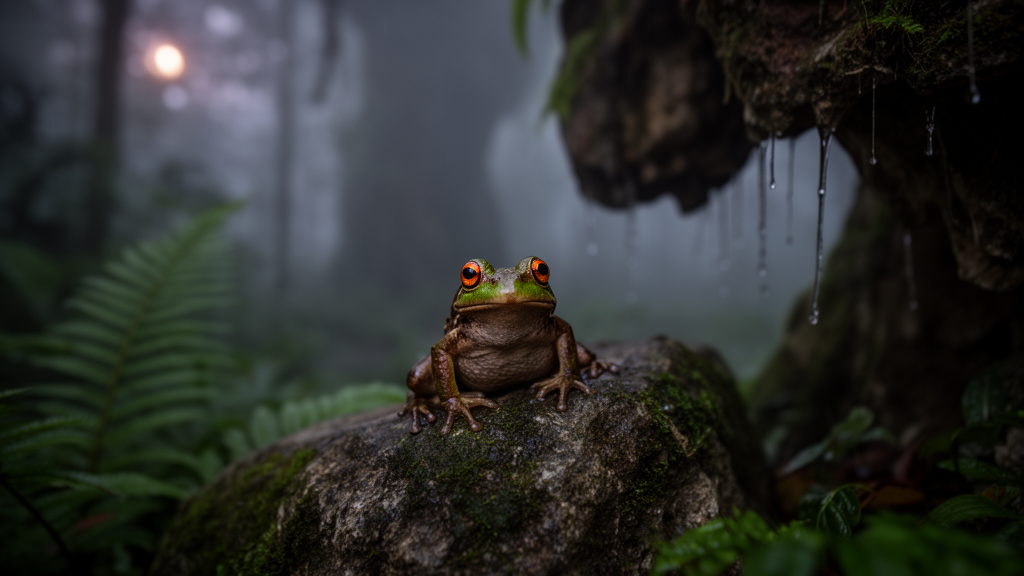
A field and taxonomic study has identified a new species of small forest frog in the genus Leptobrachella from northwestern Guangxi, China. The researchers distinguished the animal through a combination of diagnostic morphological characters and analysis of mitochondrial DNA, formally describing it as Leptobrachella yachangensis, with the proposed English name Yachang Leaf Litter Toad.
During surveys in mountainous areas of northwestern Guangxi, the team collected seven adult male and two adult female specimens of a Leptobrachella frog. The animals came from Yachang Orchid National Nature Reserve in Leye County, Baise City, at elevations of about 1,240–1,620 metres above sea level. Specimens were preserved and deposited at the Natural History Museum of Guangxi in Nanning, while thigh muscle tissue was retained in ethanol for molecular analysis.
The study sequenced a 509-base-pair fragment of the mitochondrial 16S ribosomal RNA gene from three newly collected individuals. These sequences were analysed alongside 74 samples representing 64 species of Leptobrachella and two outgroup samples, with other sequences obtained from GenBank. Maximum-likelihood analysis using RAxML and Bayesian inference using MrBayes produced identical tree topologies. Both analyses strongly supported the samples from Yachang Orchid National Nature Reserve as a monophyletic lineage, with a maximum-likelihood bootstrap value of 100 and a Bayesian posterior probability of 1.00.
The Yachang lineage was placed as the sister taxon to L. wumingensis, although support for that relationship was low. Its mean uncorrected p-distance in the 16S gene was 6.5% from L. wumingensis and 7.2% from L. damingshanensis. The researchers reported that the new lineage’s divergence from recognized congeners exceeded levels observed among recognized species of the genus. The phylogenetic and morphological results therefore supported the description of the specimens as an undescribed species rather than an assignment to any known taxon.
Leptobrachella yachangensis is a small frog, with the seven adult males measuring 28.1–31.2 millimetres in snout-vent length. Its diagnostic characters include a bicoloured iris, coppery orange above and grayish brown below; a distinct tympanum; a black supratympanic line; fingers without lateral fringes or webbing; and toes with narrow lateral fringes but no webbing. Continuous longitudinal ridges occur beneath the toes, the heels overlap when the legs are adpressed, and the tibiotarsal articulation reaches the anterior corner of the eye.
The dorsal surface is rough, with dense skin ridges and numerous conical tubercles bearing spines, while the ventral surface is smooth apart from transparent, tiny conical spines on the chest and abdomen of breeding males. In life, the dorsum is grayish brown with darker brown markings, the flanks have dark spots, and the throat, chest and abdomen are creamy white with dense, irregular dark brown speckles. Comparison with its two closest relatives also found spiny dorsal tubercles and ventral breeding spines in the new species, whereas these features were absent in L. wumingensis and L. damingshanensis.
The new species is currently known only from Yachang Orchid National Nature Reserve. It inhabits clear-water rocky streams in primary forest surrounded by broad-leaved vegetation in the granite landforms of a karst region. Males were observed calling from rock crevices and from leaves of dwarf shrubs near flowing seeps. Long-term observations indicated a breeding season from February through June, with many vocalizing individuals present in the streams during that period.
Leptobrachella yachangensis also occurs sympatrically with L. ventripunctata in rocky stream habitats in the karst mountains of Leye County, even though the phylogenetic analysis places it closer to the geographically distant L. wumingensis. The authors described this contrast as a decoupling of phylogeny and sympatry and suggested that differences in microhabitat preference, breeding-season isolation or historical dispersal may help explain such distributions. The species’ known locality is separated from that of L. wumingensis by roughly 250 kilometres in a straight line, the Hongshui River valley and continuous non-karst mountains.
The authors considered the frog’s known range insufficiently understood and recommended that it be listed as Data Deficient under International Union for Conservation of Nature criteria. Potential pressures include wind-power and ecotourism development outside the protected area, artificial forest planting in surrounding areas, and other activities that may cause water pollution or habitat fragmentation. They also called for surveys of adjacent karst areas, stronger protection of core stream habitats, and dynamic monitoring of populations and habitat. Because the species is currently known from one reserve and its distribution and threats remain poorly characterised, the study does not establish its overall population size or conservation status.
Subject of Research: Taxonomic identification of a new Leptobrachella frog species from northwestern Guangxi using morphology and mitochondrial DNA
Article Title: A new species of the genus Leptobrachella Smith, 1935 ( Anura , Megophryidae ) from northwestern Guangxi, China
Article References: Huang, Z., Zeng, Z.-C., Wang, J., Wang, H.-T., Deng, Z.-H., Wang, Z.-W., Liao, X.-W., & Mo, Y.-M. (2025). A new species of the genus Leptobrachella Smith, 1935 (Anura, Megophryidae) from northwestern Guangxi, China. Herpetozoa, 38, 321-332. https://doi.org/10.3897/herpetozoa.38.e165088
Image Credits: AI Generated
DOI: 10.3897/herpetozoa.38.e165088
Keywords: Leptobrachella, new species, taxonomy, Guangxi, mitochondrial DNA, morphology, frog conservation, karst habitat, Yachang Orchid National Nature Reserve, species, genus, Smith
News Source: Margaret Porter. (October 20, 2026). Morphological and mitochondrial evidence identifies new Leptobrachella frog from Guangxi. Scienmag.