


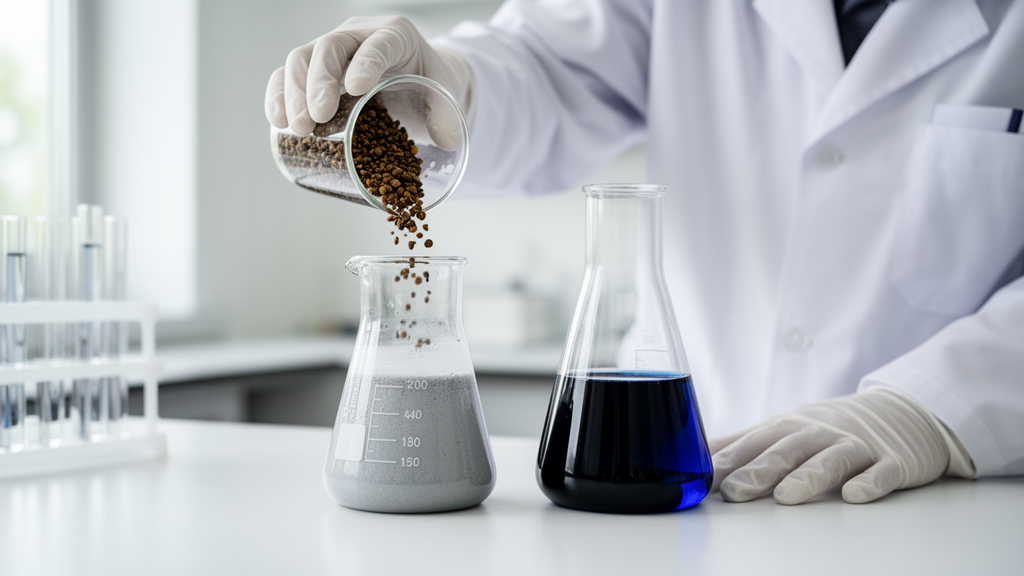
Seeds from the drumstick tree, a plant long prized for water purification, have now been engineered into silver-doped nanoparticles that can pull a stubborn textile dye out of water. Researchers at Marwadi University in India synthesized the particles from Moringa oleifera seed kernels, optimized the conditions under which they remove methylene blue from synthetic solutions, and then tested them on real effluent collected from a textile plant in Jetpur, Gujarat. The study, published open access in Discover Chemical Engineering, reports modest but measurable dye removal in the laboratory and removal efficiencies of roughly 13 to 37 percent for several pollutants in actual industrial wastewater.
The team’s motivation lies in a familiar industrial problem. Textile factories discharge complex mixtures of dyes, salts, oils, nutrients, and heavy metals such as lead, mercury, cadmium, and arsenic, and these streams can alter the pH of receiving waters, deplete dissolved oxygen, and introduce compounds that bioaccumulate in aquatic organisms. Conventional treatment trains often struggle to meet increasingly stringent discharge standards, particularly in developing regions where advanced facilities and regulatory enforcement remain limited. The authors argue that low-cost, eco-friendly technologies could open new opportunities for sustainable treatment in exactly these settings.
Silver nanoparticles are effective adsorbents and antimicrobial agents, but their conventional synthesis typically relies on toxic solvents and chemical reducing agents that generate secondary pollutants. Green synthesis offers an alternative: plant extracts contain alkaloids, terpenoids, phenols, flavonoids, proteins, and carbohydrates that can act as natural reducing and stabilizing agents. Moringa oleifera, native to the Indian subcontinent and tolerant of arid conditions, is an especially attractive candidate because its leaves, seeds, pods, bark, and roots are rich in such bioactive compounds and have a long history of use in food, medicine, and water clarification.
The synthesis followed a systematic approach the authors had reported in a previous study on iron-based nanoparticles from Moringa oleifera seeds. Deshelled seed kernels were ground and sieved through a 52-mesh screen, then mixed with 95 percent methanol at a powder-to-solvent ratio of 1:10 and stirred for 45 minutes at 3,100 rpm to strip out fatty acids and other unwanted components. After centrifugation at 2,000 rpm for 45 minutes, the solid residue was air-dried for 24 hours and treated with 0.1 N sodium chloride solution to break protein content into smaller particles. The filtered extract was then combined with 0.081 grams of silver nitrate, stirred for 30 minutes, and left for 24 hours. A color shift from light yellow to dark brown signaled that silver-doped nanoparticles had formed, and the solid product was collected on Whatman No. 42 filter paper.
Characterization confirmed the material’s identity and structure. Ultraviolet-visible spectroscopy showed a distinct absorption peak at 239.9 nanometers, a shift from the 300 to 600 nanometer range reported in earlier Moringa-based studies, which the authors attribute to their use of methanol rather than ethanol and to the exclusion of sonication. Fourier-transform infrared spectroscopy revealed peaks at 3,308.0, 1,610.2, 1,438.8, and 1,032.5 inverse centimeters, corresponding to hydroxyl groups, carbon-carbon double bonds, carbon-oxygen bonds, and carbon-oxygen-carbon linkages respectively, evidence that phytochemicals from the seeds reduced and capped the silver. Scanning electron microscopy showed irregular, agglomerated particles ranging from 164.8 to 380.3 nanometers, and energy-dispersive X-ray analysis found silver at 93.88 plus or minus 3.39 percent by mass, confirming successful doping.
The researchers determined the point of zero charge of the synthesized nanoparticles using a pH drift method reported in previous studies. For these nanoparticles the value came out at 8.6. Because methylene blue is a cationic dye, a negatively charged particle surface above this threshold should attract the dye molecules electrostatically, so all subsequent optimization experiments were run at pH values above 8.6. The authors note that operating well above this point improves interaction between dye and nanoparticles, but that excessively high pH carries operational and economic penalties for real treatment systems that must adjust wastewater chemistry.
Optimization proceeded in three stages using 50-milliliter batches of 5 milligrams per liter dye solution. Removal efficiency climbed as pH rose past 5 and peaked at pH 9, where the residual dye concentration fell to roughly 2.75 milligrams per liter, corresponding to about 45 percent removal. Dosage experiments spanning 0.5 to 5 grams per liter showed efficiency rising to an optimum of 3.5 grams per liter, at which removal reached about 45 percent with an adsorption capacity of 0.67 milligrams of dye per gram of nanoparticles. Beyond that dose, no significant improvement appeared, a pattern the authors link to overlapping adsorption sites and residual biomolecules on the particle surface. Contact time tests from 10 to 120 minutes showed efficiency plateauing near 50 percent after about an hour, with only marginal gains thereafter as available surface sites filled.
The team is candid about the limits of these numbers. The removal efficiency they achieved was lower than figures reported in comparable studies of green-synthesized nanoparticles, and they attribute the gap to the dye-to-nanoparticle mass ratio, residual biomolecules coating the particles, the methanol extraction step, modifications to the synthesis procedure, and the inherent composition of the particular Moringa seeds used. All experiments were conducted in duplicate with averaged values reported, and the parametric optimization was carried out using synthetic methylene blue dye solution, with actual industrial wastewater tested only afterward.
The real-world test followed. Samples of colored effluent from a textile unit in Jetpur, Gujarat, were treated with the nanoparticles under the optimized conditions, and six water quality parameters were measured against untreated controls. Chemical oxygen demand dropped by 36.30 percent and biological oxygen demand by 33.67 percent, the strongest results, pointing to removal of organic pollutants. Chloride fell by 26.53 percent, total phosphorus by 21.62 percent, ammoniacal nitrogen by 20.61 percent, and total nitrogen by 13.32 percent, the last figure underscoring a limited capacity for nutrient removal. Because actual effluent carries a far more complicated mixture of dyes, auxiliary chemicals, salts, and process contaminants than any synthetic solution, the authors read these figures as evidence of promising applicability under genuinely difficult conditions rather than as a benchmark for standalone performance.
The authors themselves frame the technology as a complement rather than a replacement, suggesting that MOS-Ag-NPs may be better suited as a pre-treatment or polishing step within a larger treatment train. They also flag a caution that any silver-based nanomaterial invites: potential toxicity and ecological risks from nanoparticle release cannot be overlooked at scale, so regeneration, recycling, and controlled application would be essential to prevent secondary contamination. Future work, they write, should address regeneration and recyclability, reaction kinetics and thermodynamics, isotherm modeling, deeper material characterization, and interference studies.
Subject of Research: Green synthesis of Moringa oleifera seed-mediated silver nanoparticles for dye wastewater treatment
Article Title: Parametric optimization of green synthesized Moringa oleifera seed mediated silver nanoparticles for dye effluent treatment
Article References: Joshi, J. B., & Singh, N. K. (2026). Parametric optimization of green synthesized Moringa oleifera seed mediated silver nanoparticles for dye effluent treatment. Discover Chemical Engineering, 6(1), Article 33. https://doi.org/10.1007/s43938-026-00135-x
Image Credits: AI Generated
DOI: 10.1007/s43938-026-00135-x
Keywords: Moringa oleifera, silver nanoparticles, green synthesis, methylene blue, textile wastewater, adsorption, water treatment, nanotechnology, point of zero charge, chemical oxygen demand, effluent remediation, sustainable technology
News Source: Bethany Barker. (October 30, 2026). Moringa Seeds Yield Silver Nanoparticles That Strip Dye from Wastewater. Scienmag.



