• HOME
  • NEWS
  • EXPLORE
    • CAREER
      • Companies
      • Jobs
    • EVENTS
    • iGEM
      • News
      • Team
    • PHOTOS
    • VIDEO
    • WIKI
  • BLOG
  • COMMUNITY
    • FACEBOOK
    • INSTAGRAM
    • TWITTER
Friday, September 25, 2026
BIOENGINEER.ORG
No Result
View All Result
  • Login
  • HOME
  • NEWS
  • EXPLORE
    • CAREER
      • Companies
      • Jobs
        • Lecturer
        • PhD Studentship
        • Postdoc
        • Research Assistant
    • EVENTS
    • iGEM
      • News
      • Team
    • PHOTOS
    • VIDEO
    • WIKI
  • BLOG
  • COMMUNITY
    • FACEBOOK
    • INSTAGRAM
    • TWITTER
  • HOME
  • NEWS
  • EXPLORE
    • CAREER
      • Companies
      • Jobs
        • Lecturer
        • PhD Studentship
        • Postdoc
        • Research Assistant
    • EVENTS
    • iGEM
      • News
      • Team
    • PHOTOS
    • VIDEO
    • WIKI
  • BLOG
  • COMMUNITY
    • FACEBOOK
    • INSTAGRAM
    • TWITTER
No Result
View All Result
Bioengineer.org
No Result
View All Result
Home NEWS Science News Biology

Monty Python’s silly walk: A gait analysis and wake-up call to peer review inefficiencies

Bioengineer by Bioengineer
March 12, 2020
in Biology
Reading Time: 2 mins read
0
IMAGE
Share on FacebookShare on TwitterShare on LinkedinShare on RedditShare on Telegram

IMAGE

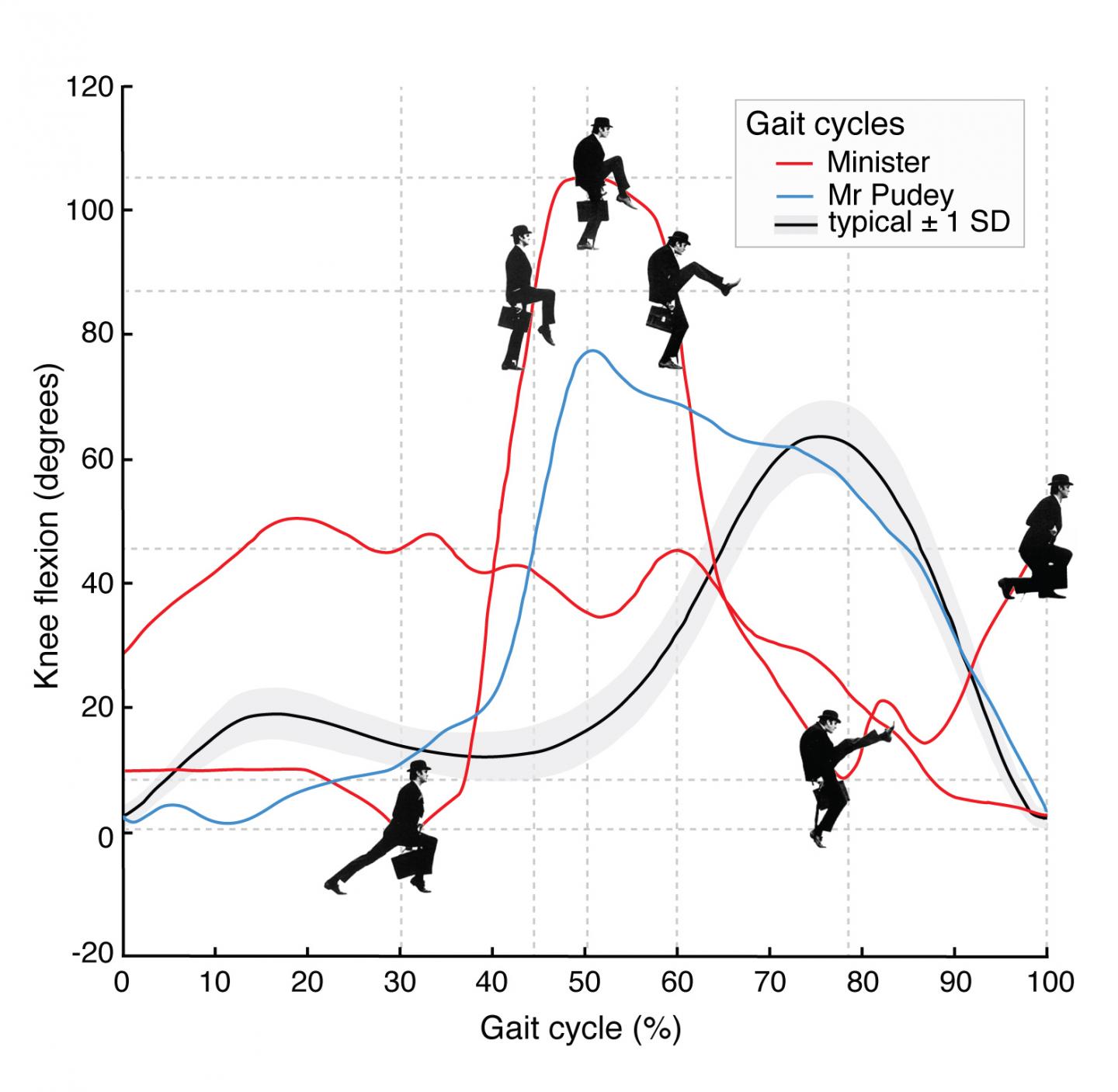
Credit: Chart created by Erin E. Butler and Nathaniel J. Dominy.


Fifty years ago, Monty Python’s famous sketch, “The Ministry of Silly Walks,” first aired on BBC One. The sketch pokes fun at the inefficiency of government bureaucracy. It opens with the Minister (John Cleese) walking in a rather unusual manner to his work, the Ministry of Silly Walks, where Mr. Pudey (Michael Palin) is waiting to meet with him to apply for a government grant to develop his silly walk. In the spirit of Monty Python’s humor, based on an actual gait analysis, a Dartmouth research team finds that the Minister’s silly walk is 6.7 times more variable than a normal walk. The findings are published in Gait & Posture.

Although Mr. Pudey’s walk was found to be only 3.3 times more variable than a normal walk, the research team agreed with the Minister’s decision that he had a promising silly walk that was deserving of a Research Fellowship.

The team points out how bureaucratic inefficiency can be likened to that of the peer-review process associated with academic research in the health sciences, particularly when applying for funding. Applying for a federal grant is extremely time consuming and can take months to prepare. An application may require a 150-page proposal followed by a review by a panel of researchers, who are often flown in for the occasion. Peer review protocols often require that the panelists must reach a consensus of 75 percent or more to approve a proposal.

By contrast, the Dartmouth team points out how the National Health and Medical Research Council of Australia pioneered a streamlined grant application process in 2013, which resulted in an estimated savings in 2015 of $A2.1-$4.9 million per year.

“The peer review research process has become rather unwieldy,” said Nathaniel J. Dominy, the Charles Hansen Professor of Anthropology, who co-authored the study with Erin E. Butler, who was a postdoctoral fellow at the Neukom Institute at Dartmouth at the time the research was conducted. “If the process was streamlined and grants were awarded more quickly, researchers could start their work earlier, accelerating the timeline for research. Similarly, grant administrators would recoup time and money, which could potentially free up more money for research funding,” explained Dominy.

Butler is available for comment at: [email protected].

###

Media Contact
Amy D. Olson
[email protected]
603-646-3274

Original Source

https://www.dartmouth.edu/press-releases/montypythonssillywalk.html

Tags: AnthropologyBehaviorBiologyHistoryMass MediaMedicine/HealthOrthopedic MedicineSocial/Behavioral Science
Share13Tweet8Share2ShareShareShare2

Related Posts

Cell Death Regulator BI-1 Emerges as Key Switch in Plant Immunity Against Oomycete Pathogens

Cell Death Regulator BI-1 Emerges as Key Switch in Plant Immunity Against Oomycete Pathogens

September 25, 2026
Chemists Turn to Eudesmol Isomers to Grade the World’s Priciest Wood

Chemists Turn to Eudesmol Isomers to Grade the World’s Priciest Wood

September 25, 2026

AI-Guided Modeling Uncovers Hidden Switches That Could Heat Up Cold Pancreatic Tumors

September 25, 2026

NAD+ Collapse Drives Senescent CD8+ T Cells That Worsen Ulcerative Colitis

September 25, 2026
Please login to join discussion

POPULAR NEWS

  • New Study Maps How Hospital AI Turns Information Chaos into Faster, Cheaper Care

    29 shares
    Share 12 Tweet 7
  • AI Forecasting Reshapes Doctor Schedules in a Pediatric Emergency Room

    29 shares
    Share 12 Tweet 7
  • Damiana Plant Polysaccharides Extend Lifespan in Worms and Flies, Study Finds

    29 shares
    Share 12 Tweet 7
  • Forever Chemicals in Pregnancy Tied to Higher Gestational Diabetes Risk, Vitamin D May Blunt the Effect

    29 shares
    Share 12 Tweet 7

About

We bring you the latest biotechnology news from best research centers and universities around the world. Check our website.

Follow us

Recent News

New Study Maps How Hospital AI Turns Information Chaos into Faster, Cheaper Care

AI Forecasting Reshapes Doctor Schedules in a Pediatric Emergency Room

Damiana Plant Polysaccharides Extend Lifespan in Worms and Flies, Study Finds

Subscribe to Blog via Email

Enter your email address to subscribe to this blog and receive notifications of new posts by email.

Join 85 other subscribers
  • Contact Us

Bioengineer.org © Copyright 2023 All Rights Reserved.

Welcome Back!

Login to your account below

Forgotten Password?

Retrieve your password

Please enter your username or email address to reset your password.

Log In
No Result
View All Result
  • Homepages
    • Home Page 1
    • Home Page 2
  • News
  • National
  • Business
  • Health
  • Lifestyle
  • Science

Bioengineer.org © Copyright 2023 All Rights Reserved.