Credit: MSU Photo by Adrian Sanchez-Gonzalez
BOZEMAN — In the engineer’s world, vibration is usually a bad thing. It means that something is loose, out of balance or unexpectedly catching the wind, that energy is being wasted or a part is being damaged. Engineers usually try to make vibration go away.
So it’s notable that Montana State University engineering researcher Mark Jankauski studies beneficial vibrations that could help create a new generation of flying machines. To do that, he turns to an unusual inspiration: insects.
“Insects have really leveraged vibration to enhance their flying efficiency,” said Jankauski, assistant professor in the Department of Mechanical and Industrial Engineering in MSU’s Norm Asbjornson College of Engineering. “It allows them to do some amazing things.”
A fruit fly, for example, flaps its wings 10 times or more with a single nerve pulse to specialized muscles in its midsection, according to Jankauski. The muscle contraction creates a vibration that does the actual flapping, conserving energy and giving the fly the maneuverability that comes with rapid wing motion.
Backed by a new, $619,000 CAREER grant from the National Science Foundation, Jankauski will develop models that explain the inner workings of vibrational insect flight and how they could be applied to designing drones or other small aircraft. The CAREER grant is considered the premier award given to early-career researchers.
“We’re thrilled that the National Science Foundation is recognizing Mark’s potential,” said Dan Miller, head of the mechanical and engineering department. “His area of research is quite exciting, and he has already made a huge impact on his peers and on students.”
Engineers have partnered with biologists to help explain how insects fly, Jankauski said. But much remains unknown, and engineers haven’t begun to harness the design insights produced by millions of years of insect evolution.
The research isn’t intended to translate directly into a specific technology like an improved drone rotor, he said, but rather create advanced models that could inform a range of engineering applications, including flight.
“The question really is, how do we look at these natural systems, learn the concepts behind them and apply them to engineering,” said Jankauski, who won a $370,000 grant from the NSF last spring for similar research focused on the complex motions of flexible insect wings.
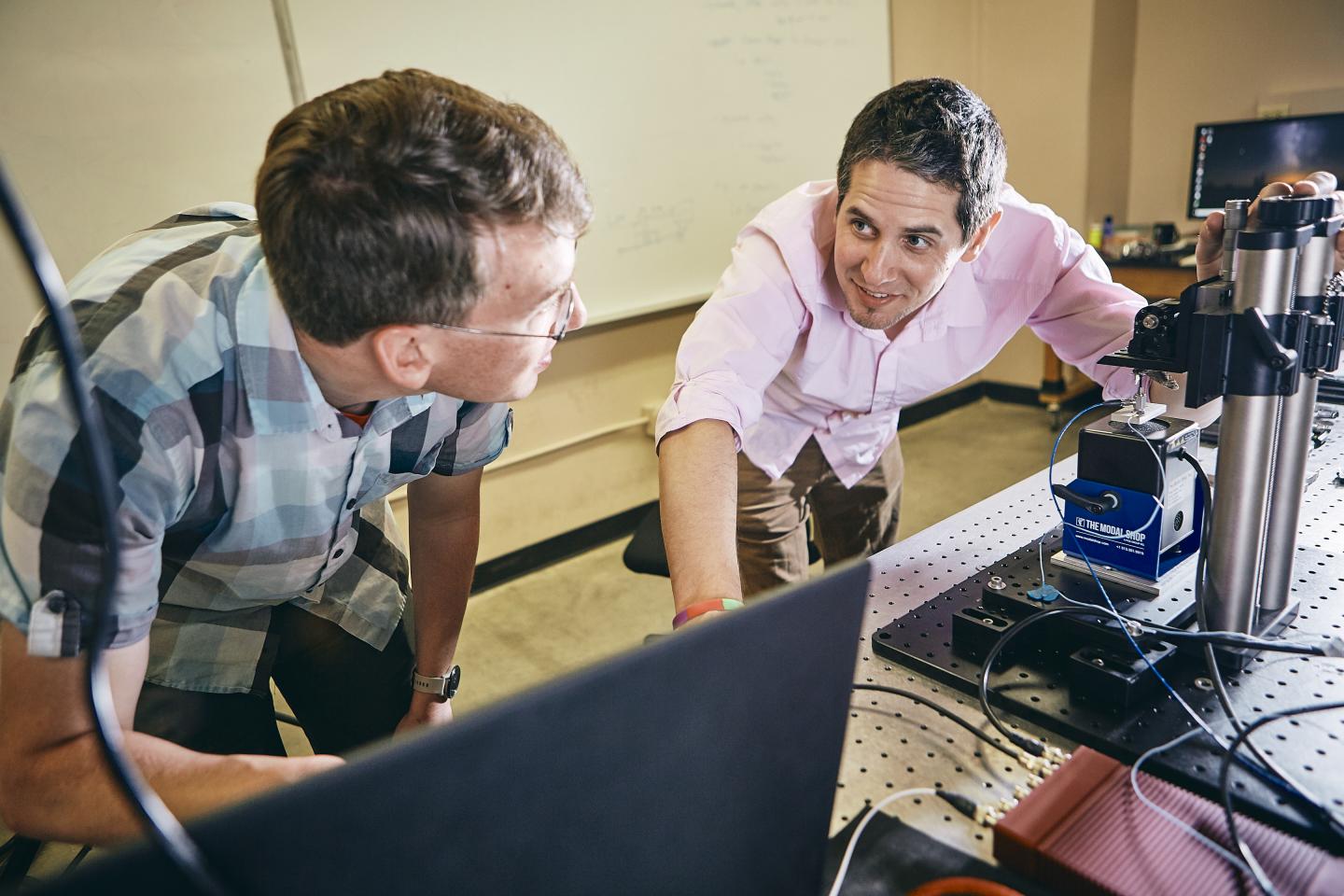
In his lab, Jankauski has specialized devices that can apply precise forces to wing replicas and insects and measure how they bend and flex. In this project, he will observe how the intricate flight systems of insects such as honeybees and hawk moths respond to vibration. Using that data, his team can develop sophisticated computer algorithms that approximate the vibrating flight behavior. The models can then be used to predict the workings of vibrating structures that don’t exist in nature.
Jankauski first got involved in studying insect flight nearly a decade ago, while a doctoral student at University of Washington. He considered several possible research options related to rotor-based flight before his adviser mentioned the possibility of studying flapping wing insects instead. “It caught me off-guard,” he said. “It was so much different than anything else I’d heard of. It really sparked my interests.”
Since joining the MSU faculty in 2017, Jankauski has collaborated with fellow mechanical engineering researchers Erick Johnson on computer modeling and Chelsea Heveran on the material science of insect exoskeletons. He said the CAREER award also marks the latest chapter of collaboration with insect researchers in the Department of Land Resources and Environmental Sciences in MSU’s College of Agriculture, including Bob Peterson and David Weaver. He has also worked with Michelle Flenniken in the Department of Plant Sciences and Plant Pathology to collect honeybees from MSU’s Pollinator Garden.
“It has been a really great experience to work with these teams who bring their different perspectives and expertise,” Jankauski said. “I’ve been very fortunate to land here.”
###
Media Contact
Mark Jankauski
[email protected]
406-994-1399
Original Source
https:/