


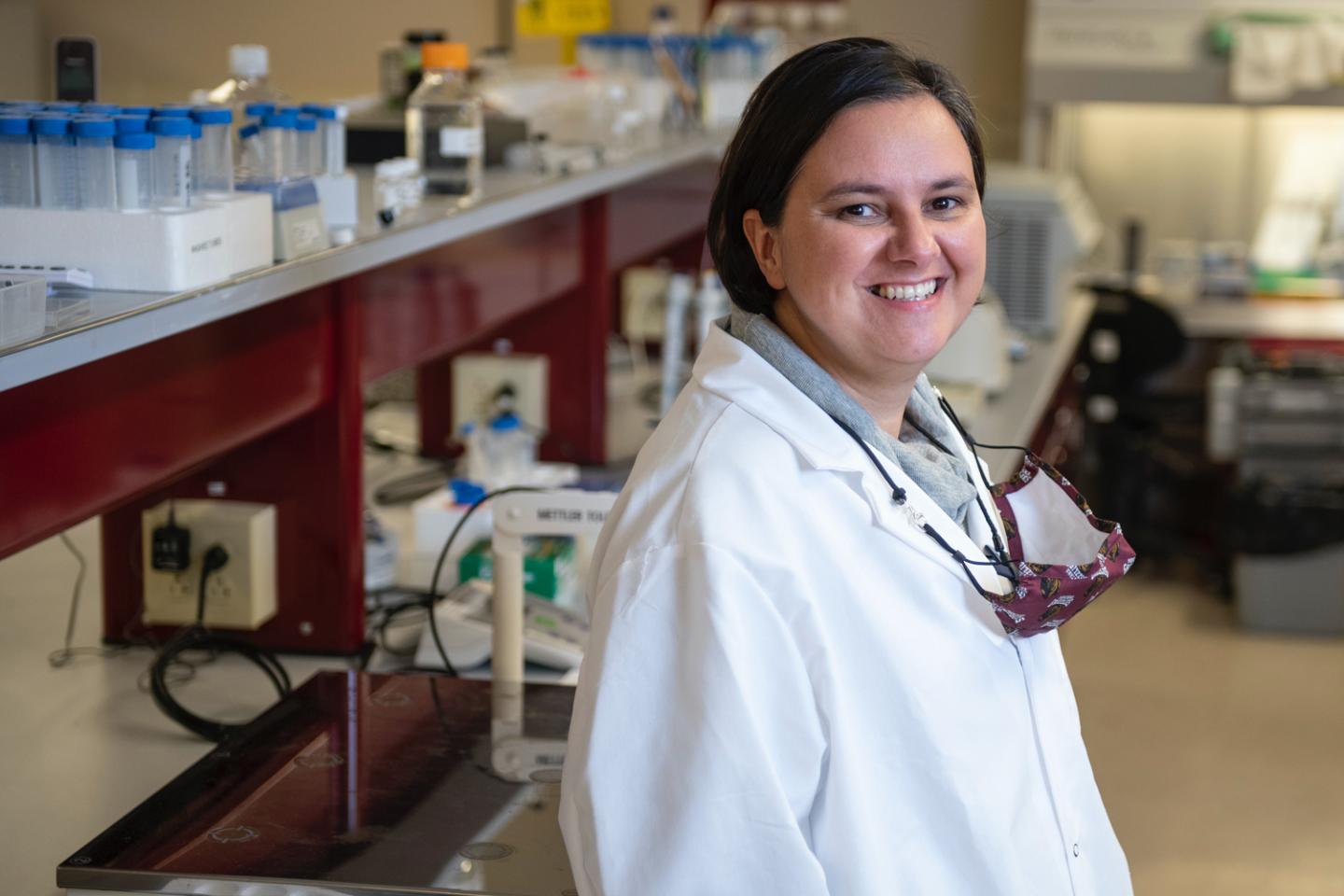
Credit: Photo by Tommy Martino
MISSOULA – University of Montana scientist Monica Serban is on a research roll.
In recent months the UM associate professor and her team have earned three awards totaling $3.9 million in funding to study preventing hearing loss among U.S. troops, combating ear infections and creating a synthetic skin product.
For her first award, Dr. Serban earned a $2.4 million grant from the Office of Naval Research to explore new engineered systems to prevent hearing loss among U.S. sailors and Marines. The award potentially is renewable for two additional years to provide nearly $7.5 million in funding.
“In collaboration with a strategic commercial partner, we seek to enable the development of a noise-level-triggered drug dosing and delivery system to prevent cochlear damage,” Serban said. “This system is intended to respond in real-time to harmful sound levels, noninvasively deploy hearing protective agents and prevent subsequent ear trauma.
“To our knowledge, this would be the first-of-its-kind system,” she said, “and it has the potential to revolutionize the noise-induced hearing loss protection field.”
The Serban group will develop some of the key components to help prototype this innovative drug delivery system through the following three objectives:
- Develop a physiologically representative tympanic and round-window-membrane tissue models for ear-on-a-chip devices to enable rapid screening of therapeutics.
- Develop and identify novel hearing-loss protective therapeutic agents.
- Validate therapeutics in ear-on-a-chip devices and develop noninvasive drug-delivery systems.
“My wife’s brother served in the Navy on aircraft carriers, so I saw the effects of noise damage to hearing firsthand” said Dr. Bruce Bowler, director of UM’s Center for Biomolecular Structure and Dynamics. “This work will have huge benefits for improving the long-term quality of life for those who serve our country in the military.”
For the second grant award, Serban and Promiliad BioPharma Inc. received a $1.4 million National Institutes of Health Phase II Small Business Technology Transfer award. The funding will be used to continue the development of single-application antibiotic delivery systems for outer ear infections.
Outer ear infections (otitis externa or OE) affect an estimated 10% of people in their lifetime, with associated health care costs amounting to over $500 million annually.
Currently, these infections are treated with topical antibiotic regimes and can be supplemented in severe cases with oral medication. However, incorrect application or noncompliance with the administration schedule of antibiotics leads to infection persistence, recurrence and, potentially, development of antibiotic-resistant bacterial strains.
In diabetic or elderly patients, the infection can be life threatening if it progresses into necrotizing or malignant otitis externa (MOE), with severe health consequences. In recent years, the incidence rate of MOE has significantly increased and has been associated with antibiotic-resistant bacterial strains. Therefore, there is a critical need to develop safe and effective therapies for the treatment of OE and prevention of MOE.
Serban’s approach to this problem is the development of ThixOtic®, a proprietary drug delivery system that would enable the one-time, point-of-care application of drugs to effectively treat the infection and diminish treatment non-compliance-related risk of antibiotic resistance development, infection recurrence and complications.
“Dr. Serban has developed a truly ingenious approach for slow release of antibiotics that will increase the efficacy and ease with which outer ear infections are cured.” Bowler said. “The simple one-time application of antibiotics will be a real boon for both doctors and patients.”
The third award Serban received is from the M.J. Murdock Charitable Trust for $60,000 to advance the commercialization of a bioengineered system for skin reconstruction.
There are now no critical-emergency, large-surface skin-wound-management products available for first responders. Large-area skin defects typically are managed with the patient’s own skin or cadaveric donor skin grafts, as well as semi-synthetic products that involve a two-step surgical procedure and still require a human superficial skin layer graft.
Serban will use the Murdock award to ready a versatile, bioengineered, large-skin-wound management system for technology transfer to the marketplace and subsequent commercialization via strategic field-of-use licensing.
Her product is formulated from natural biomaterials to feel and look like skin and enhanced with additional design features to promote wound healing and suture-free fixation, as well as enable localized drug delivery.
“This grant is important because it will allow us to move a technology developed in our laboratory into the commercialization space and subsequently to the patients who need and could benefit from this product,” Serban said.
“I am excited to see our research have a societal impact and to be positioned to make a positive difference on someone’s quality of life. I am grateful for the University’s support for translational research and thank the Murdock Charitable Trust for their invaluable support. This award is the result of a team effort, and it shows that together we can make a difference.”
“Dr. Serban’s research is representative of the high impact work going on in our research center at UM,” Bowler said. “This particular project has real potential to both improve the lives of Montanans and spur economic development within the state. We are very grateful to the Murdock Charitable Trust for their support.”
###
Media Contact
Monica Serban
[email protected]
Original Source
https:/



