• HOME
  • NEWS
  • EXPLORE
    • CAREER
      • Companies
      • Jobs
    • EVENTS
    • iGEM
      • News
      • Team
    • PHOTOS
    • VIDEO
    • WIKI
  • BLOG
  • COMMUNITY
    • FACEBOOK
    • INSTAGRAM
    • TWITTER
Sunday, June 7, 2026
BIOENGINEER.ORG
No Result
View All Result
  • Login
  • HOME
  • NEWS
  • EXPLORE
    • CAREER
      • Companies
      • Jobs
        • Lecturer
        • PhD Studentship
        • Postdoc
        • Research Assistant
    • EVENTS
    • iGEM
      • News
      • Team
    • PHOTOS
    • VIDEO
    • WIKI
  • BLOG
  • COMMUNITY
    • FACEBOOK
    • INSTAGRAM
    • TWITTER
  • HOME
  • NEWS
  • EXPLORE
    • CAREER
      • Companies
      • Jobs
        • Lecturer
        • PhD Studentship
        • Postdoc
        • Research Assistant
    • EVENTS
    • iGEM
      • News
      • Team
    • PHOTOS
    • VIDEO
    • WIKI
  • BLOG
  • COMMUNITY
    • FACEBOOK
    • INSTAGRAM
    • TWITTER
No Result
View All Result
Bioengineer.org
No Result
View All Result
Home NEWS Science News

Molecule shown to repair damaged axons

Bioengineer by Bioengineer
March 8, 2017
in Science News
Reading Time: 2 mins read
0
Share on FacebookShare on TwitterShare on LinkedinShare on RedditShare on Telegram
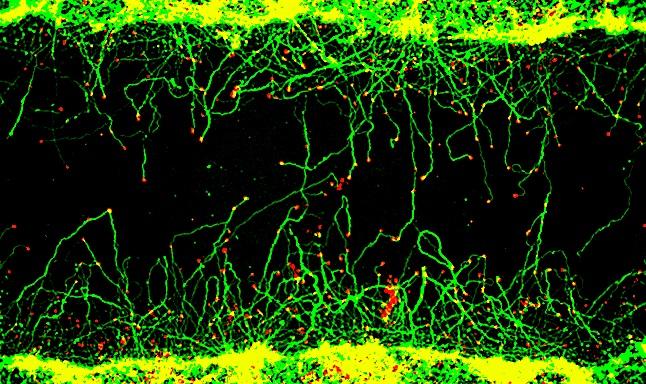
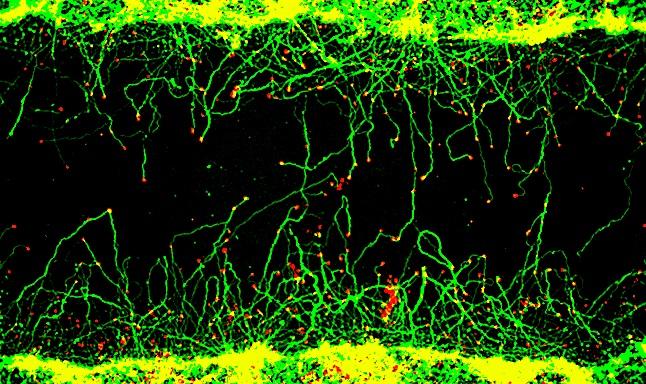
IMAGE

Credit: The Neuro

A foray into plant biology led one researcher to discover that a natural molecule can repair axons, the thread-like projections that carry electrical signals between cells. Axonal damage is the major culprit underlying disability in conditions such as spinal cord injury and stroke.

Andrew Kaplan, a PhD candidate at the Montreal Neurological Institute and Hospital of McGill University, was looking for a pharmacological approach to axon regeneration, with a focus on 14-3-3, a family of proteins with neuroprotective functions that have been under investigation in the laboratory of Dr. Alyson Fournier, professor of neurology and neurosurgery and senior author on the study.

During his search, he found research describing how plants respond to a specific type of fungal infection. When plants are exposed to fusicoccin-A, a small molecule produced by a certain strain of fungus, the leaves of the plant wilt but the roots grow longer. Fusicoccin-A affects 14-3-3 activity by stabilizing its interactions with other proteins.

"While 14-3-3 is the common denominator in this phenomenon, the identity of the other proteins involved and the resulting biological activities differ between plants and animals," says Kaplan.

Kaplan theorized that fusicoccin-A could be an effective way of harnessing 14-3-3 to repair axons. To test this theory, he and his fellow researchers treated mechanically damaged neurons in culture with the molecule and observed the results.

"When I looked under the microscope the following day the axons were growing like weeds, an exciting result that led us to determine that fusicoccin-A can stimulate axon repair in the injured nervous system," says Kaplan.

Besides brain and spinal cord injury, axonal damage is a factor in many other disorders and diseases, including multiple sclerosis and neurodegenerative conditions. The team's discovery means that fusicoccin-A and similar molecules could be the starting point to develop drugs that treat axonal damage. Kaplan says future work should focus on better understanding the mechanisms by which fusicoccin-A improves axon repair.

In particular, a protein called GCN1 holds promise. The team found that the physical bonding of 14-3-3 and GCN1 is an important factor in fusicoccin-A-induced axon growth. Now scientists can examine the function of GCN1 in the nervous system and test whether the bonding with 14-3-3 could serve as a drug target for more tailored therapies.

"We have identified a novel strategy to promote axon regeneration with a family of small molecules that may be excellent candidates for future drug development," says Fournier. "This is an exciting advance because the field has struggled to find treatments and identify targets for drugs that stimulate axon repair."

###

Their paper, published in the journal Neuron on March 8, 2017, was funded by the Canadian Institutes for Health Research.

Media Contact

Shawn Hayward
[email protected]
514-398-3376
@McGillU

http://www.mcgill.ca

############

Story Source: Materials provided by Scienmag

Share12Tweet8Share2ShareShareShare2

Related Posts

Nutrition Literacy, Diet Diversity Linked to Frailty in Elderly

June 7, 2026
Glutenite Reservoir Permeability via Variable T2 Cutoff — Technology and Engineering

Glutenite Reservoir Permeability via Variable T2 Cutoff

June 7, 2026

Work-Related Factors Linked to PFAS Levels in Canadians

June 6, 2026

Complete Genomes Unveil Mycobacterium Tuberculosis Diversity

June 6, 2026
Please login to join discussion

POPULAR NEWS

  • ESMO 2025: mRNA COVID Vaccines Enhance Efficacy of Cancer Immunotherapy

    322 shares
    Share 129 Tweet 81
  • Multi-Hospital Study Reveals Long Covid Burden Is Twice as High as Current Estimates

    89 shares
    Share 35 Tweet 22
  • Saying Goodbye to PGY-6: Pediatric Fellowship Realities

    81 shares
    Share 32 Tweet 20
  • Common Food Preservatives Associated with Elevated Blood Pressure and Increased Heart Disease Risk

    57 shares
    Share 23 Tweet 14

About

We bring you the latest biotechnology news from best research centers and universities around the world. Check our website.

Follow us

Recent News

Nutrition Literacy, Diet Diversity Linked to Frailty in Elderly

Glutenite Reservoir Permeability via Variable T2 Cutoff

Work-Related Factors Linked to PFAS Levels in Canadians

Subscribe to Blog via Email

Enter your email address to subscribe to this blog and receive notifications of new posts by email.

Join 82 other subscribers
  • Contact Us

Bioengineer.org © Copyright 2023 All Rights Reserved.

Welcome Back!

Login to your account below

Forgotten Password?

Retrieve your password

Please enter your username or email address to reset your password.

Log In
No Result
View All Result
  • Homepages
    • Home Page 1
    • Home Page 2
  • News
  • National
  • Business
  • Health
  • Lifestyle
  • Science

Bioengineer.org © Copyright 2023 All Rights Reserved.